
On this page
Top picks at a glance
As an Amazon Associate I earn from qualifying purchases.
- 1
 Zulay Kitchen Premium Apple Corer Tool9.7/10View on Amazon
- 2
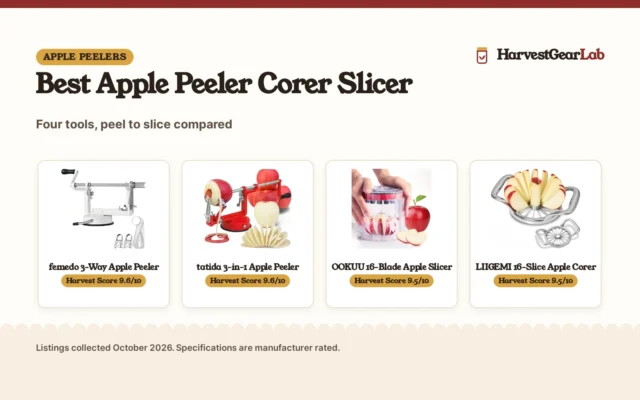
 femedo Apple Peeler Slicer Corer9.6/10View on Amazon
- 3
 tatida Apple Peeler Slicer Corer 3 In 19.6/10View on Amazon
- 4
 Fox Run Apple CorerView on Amazon
- 5
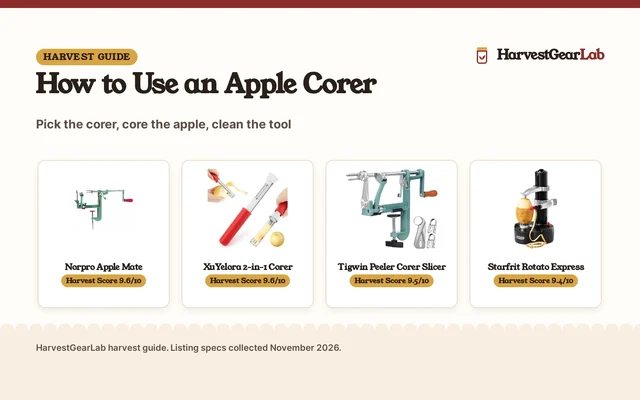
 Norpro Stainless Steel Apple Corer with PlungerView on Amazon
- 6
 Premium Stainless Steel Apple CorerView on Amazon
- 7
 SCHVUBENR Apple Slicer and CorerView on Amazon
- 8
 Norpro Apple Master-AppleView on Amazon
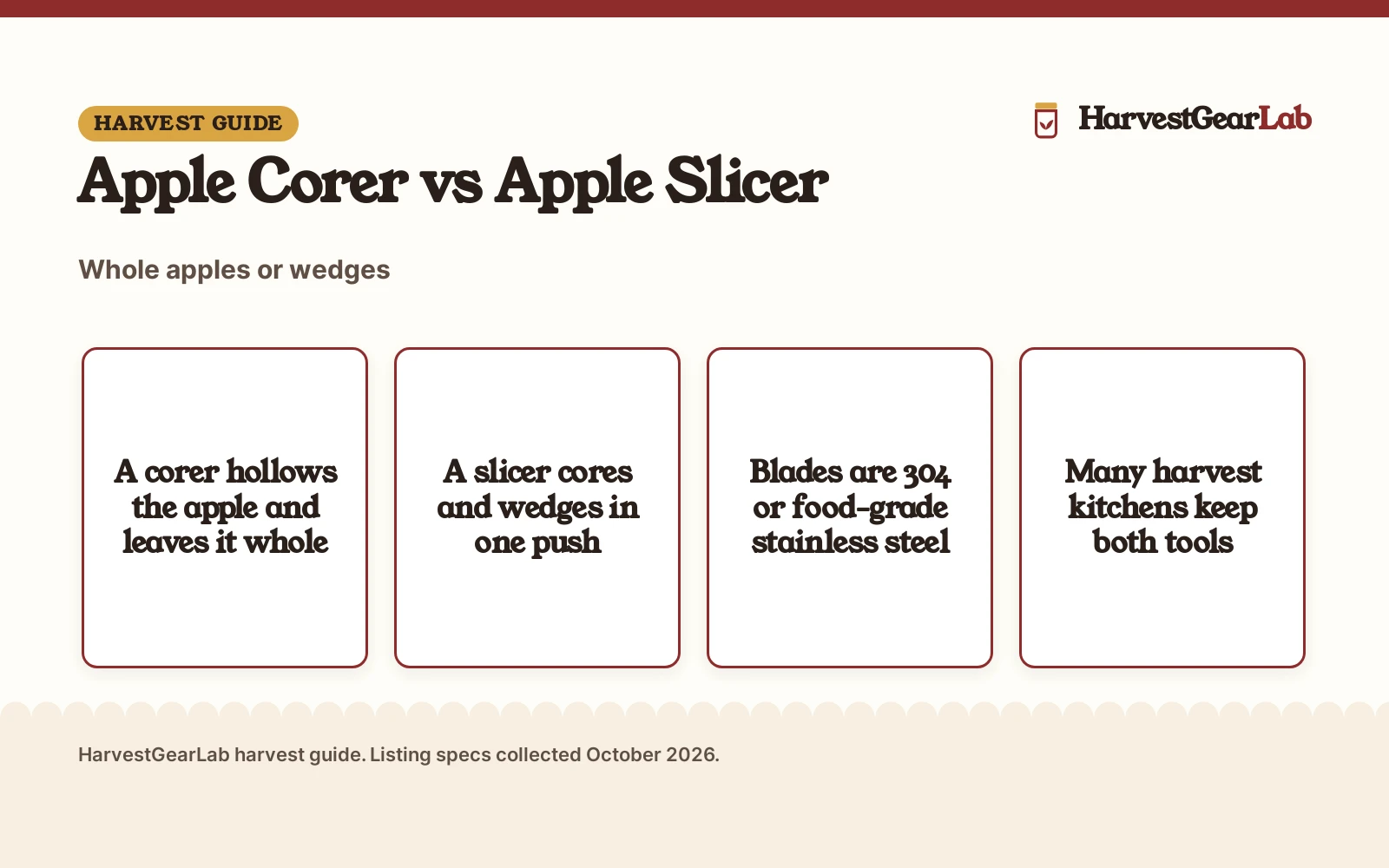
The apple bucket is full and the pies are calling, so apple corer vs apple slicer is the question that decides how fast the fruit gets prepped. The short version: a corer removes the core and leaves the apple whole, while a slicer cores and cuts it into wedges in one push. Pick the corer for whole baked apples, the slicer for snack wedges, or both for a busy harvest. This guide explains the tools step by step.
Runners-up to consider
 Fox Run Apple CorerCheck price on Amazon
 Norpro Stainless Steel Apple Corer with PlungerCheck price on Amazon
 Premium Stainless Steel Apple CorerCheck price on Amazon
 SCHVUBENR Apple Slicer and CorerCheck price on Amazon
 Norpro Apple Master-AppleCheck price on Amazon
 Apple Peeler Slicer Corer 3 In 1Check price on Amazon
HarvestGearLab earns a commission when you buy through links on this page, at no extra cost to you. As an Amazon Associate I earn from qualifying purchases. Affiliate disclosure.
Apple corer vs apple slicer: the short answer
An apple corer is a tube with serrated blades that punches through the apple and pulls the core out, leaving the apple whole. An apple slicer is a ring of blades that presses down over the apple, cutting it into wedges and removing the core at the same time. The corer serves whole-apple jobs: baking, stuffing, drying rings. The slicer serves wedge jobs: snacks, pies, salads.
One corer pick and one slicer pick
Two labeled picks from the listings we compared, so you can match the job to the tool.
- Corer pick: NADOBA Apple Corer. Does the whole-apple job: push down, twist once, pull the core out, then press the easy-open lever to release it. The listing states 7.3″ length and a stainless steel blade in a molded plastic collar.
- Corer alternative: Rainspire Apple Corer. Same whole-apple job. The listing states 304 stainless steel, serrated blades and dishwasher safe cleanup.
- Slicer pick: Asdirne Apple Slicer & Corer Set. Does the wedge job: the set holds an 18cm apple corer and an 18cm apple cutter, and the listing says the cutter makes 8 even slices.
What an apple corer does
The corer goes in from the stem end and comes out the bottom, taking the seeds and core with it. The NADOBA listing describes push-and-twist action, and its easy-open lever releases the core from the tube. The apple stays whole, which is what baking and drying need.
Corers suit precision work. When the recipe needs whole apples, hollowed for filling or dried as rings, the corer is the right tool. It is slower than a slicer for bulk prep, because each apple gets one tool and one motion, and the wedges still need cutting by hand.
What an apple slicer does
The slicer does three jobs at once: it wedges the apple, cuts around the core and leaves the core in the center ring. One push on the handles and the apple falls into even pieces. The Asdirne cutter is an 18cm hand tool with stainless steel blades and ergonomic non-slip handles, and the maker says it cuts the apple into 8 even slices.
Slicers suit volume. For lunchboxes, pies and dehydrator trays, even wedges matter: they bake and dry at the same rate. The tradeoff is control: the slicer decides the wedge count, not you, and it cannot leave the apple whole.
Speed and batch size
For a few apples, the difference is seconds. For a bushel, it is the afternoon. The slicer wins on speed for wedge prep: one push per apple, no second cut. The corer wins for whole-apple prep, because the slicer cannot do that job at all. Match the tool to the batch: slicer for the pie filling, corer for the baked apples.
Many harvest kitchens keep both. They are small, simple tools that live in the same drawer, and the pair covers every apple job. Our apple slicer under 20 guide covers the slicer side, and our apple corer under 15 guide covers the corer side.
Blades and materials: 304 stainless steel
Blades are the working part of both tools. The Rainspire listing names 304 stainless steel with serrated blades, and the Asdirne listing says its blade is food grade stainless steel. Stainless matters in a wet tool: the makers say it resists rust, and a sharp edge keeps its bite through a season of apples.
Handles matter too. The NADOBA listing describes a ridged non-slip plastic handle meant for wet hands, and the Asdirne set uses ergonomic non-slip handles with TPR. The tool gets pushed hard, so the grip must not slip. Dishwasher safe, stated on the NADOBA and Rainspire listings, means the tool actually gets cleaned after a sticky session.
What to skip or double-check
Skip the combo confusion. A slicer-and-corer set, like the Asdirne, is two tools in one box, not one tool doing both jobs. The set suits a new kitchen; a single tool suits replacing a worn one.
Double-check what the listing states. The Asdirne listing gives no warranty term, and the NADOBA listing gives none either. Check the product page before you buy if a warranty matters to you.
FAQ: preserving at home
Can a slicer replace a corer?
No. A slicer cores and wedges at once; it cannot leave the apple whole. For baked or stuffed apples, you need a corer.
Which is faster for pies?
The slicer: one push gives even wedges ready for the pie. The corer would need a second cut by hand.
What material should the blades be?
Stainless steel: the Rainspire listing names 304 stainless and the Asdirne listing names food grade stainless, and both makers present it as a durable blade material.
More preserving guides
See all harvest processing guides.
More guides: apple corer under 15 and apple slicer for kids.