
On this page
Top picks at a glance
As an Amazon Associate I earn from qualifying purchases.
- 1
 DASH Safe Slice Mandoline for VegetablesView on Amazon
- 2
 OXO Good Grips Handheld Mandoline Slicer with Non-Slip HandleView on Amazon
- 3
 ONCE FOR ALL Safe Mandoline Slicer KitchenView on Amazon
- 4
 VEKAYA Mandoline Slicer for KicthenView on Amazon
- 5
 ONCE FOR ALL Safe Mandoline Slicer ProView on Amazon
- 6
 FullstarView on Amazon
A bean frencher and a mandoline do different cuts. A bean frencher feeds green beans through rotary blades that slice them lengthwise into thin French-style slivers. A mandoline draws food across a fixed flat blade for crosswise slices. For true French-cut beans, the frencher is the purpose-built tool; a mandoline can make diagonal slices but not the lengthwise French cut. None of the four products here is a mandoline: the gear below covers the bean-frencher side, ranked by score.
Runners-up to consider
 DASH Safe Slice Mandoline for VegetablesCheck price on Amazon
 OXO Good Grips Handheld Mandoline Slicer with Non-Slip HandleCheck price on Amazon
 ONCE FOR ALL Safe Mandoline Slicer KitchenCheck price on Amazon
 VEKAYA Mandoline Slicer for KicthenCheck price on Amazon
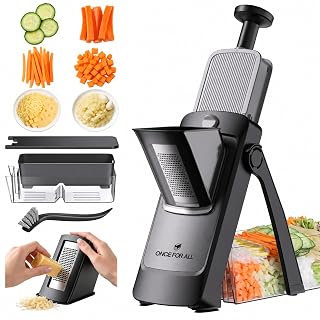 ONCE FOR ALL Safe Mandoline Slicer ProCheck price on Amazon
 FullstarCheck price on Amazon
HarvestGearLab earns a commission when you buy through links on this page, at no extra cost to you. As an Amazon Associate I earn from qualifying purchases. Affiliate disclosure.
Bean frencher vs mandoline: the difference
The frencher is a bean specialist. The Norpro, KitchenCraft Rotary and Westmark listings all describe a rotary crank with stainless steel blades that cuts beans lengthwise as you turn the handle. The Krisk is a handheld tool that strings and slices in one motion. A mandoline, by contrast, is a general slicer: one flat blade, and the food moves across it. If your goal is French-cut green beans for the freezer or the canner, the frencher’s lengthwise cut is the one these listings describe.
The gear, ranked
1. KitchenCraft Rotary Runner Bean Slicer: the suction-pad pick
The KitchenCraft Rotary lists 3 sharp stainless steel blades that cut diagonally across the beans, a suction pad that attaches to any flat kitchen surface, and rigid plastic construction. It measures 4.17 x 4.13 x 9.17 inches, weighs 285 g, and the listing states a 12-month guarantee. Care is hand wash only.
2. Norpro Deluxe Bean Frencher: the clamp-on pick
The Norpro lists a rotary cutting mechanism with stainless steel rotary blades, a cast aluminum body and a screw clamp that fits tables up to 1.25 inches thick. The bullets state a 3.5-inch cube; the spec table says 3.25 x 3 x 2 inches, and we trust the bullets. It weighs 4 ounces. The bullets recommend hand washing while the spec table says dishwasher safe; we trust the bullets.
3. Westmark Rotary Bean Slicer: the 3-knife pick
The Westmark lists 3 hardened and sharpened stainless steel knives that trim beans to equal lengths, a coated aluminum and stainless steel body, and easy cleaning with soap and water. The bullets state 6 x 5 x 10 inches against the spec table’s 10.43 x 4.84 x 5.51; we trust the bullets. It weighs 16 ounces and the spec table states dishwasher safe.
4. Krisk Bean Stringer and Slicer: the handheld pick
The Krisk is the only handheld tool here: it strings and slices in one motion, with a stainless steel blade that cuts off the top and tail of the bean. It measures 6.69 x 4.33 x 1.18 inches and is hand wash only. No crank, no clamp, no mounting needed.
How to choose bean frencher vs mandoline
Crank or handheld
The three rotary models turn a handle to feed beans through the blades, which suits big batches at harvest time. The Krisk works bean by bean in the hand, which suits a small picking. If you process bushels, the crank models earn their counter space.
How it stays put
The Norpro clamps to tables up to 1.25 inches thick, the KitchenCraft Rotary uses a suction pad on flat surfaces, and the Krisk needs no mounting at all. Match the mounting to your counter: a thick farmhouse table takes the clamp, a smooth countertop takes the suction pad. See bean frencher vs knife for the other hand-tool debate.
Blades and cleaning
All four state stainless steel blades, with 3 blades on the KitchenCraft Rotary and the Westmark. On cleaning, the listings split: the KitchenCraft Rotary and the Krisk are hand wash only, the Westmark spec table states dishwasher safe, and the Norpro bullets recommend hand washing. Compare with kraut cutter vs mandoline slicer for another crank-versus-blade matchup.
In the Preserving Kitchen
- Top and tail the beans before cranking; the Krisk does this in the same motion.
- Hand wash the blades and dry them right away, even on the models whose spec tables state dishwasher safe.
- Clamp or suction the slicer down before the first bean, not after it starts to walk.
- Store the crank models where the handle cannot snag; the Norpro’s 3.5-inch cube fits a drawer.
FAQ: preserving at home
Can a mandoline French-cut green beans?
A mandoline slices crosswise, so it makes rounds or diagonal slices, not the lengthwise French cut these rotary slicers produce.
Which frencher is best for big batches?
The rotary crank models: the Norpro, KitchenCraft Rotary and Westmark all describe feeding beans through blades by turning a handle.
Do these need mounting?
The Norpro clamps to tables up to 1.25 inches thick and the KitchenCraft Rotary uses a suction pad. The Krisk is handheld.
Are any dishwasher safe?
The Westmark spec table states dishwasher safe. The KitchenCraft Rotary and Krisk are hand wash only, and the Norpro bullets recommend hand washing.
Which has a stated guarantee?
The KitchenCraft Rotary listing states a 12-month guarantee. The other three state no warranty term.
More preserving guides
See every bean frencher guide and all harvest processing guides.
More picks: bean frencher vs knife and kraut cutter vs mandoline slicer.