
On this page
A bowl of dough that will not rise on a cold counter is a familiar sight in a home bakery, and it raises the question: bread proofing box temperature. The short answer: set the box inside the temperature range its maker lists, warm enough to keep the dough rising steadily, and let the timer and the humidity tray do the rest. This guide explains what the setting does, how to pick a setting from the range your box lists, and how humidity, the rack and the timer fit in.
HarvestGearLab earns a commission when you buy through links on this site, at no extra cost to you. As an Amazon Associate I earn from qualifying purchases. Affiliate disclosure.
Bread proofing box temperature: the short answer
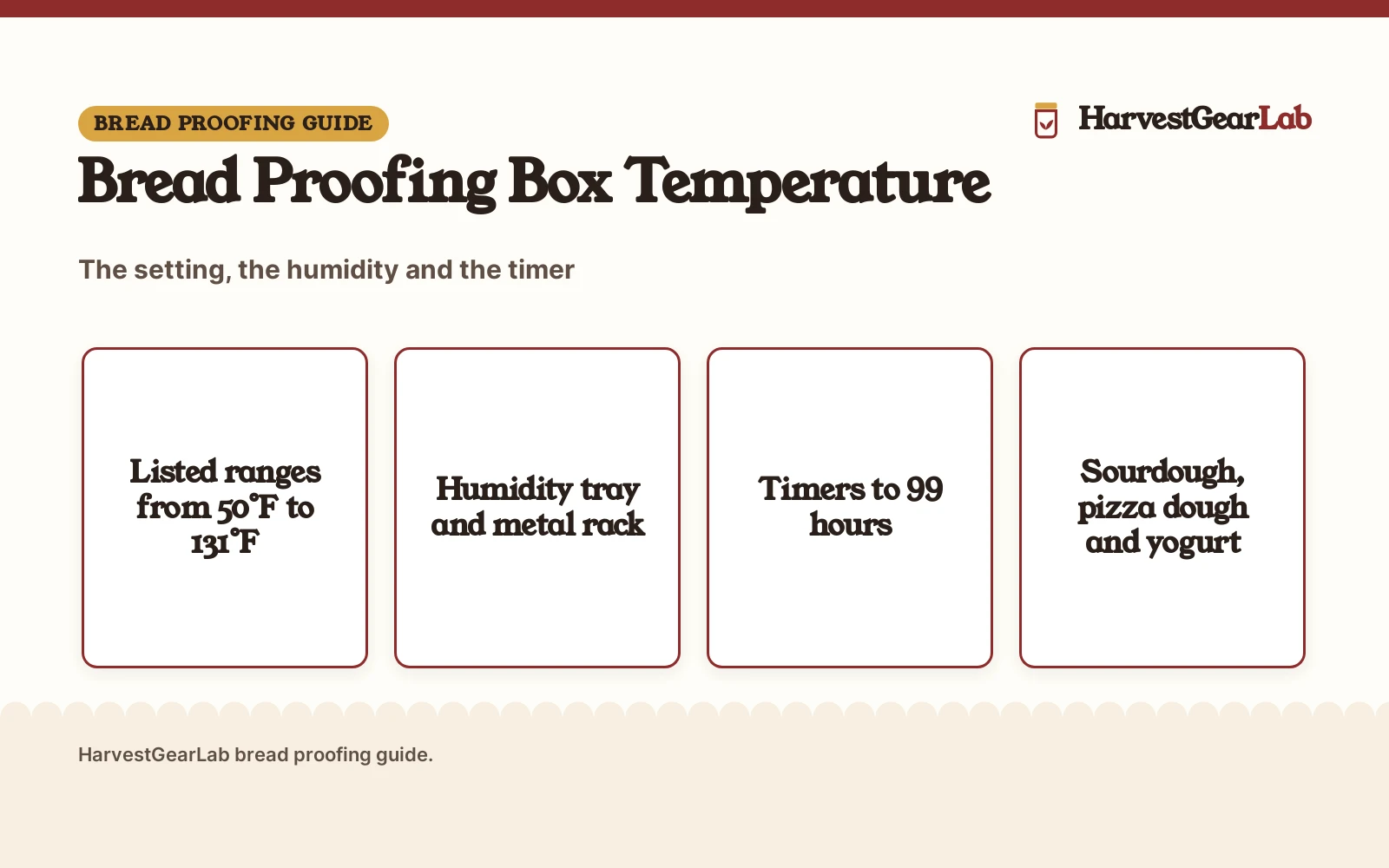
The boxes listed in this guide cover a wide span between them. The Wnfou lists 68-131°F with a 99-hour timer, the Viowil lists 50-122°F with a 48-hour timer and ±1°F precision, and the Berverra lists 86-113°F with a 24-hour timer. The table below puts the three ranges side by side; the rest of this guide explains how to choose a setting inside the range your box lists.
| Box | Listed temperature range | Timer |
|---|---|---|
| Wnfou | 68-131°F | 99 hours |
| Viowil | 50-122°F | 48 hours |
| Berverra | 86-113°F | 24 hours |
What the temperature setting does
Temperature sets the pace of the rise. Warm dough rises faster, cool dough rises slower, and a steady setting keeps the rise predictable from one bake to the next. That steadiness is the real job of the box: a kitchen that warms up and cools down through the day makes dough behave differently each time, while a box holds one setting until the timer ends.
The boxes listed here warm from three sides, front, back and bottom, so the dough warms evenly instead of from one side only, and the Viowil and Berverra list 5 layers of insulation to hold that warmth steady. A clear viewing window on top lets you check the rise without lifting the lid, which keeps the warm air inside.
How to pick a setting for the dough
Start inside the range your box lists and watch the dough, not the dial. If the dough rises faster than you want, set the box lower next time; if it rises slowly, set it higher. Small moves work better than large ones, and the dough tells you when the setting is right: it should rise steadily and hold its shape.
Sourdough starter, pizza dough, yogurt and bagels all sit in the same box, and the Wnfou lists all of them as uses, so one box can cover the whole list if the setting suits each one. When a recipe calls for a slow rise, use the low end of the range your box lists; when time is short, use the high end. Never set the box past the top of its listed range: the Wnfou tops out at 131°F, the Viowil at 122°F and the Berverra at 113°F.
Humidity, the rack and the viewing window
The temperature setting is only part of the box. The Wnfou lists a water tray that holds water to maintain humidity for a better rise and doubles as a drip tray for condensation from the top, while the other boxes list a waterproof interior that wipes clean. A metal rack keeps the dough elevated, and the Berverra lists a stainless steel shelf that prevents bottom overheating, so heat spreads evenly instead of gathering under the bowl.
The Viowil lists a 4-hour safety timer with automatic shut-off, and the Wnfou shuts off automatically when its timer ends. Foldable storage matters too: all three boxes fold flat for storage, and the Wnfou weighs 3.6 pounds while the Berverra weighs 3.38 pounds, so either one moves easily between a shelf and the counter.
Timers and automatic shut-off
The timer decides how long the box holds its setting. The Wnfou lists a 99-hour timer, the Viowil lists a 48-hour timer and the Berverra lists a timer from 1 hour to 24 hours. Set the timer for the rise you expect, then check the dough through the viewing window instead of opening the lid.
The Viowil lists a built-in 4-hour safety timer with automatic shut-off, and the Wnfou system shuts off automatically when time ends, so the box does not keep heating after the time you set. If the dough needs more time, set the timer again rather than leaving the box running past its listed range.
What to skip or double-check
- Setting past the top of the listed range: the boxes here top out at 113°F, 122°F and 131°F, so stay inside the range your box lists.
- Opening the lid to check the dough: use the viewing window and keep the warm air inside.
- Placing the bowl straight on the bottom: use the metal rack or the stainless steel shelf so heat spreads evenly.
- Forgetting the water tray: the Wnfou tray holds water to maintain humidity, so fill it when the box lists one.
- Storing the box unfolded: all three boxes fold flat, so fold it for storage and keep the lining clean.
FAQ: preserving at home
What temperature should a bread proofing box be set to?
There is no single figure for every dough. The boxes listed here span 50°F to 131°F between them, so set your box inside the range its maker lists, start near the low end for a slow rise, and move the setting up when the dough rises too slowly.
Can a proofing box be too warm for dough?
Yes, if the setting runs past the range the maker lists. The Berverra tops out at 113°F, the Viowil at 122°F and the Wnfou at 131°F, so the safe ceiling is the top of your own box’s range.
How long can dough stay in a proofing box?
The timers on the boxes listed here run 24, 48 and 99 hours, so the box can hold a setting far longer than a single rise needs. The Viowil also lists a 4-hour safety timer with automatic shut-off. Check the dough through the viewing window and end the rise when it looks ready, rather than leaving it to the timer alone.
Does a proofing box need water for humidity?
The Wnfou lists a water tray that holds water to maintain humidity for a better rise, and it doubles as a drip tray for condensation from the top. The Viowil and Berverra list a waterproof interior that is easy to clean. Add water to the tray when your box lists one, and keep the lid shut so the humidity stays inside.
Can one box proof sourdough, pizza dough and yogurt?
Yes. The Wnfou lists sourdough starter, pizza dough proofing, yogurt and bagels, the Viowil lists sourdough, pizza dough, yogurt, kombucha and chocolate, and the Berverra lists sourdough starter, bread baking, pizza dough, yogurt and seed starting. One box covers the whole list as long as the setting suits each use.
More preserving guides
See every bread and pasta making guide and all Harvest Guides guides.
More picks: bread proofing boxes, proofing baskets for sourdough, bread machines and sourdough starter kits for beginners.