
On this page
A bread slicer guide starts with a fresh loaf on the counter and a knife that will not cut it even. The short answer: a hand crank slicer with an adjustable thickness guide, a sharp stainless steel blade and a base that stays put on the counter. This guide walks through each part in the order that matters, and points to comparisons of specific listings for the details.
HarvestGearLab earns a commission when you buy through links on this site, at no extra cost to you. As an Amazon Associate I earn from qualifying purchases. Affiliate disclosure.
Bread slicer guide: the short list
Most home bakers start with five parts: a thickness adjustment, a blade, a guide with a scale line, a steady base and a size that fits the loaf and the counter. The table shows what each part does and what to check.
| Part | What it does | What to check |
|---|---|---|
| Thickness adjustment | Sets how thick each slice comes out | 0 to 0.9 in on the listings here |
| Blade | Cuts the loaf | Stainless steel, replaceable |
| Guide and scale line | Keeps slices even and repeatable | Metal guide, clear markings |
| Base and suction cups | Holds the slicer still on the counter | Solid wood base, 4 suction cups |
| Size | Fits the loaf and the counter | 11.8 to 13.8 in long |
Start with the loaf, not the slicer
Before you compare slicers, sort the bread you bake most. The listings here cover crusty sourdough, sandwich bread, bagels, croissants, rye bread and baguettes, plus cakes, cheese, deli meats, fruit and vegetables on some models. A crusty sourdough loaf needs a sharp blade and a firm guide so the crust does not crush the crumb, while a soft sandwich loaf needs a light touch and an even feed.
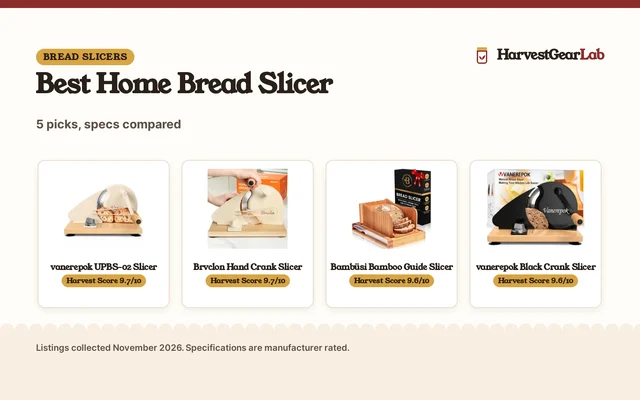
A slicer with an adjustable thickness guide covers both, with a thin setting for sandwich slices and a thick setting for toast. If the loaf is mostly sourdough rounds, look for a guide that fits a round loaf and a blade that handles a hard crust. If it is mostly sandwich bread, the thickness range and the scale line matter more than the crust. Our best home bread slicer comparison lines up slicers by thickness, blade and base.
Thickness: from thin to thick
Thickness is the first number to check. The listings here adjust from 0.1 to 0.9 in, with some starting at 0 in, and the Zassenhaus slicer adjusts up to 0.7 in. A vanerepok listing gives three useful marks: 0.3 in for ultra-thin sandwiches, 0.6 in for whole wheat bread and 0.9 in for thick toast.
Pick a range that covers the thinnest slice and the thickest slice you make. A clear scale line helps you return to the same thickness loaf after loaf, and a knob turn sets the thickness without tools. Turn the knob to the mark you want, check the scale line, and slice a heel piece first to confirm the thickness.
Blade, guide and scale line
The blade does the cutting, and every listing here uses stainless steel. Zassenhaus lists an 18/8 stainless steel blade, and SOWKIPE lists food-grade stainless steel blades with serrated edges. A serrated edge bites into a hard crust where a straight edge can skid, and a sharp blade keeps soft bread from tearing.
Look for a blade that comes off for cleaning and replacement: Brvclon, vanerepok, CAWIU and TENGIZUOHZ all list a removable or replaceable blade. A metal guide keeps each slice lined up and away from the handle, and a scale line marks the thickness so every slice matches the last. Zassenhaus traces its kitchen tools to 1867, and its slicer adjusts by a base knob with the bread guided along the blade by turning the handle.
A base that stays put
A slicer that slides across the counter is worse than no slicer at all. The listings here pair a solid wood base with an aluminum alloy frame or body. Most listings here add suction cups underneath: vanerepok, SOWKIPE and CAWIU each list 4 suction cups, and Brvclon and TENGIZUOHZ list strong suction cups. CAWIU lists a 0.8-inch thick wooden base.
Set the slicer on a smooth, dry countertop so the cups can grip, and press the base down before the first slice. A removable protective cover, listed by CAWIU, keeps the blade covered in storage. After slicing, wipe surface residue away with a cloth or brush, and hand wash with a damp cloth where the maker says so: Zassenhaus lists hand wash only using a damp cloth.
Size it to the loaf and the counter
Footprints on the listings here include 11.8 by 7.9 in, 11.75 by 8 in and 13.8 by 11.4 in, and heights run from 7.3 in to 7.9 in. Weights stated on the listings here are 4.5 lb for the CAWIU slicer and 9.1 lb for the Zassenhaus slicer. Measure the counter space before ordering, and leave room for the loaf beside the slicer and for the crank handle to turn.
Storage matters too: the listings describe a compact size that saves counter space, and the blade comes off for cleaning on several models. The Brvclon listing includes 10 bread bags with the slicer, and the CAWIU listing adds a removable protective cover for safe, hygienic storage.
What to skip or double-check
- A slicer with no thickness adjustment: check that the listing states a thickness range before buying, since the range is what makes one slicer fit thin sandwiches and thick toast.
- A blade that cannot come off: look for a removable or replaceable blade, so cleaning and replacement stay simple.
- A base with no grip: check for suction cups or another grip, and set the slicer on a smooth countertop.
- A slicer that dwarfs the counter: check the footprint against the counter space, and leave room for the loaf and the crank handle.
- A warranty you cannot find: Brvclon and TENGIZUOHZ list a 3-year warranty, and vanerepok lists a 4-year warranty, so check the term before buying.
What this guide does not cover
This guide covers choosing and using a bread slicer. It does not cover baking the loaf itself: for the bake, see the best tools for artisan bread making and best Dutch oven for baking sourdough bread guides. Every bread and pasta guide on the site is collected in the bread and pasta section.
FAQ: preserving at home
What thickness should I slice bread at?
It depends on the bread and the meal. A vanerepok listing gives 0.3 in for ultra-thin sandwiches, 0.6 in for whole wheat bread and 0.9 in for thick toast, and the listings here adjust up to 0.9 in, except for the Zassenhaus slicer at 0.7 in.
Can a bread slicer cut sourdough?
Yes. The listings here cover crusty sourdough, bagels, rye bread and baguettes, with stainless steel blades and a metal guide to keep the slices even.
How do I keep the slicer from moving while I slice?
Set it on a smooth countertop so the suction cups can grip, and press the base down before the first slice. Vanerepok, SOWKIPE and CAWIU each list 4 suction cups, and Brvclon and TENGIZUOHZ list strong suction cups.
Can I replace the blade on a bread slicer?
On most listings here, yes. Brvclon, vanerepok, CAWIU and TENGIZUOHZ all list a removable or replaceable blade, so check the listing for your model.
How do I clean a bread slicer?
Wipe surface residue away with a cloth or brush after use. Zassenhaus lists hand wash only using a damp cloth, and several listings add that the blade comes off for cleaning.
More preserving guides
See every bread making guide and all bread and pasta guides.
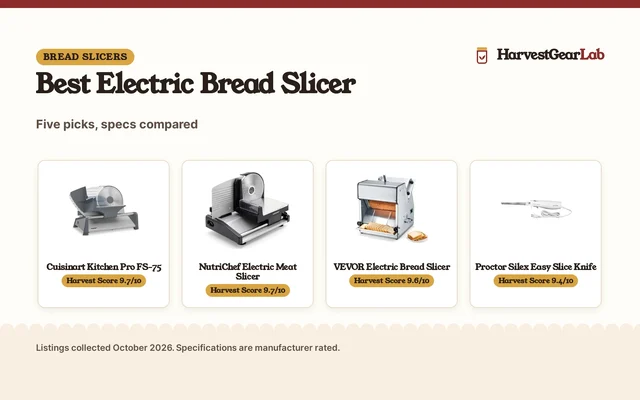
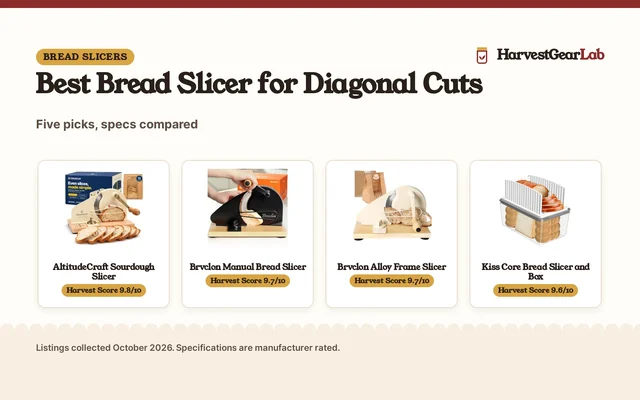
More picks: electric bread slicers, bread knives, bread slicers for diagonal cuts and bread boxes for homemade sourdough.