
On this page
Top picks at a glance
As an Amazon Associate I earn from qualifying purchases.
- 1
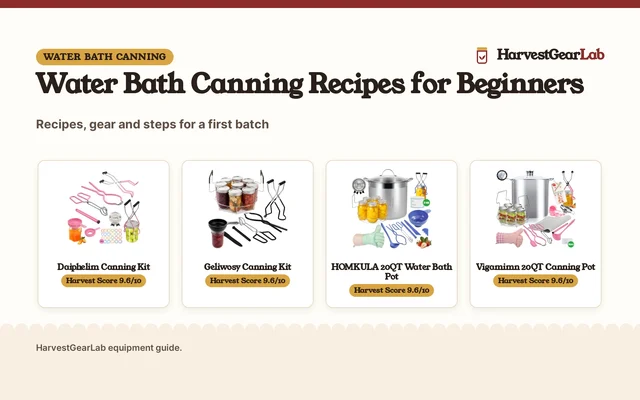
 Vigamimn 20QT Canning Pot with Rack and Lid9.6/10View on Amazon
- 2
 Daiphelim Canning Kit9.6/10View on Amazon
- 3
 HOMKULA 20QT Water Bath Canning Pot with Rack and Lid9.6/10View on Amazon
A crate of green beans waits on the counter, corn fills a basket by the sink, and potatoes crowd the pantry shelf while the garden keeps producing faster than the family can eat fresh. Canning vegetables for beginners starts with sorting that harvest by method, then matching the method to the right canner, jars and hand tools. Plain vegetables need a pressure canner, while pickled vegetables and tomatoes with added acid can go in a boiling water bath when a current USDA recipe says so. This guide covers the gear in the order you need it.
HarvestGearLab earns a commission when you buy through links on this site, at no extra cost to you. As an Amazon Associate I earn from qualifying purchases. Affiliate disclosure.
Canning vegetables for beginners: the short list
Most home canners start with a small set of gear groups, shown in the table below.
| Equipment | What it does | Needed for | Start now? |
|---|---|---|---|
| Water bath canner with rack | Holds jars in boiling water | Pickled vegetables, acidified tomatoes | Yes, for high-acid foods |
| Pressure canner | Locks shut and traps steam to run hotter than boiling | Plain vegetables, meat, stock | Yes, for low-acid foods |
| Canning jars, lids and bands | Hold and seal the food | Every method | Yes |
| Jar lifter, funnel, lid lifter, bubble remover | Move and fill hot jars safely | Every method | Yes |
| Food mill, ladle, extra pots | Speed up prep | Sauces and purees | Later |
Start with the method, not the pot
Before you buy anything, sort the vegetables you want to put up into groups by acidity. High-acid foods, such as pickled vegetables and tomatoes with added acid, can go in a boiling water bath when you follow a current USDA recipe. Low-acid foods, such as green beans, corn, potatoes, meat and stock, need a pressure canner. Boiling water alone does not get hot enough for them, and extra time does not change that.
If your list is all pickles and acidified tomatoes, a water bath canner is enough for now. If it includes plain vegetables or meat, you need a pressure canner. Our what is a water bath for canning guide explains the water bath method, and how to start canning covers the gear you need as a beginner.
A canner sized by jar count
Canner volume in quarts is less useful than the jar count the maker states. Pick the size that matches the batch you will fill in an afternoon of canning.
A water bath pot such as the Supa Ant lists a 24 quart capacity, with dimensions of 14.5 inches by 14.5 inches by 11.0 inches, and a stainless steel rack with foldable handles for lifting jars in and out of boiling water. The same listing describes a kit of 11 items, including a funnel, jar lifter, magnetic lid lifter and jar wrench, plus 90 labels for marking jars. That kind of bundled kit suits a beginner who wants the hand tools in the same box as the pot.
For a water bath canner, check that a rack is included and that the base suits your stove. For a pressure canner, look for a stated gauge, a regulator weight and an overpressure plug, and confirm it is sold as a canner, not only as a pressure cooker. Compare options in our best canning kit for beginners guide.
Jars, lids and bands
Use jars made for home canning. Small jars suit jams and jellies, mid-size jars suit most vegetables, and large jars suit whole fruit and tomatoes. Jars and bands can be reused for years if they are free of chips and rust, but the flat lids with sealing compound are made to seal a batch and then be retired. Buy spare lids, since a nicked rim or a lid that does not seal sends you back to the box.
Mixing wide-mouth and regular-mouth jars is fine, but you will need lids and bands to match the mouth size of each jar. See our best canning lids for beginners guide and the cheap canning jars guide if you are stocking up.
Hand tools that handle hot jars
A small set of tools makes canning day safer:
- Jar lifter: grips a hot jar so you can lift it out of boiling water.
- Wide-mouth funnel: keeps food off the jar rim, where it can stop the lid from sealing.
- Magnetic lid lifter: picks warm lids out of a pan without touching the sealing compound.
- Bubble remover and headspace tool: releases trapped air and checks the headspace your recipe gives.
- Canning rack: keeps jars off the bottom of the pot.
These often come together in a kit. Our best canning tool kit for beginners comparison lines up the sets by pieces and materials.
Kitchen basics you probably already own
You will also lean on everyday kitchen gear: a large pot, a ladle, a cutting board and sharp knife, clean towels for hot jars, and a timer. For tomato sauce and purees, a food mill strains out skins and seeds faster than a sieve; see our best tools for canning tomatoes guide if you plan large sauce batches.
What to skip or check before you buy
- Processing jars in the oven: skip it. Dry oven heat is not a safe way to process canning jars.
- Electric pressure cookers: do not use an electric pressure cooker for canning unless the maker states it is made for pressure canning.
- Small stovetop cookers sold as cooker and canner: check the stated jar capacity before you treat it as a pressure canner.
- Old or secondhand canners: check the gauge, seal and safety plug before use, and ask your local extension office about checking a dial gauge.
- Reused flat lids: buy new flat lids for every batch.
What this guide does not cover
This is an equipment checklist. It does not give recipes, processing times, pressures, headspace figures or altitude changes. Take those from current USDA and National Center for Home Food Preservation guidance, and follow them exactly for each food.
FAQ: preserving at home
What is the minimum equipment needed for water bath canning?
A large pot deep enough to cover the jars with boiling water, a rack to keep jars off the bottom, canning jars with new lids and bands, and a jar lifter. A funnel and lid lifter help but are not strictly required.
Do I need a pressure canner to can plain vegetables?
Yes. Plain vegetables are low-acid foods, so they need a pressure canner. A water bath canner is enough for pickles, jams and acidified tomatoes.
Can I use a regular stockpot as a water bath canner?
Yes, if it is deep enough to cover the jars with boiling water and you add a rack to keep them off the bottom.
Can I reuse canning jars and lids?
Jars and bands can be reused as long as they have no chips, cracks or rust. The flat lids with sealing compound are made to seal a batch and then be retired, so buy new lids for every batch.
Is a canning kit worth buying for a beginner?
For most beginners, yes. A kit bundles the jar lifter, funnel, lid lifter and bubble remover you need at the start, and some include a rack. The Supa Ant kit (on Amazon) lists 11 items and 90 labels.
More preserving guides
See our canning for survival guide and the canning kit vs pickling kit guide for more ways to keep the harvest.
More picks: canning kits for beginners, canning tool kits for beginners, water bath canning and how to start canning.