
On this page
Top picks at a glance
As an Amazon Associate I earn from qualifying purchases.
- 1
 Compact Vacuum Sealer for Food with Visible Tank9.7/10View on Amazon
- 2
 Vacuum Sealer for Food: 30 Reusable Bags and 20ml Tank9.6/10View on Amazon
- 3
 Compact Vacuum Sealer for Food with 30 Reusable Bags 80kPa9.6/10View on Amazon
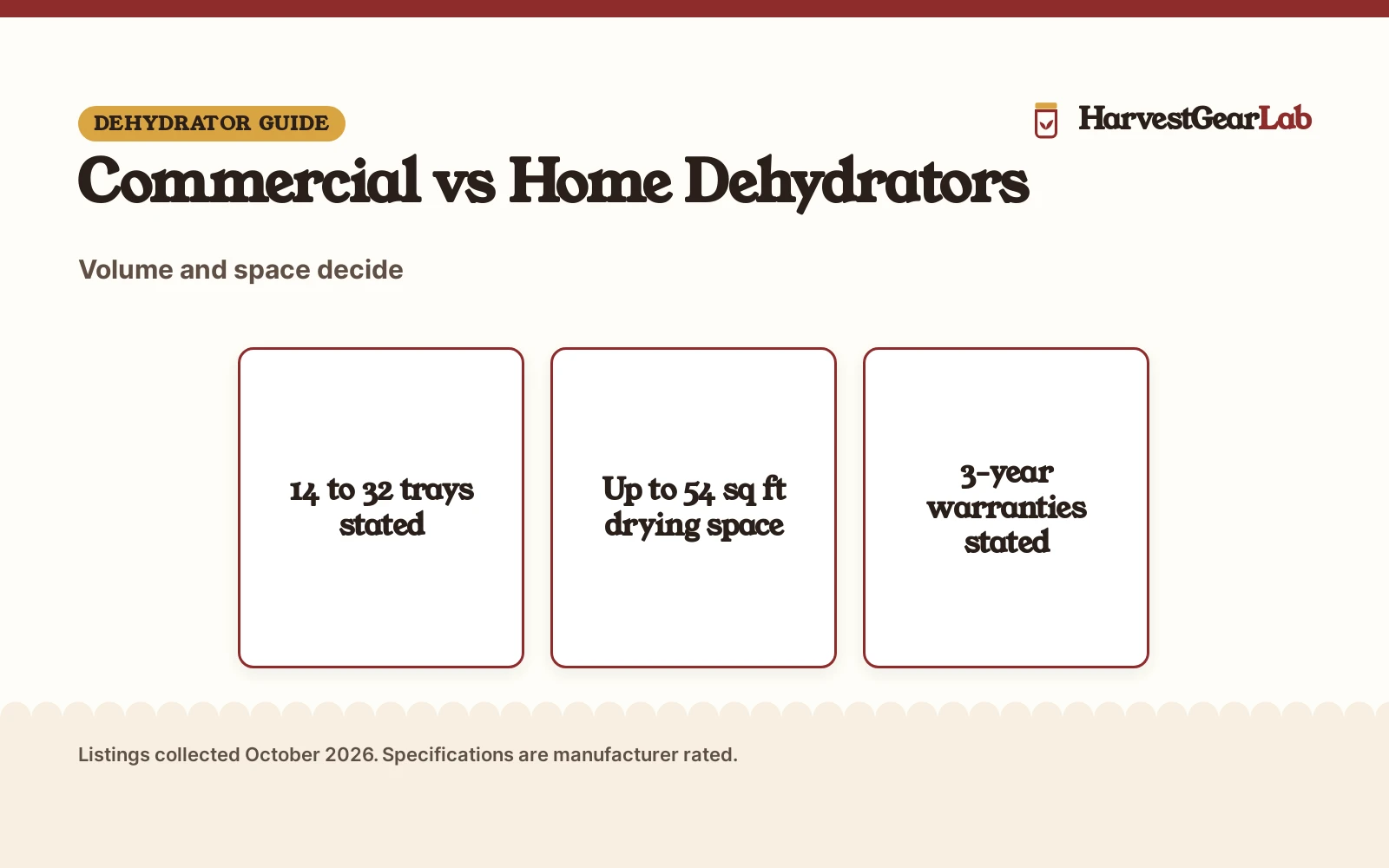
Commercial dehydrator vs home dehydrator comes down to volume and space. Choose commercial when you dry whole harvests or jerky for a business: the listings state 14 to 32 trays, 54 square feet of drying space and up to 3150 watts. Choose a home dehydrator when you dry snacks for the family on a countertop: lighter, fewer trays, simpler. Every figure below comes from the reference listings.
HarvestGearLab earns a commission when you buy through links on this page, at no extra cost to you. As an Amazon Associate I earn from qualifying purchases. Affiliate disclosure.
Commercial dehydrators
Commercial dehydrators scale up every figure. The NutriChef NCFD20S listing states 2000 watts, 20 stainless steel trays, 95-167°F, a touch-control LED display and a glass door. The Cercker DBC-14A listing states 1200 watts, 14 trays at 12.52 by 9.84 inches, 70-190°F, a 24-hour timer, noise at or under 50 dB and a 3-year warranty. The Cercker DBC-16B listing states 1500 watts, 16 trays of 27.28 square feet, 70-190°F, 316 stainless steel trays, 53.6 pounds and a 3-year warranty. The Cercker DBC-22 listing states 2500 watts, 22 trays of 37.5 square feet, 70-190°F, 66.6 pounds and a 3-year warranty. The Osluken listing states 1100 watts, 18 trays of 18.1 square feet, 86-194°F, a 48-hour timer, 5 presets, under 55 dB and a 3-year warranty. The VarmBake DBA-32J listing states 3150 watts, 220 volts, 32 trays of 54 square feet, 104-194°F, 105 pounds and a 3-year warranty. Commercial units need dedicated space and, at 3150 watts and 220 volts, dedicated power.
Home dehydrators
Home dehydrators are countertop machines built for family batches, not business volume. They hold fewer trays, weigh far less than the 53.6 to 105 pounds stated on the commercial listings, and plug into a standard kitchen outlet rather than the 220 volts stated on the largest commercial unit. You give up tray count and speed, but you gain a machine that fits on a counter and costs far less to run.
Commercial dehydrator vs home dehydrator: head to head
| Aspect | Commercial (listings) | Home (general) |
|---|---|---|
| Trays stated | 14 to 32 | Fewer, countertop scale |
| Drying space | Up to 54 square feet | Much smaller |
| Wattage stated | 1100 to 3150 watts | Lower |
| Weight stated | 53.6 to 105 lbs | Countertop light |
| Power stated | Up to 220 volts | Standard outlet |
| Warranty | 3 years stated | Often 1 year |
Every figure in the table comes from the reference listings. Where a listing states nothing, the table leaves it unclear.
How to read the commercial listings
Start with the temperature range, since it decides what you can dry. The listings state 95 to 167°F on the NutriChef, 70 to 190°F on the Cercker models, 86 to 194°F on the Osluken and 104 to 194°F on the VarmBake. Pick the range that covers everything you plan to dry, not just today’s batch.
Then check the timer and noise figures. The Cercker DBC-14A lists a 24-hour timer and noise at or under 50 dB; the Osluken lists a 48-hour timer and noise under 55 dB. A long timer matters for overnight and multi-day batches, and a lower noise figure matters if the machine runs in a living space rather than a barn.
Measure your space against the weight and power. The listings state 53.6 pounds on the Cercker DBC-16B and 105 pounds on the VarmBake, with 1100 to 3150 watts across the commercial range. The VarmBake also states 220 volts, which needs a dedicated circuit rather than a standard outlet. Count your trays too: 14 to 32 across the listings, with stated drying space from 27.28 square feet to 54 square feet.
Finally, read the warranty line before you buy. The Cercker, Osluken and VarmBake listings each state a 3-year warranty. A machine this heavy and powerful is worth the warranty check, since moving it for service is a job on its own.
Which should you buy?
Buy commercial if
- You dry whole harvests or sell product; the listings state 14 to 32 trays.
- You need throughput: 1100 to 3150 watts stated, with timers to 48 hours.
- You have floor space and proper power; the VarmBake states 220 volts and 105 pounds.
Buy home if
- You dry snacks for the family.
- You need a countertop machine you can move and store.
- You want lower running costs and simpler operation.
For dryer types, see our digital vs analog food dehydrator and solar dehydrator vs electric food dehydrator guides.
FAQ: preserving at home
How many trays does a commercial dehydrator have?
The listings state 14 to 32 trays, with drying space from 27.28 to 54 square feet.
What power does a commercial dehydrator need?
The listings state 1100 to 3150 watts, with the largest unit at 220 volts.
Do commercial dehydrators carry longer warranties?
Yes. The Cercker, Osluken and VarmBake listings all state 3-year warranties.
More preserving guides
Also see our digital vs analog food dehydrator. Also see our solar dehydrator vs electric food dehydrator.
More picks: