
On this page
A batch of homebrew is ready to leave the fermenter, friends are coming over, and the practical question is what it costs to keg the beer and pour it at home. The cost of beer keg gear depends on the keg, the tap hardware, and the gas supply or pump that moves the beer, so the total is a sum of parts rather than a fixed figure. This guide walks through each part in turn, using the sizes and capacities the makers publish.
HarvestGearLab earns a commission when you buy through links on this site, at no extra cost to you. As an Amazon Associate I earn from qualifying purchases. Affiliate disclosure.
Cost of beer keg: the short answer
The keg holds the beer, the tap line carries it to the glass, and gas pressure or a hand pump moves it. The table below names the parts and what shapes what each one costs.
| Part | What it does | What shapes the cost |
|---|---|---|
| Keg | Holds and protects the beer | Size, material and finish |
| Beer line and tap | Carries beer from keg to glass | Length, faucet style and fittings |
| Disconnects and clamps | Join the lines to the keg posts | Barb size, count and material |
| Gas line and regulator | Supplies pressure for the pour | Length, clamp size and regulator style |
| CO2 cartridges or hand pump | Powers the pour | Cartridge size or pump build |
Keg size shapes the cost
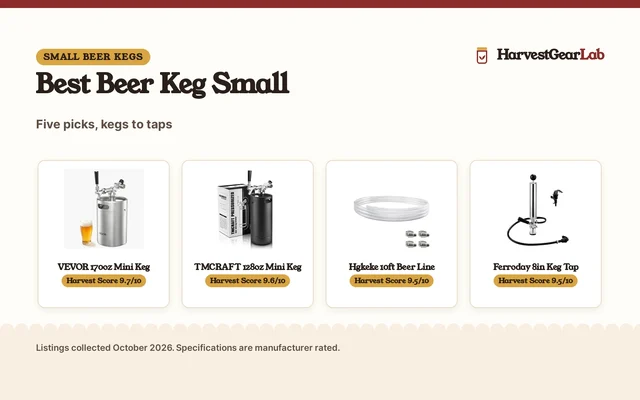
The mini kegs in the published figures come in 128oz, 170oz and 3.6L sizes. Gancowise and KEG STORM both list a 128oz mini keg, KEG STORM states the same capacity as 1 gallon, TMCRAFT lists a 170oz mini keg, and WELLBOM lists a 3.6L mini keg with a hand pump. A larger keg suits a gathering, while a smaller keg fits a standard refrigerator or cooler.
The makers also list keg dimensions. The Gancowise 128oz keg measures 7.3 inches long by 5.3 inches wide by 18.3 inches high, while the TMCRAFT 170oz keg measures 6.9 inches by 9 inches by 18 inches. Measure the space in the refrigerator or cooler before ordering, and compare it with the dimensions the maker lists. The kegerator size guide explains how to measure the keg and then the space.
Material and build
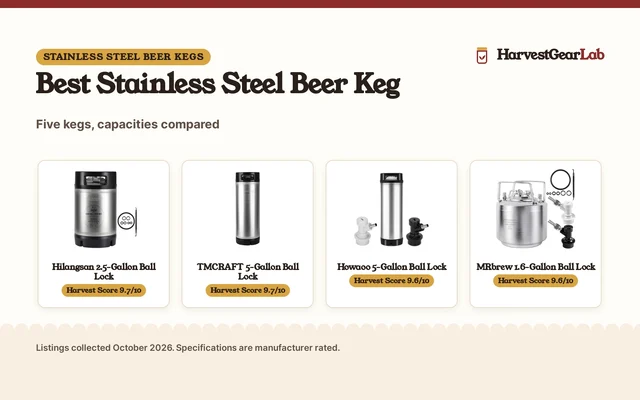
The mini kegs in the published figures use stainless steel. KEG STORM lists food-grade 304 stainless steel with a matte black finish and describes the keg as BPA-free, TMCRAFT lists food grade stainless steel that keeps beer flavor and holds carbonation, and WELLBOM lists food-grade stainless steel for its 3.6L keg. Stainless steel resists rust, and a matte black finish resists scratches and fingerprints.
Build details also change what a keg costs to own. The KEG STORM keg has built-in side handles and parts that come apart for cleaning, the Gancowise keg has a self-closing faucet with a spring and a pressure release valve, and the TMCRAFT keg has an adjustable faucet that controls flow by turning a knob. A faucet that closes on its own wastes less beer at the tap, and parts that come apart make cleaning simpler after each use.
Tap hardware and lines
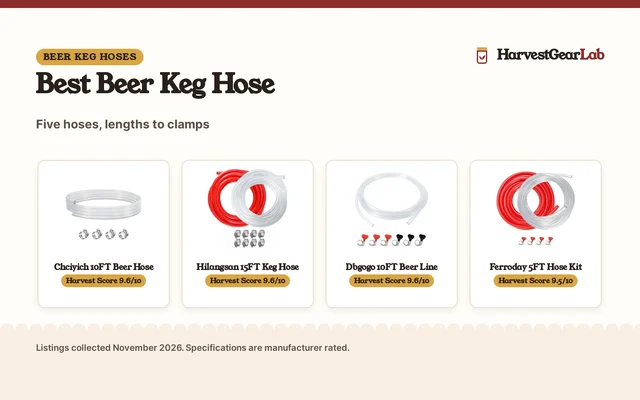
The beer line is the part that most often gets bought in the wrong length. Ferroday lists a 3 ft ball lock beer line and a 5 ft ball lock beer line, each with a picnic tap, a swivel nut, a ball lock disconnect and 2 anti-loosen clamps. A longer line gives more room between the keg and the tap. Hgkeke lists a 25 feet red CO2 gas line with 6 pieces of 6-12mm hose clamps, sized for a 5/16-inch barb, with a 7.5mm inside diameter.
Disconnects join the lines to the keg posts, and the barb size has to match the hose. MRbrew lists a set of 2 ball lock disconnects with 1/4-inch liquid barb fittings, and Dbgogo lists a set of 4 pairs with a 1/4-inch beer barb and a 5/16-inch gas barb, plus 8 spare keg post gaskets. Spare gaskets cover a worn seal without a separate order, and both barb sizes cover the liquid and gas sides of a Corny keg. Ferroday also lists a floating dip tube with a 31-inch silicone tube and a 304 stainless steel ball, made to draw from the top layer of the keg, and the maker notes it suits a 55L fermentor and can be cut shorter for a smaller vessel.
CO2 supply or hand pump
Pressurized mini kegs use CO2 cartridges to hold carbonation and push the beer. KEG STORM and Gancowise both list a regulator that fits standard 16g CO2 cartridges, and Gancowise states a 3/8-inch thread on the cartridge connection. TMCRAFT states the same 3/8-inch thread and adds that a 16g capsule can tap 128oz of beer, with the cartridge sold separately. Cartridges are a running cost, so a brewer who pours often will go through them faster than a brewer who pours now and then.
The other route is a hand pump, which needs no cartridges and no regulator. WELLBOM lists a 3.6L black mini keg with a 4-inch keg party pump, 2 beer taps and 2 hose clamps, and the beer is dispensed by hand pumping. A pump suits a picnic or a gathering where cartridges would be an extra thing to carry, and a CO2 setup suits a keg that stays in the refrigerator. Compare the best home brewing tap guide for faucet styles, and the best beer keg hose guide for line lengths.
What to check before buying
Fit comes before cost: check that the disconnects match the keg posts, the barb sizes match the hoses, and the keg fits the refrigerator or cooler. The Gancowise keg lists a 12 months quality assurance term, TMCRAFT lists a 1-year warranty, and Hgkeke states a 3 years term on its gas line. A stated term shows the maker stands behind the item.
Compare the figures the makers publish, not the shape of the keg alone. A 128oz keg with a regulator and a tap costs more to set up than the keg on its own, and a 170oz keg with an adjustable faucet adds parts on top of the larger vessel. The best stainless steel beer keg guide lines up kegs by size and material, and the best beer keg small guide covers small kegs and taps for tight spaces.
What this guide does not cover
This guide covers the parts that shape the cost of beer keg gear. It does not give serving advice or carbonation settings beyond what the makers state, and it does not cover full kegerator builds or commercial keg systems. For the broader setup, see the home brewing section, and for kegs by size, the best beer keg small guide.
FAQ: preserving at home
How much does a beer keg cost?
There is no set figure, because the total covers the keg, the tap line, the disconnects and the gas supply or pump. Compare the full set of parts before ordering.
What size beer keg fits a home refrigerator?
The 128oz mini kegs the makers list suit a standard refrigerator or cooler. Gancowise lists its 128oz keg at 7.3 inches by 5.3 inches by 18.3 inches, and TMCRAFT lists its 170oz keg at 6.9 inches by 9 inches by 18 inches. Measure the shelf space first and compare it with the dimensions the maker lists.
Do I need CO2 cartridges for a mini keg?
It depends on the keg. Pressurized mini kegs from KEG STORM, Gancowise and TMCRAFT use 16g CO2 cartridges with a 3/8-inch thread, while the WELLBOM 3.6L keg uses a hand pump and needs no cartridges. Check whether the keg lists a regulator or a pump before ordering.
What parts do I need besides the keg?
A beer line with a tap, disconnects that match the keg posts, and a gas line with clamps. Ferroday lists 3 ft and 5 ft beer lines with a picnic tap and disconnect, and Hgkeke lists a 25 feet gas line with 6 clamps. Match the barb sizes, 1/4-inch for beer and 5/16-inch for gas, to the hoses.
More preserving guides
See every Beer Brewing guide and all Home Brewing and Wine guides.
More picks: stainless steel beer kegs, beer keg hoses, kegerators for homebrew and growlers for home brewed beer.