
On this page
Top picks at a glance
As an Amazon Associate I earn from qualifying purchases.
- 1
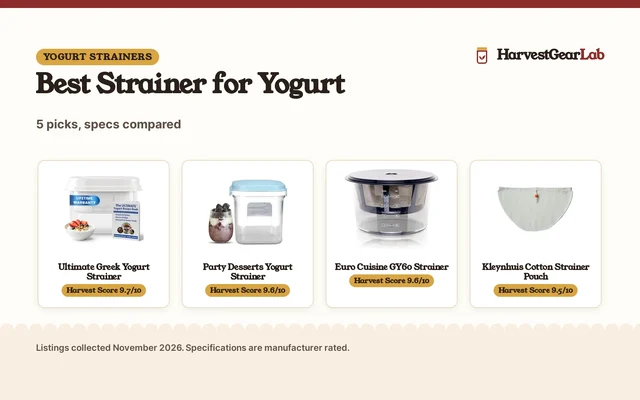
 Ultimate Greek Yogurt Strainer9.7/10View on Amazon
- 2
 Euro Cuisine GY60 Greek Yogurt Maker Strainer9.6/10View on Amazon
- 3
 Party Desserts Greek Yogurt Strainer with Lid9.6/10View on Amazon
A pot of fresh yogurt, a bowl, and a square of cloth are all a diy yogurt strainer needs to be. A diy yogurt strainer is any clean, fine cloth or mesh bag set over a bowl so the whey drains away and the yogurt left behind turns thick and creamy. No dedicated gadget is required: the same cheesecloth and nut milk bags sold for straining nut milk, juice and cheese work for yogurt, and the method stays the same whatever cloth is used. This guide walks through the cloth to pick, the setup to use, and the mistakes to avoid, so the next batch comes out thick.
HarvestGearLab earns a commission when you buy through links on this site, at no extra cost to you. As an Amazon Associate I earn from qualifying purchases. Affiliate disclosure.
diy yogurt strainer: the short list
Most home cooks get started with a small set of items. The table shows what each one does and when it is needed.
| Item | What it does | When to use it | Notes |
|---|---|---|---|
| Cheesecloth, grade 100 | Lines a bowl or colander and holds back curds while whey drains | Every batch | Hemmed edges keep threads out of the yogurt |
| Nut milk bag, fine mesh | Holds yogurt inside a drawstring bag over a bowl | Repeat batches | Rinse after use and hang to dry |
| Bowl and colander | Catch whey below and support the cloth above | Every batch | Pick a bowl deep enough to keep cloth clear of whey |
| Spoon and clean jar | Move yogurt and store the strained result | After straining | Keep the jar clean and dry before filling |
Start with the cloth, not the gadget
Before buying anything, sort the methods into two groups. Loose cheesecloth suits a cook who strains yogurt now and then and wants a cloth that folds away in a drawer. A sewn mesh bag suits a cook who strains yogurt often and wants a bag that rinses clean and hangs to dry. The listings describe cheesecloth as 100% unbleached cotton with hemmed edges, and nut milk bags as fine nylon mesh with a drawstring, so the choice is between a flat cloth and a sewn bag, not between good and bad straining.
If the plan is a batch now and then, cheesecloth is enough for now. If the plan is a regular batch, a mesh bag earns its place. Our best strainer for yogurt comparison lines up dedicated strainers for readers who want a ready-made option, and the yogurt maker uses guide covers what else a yogurt maker can do at home.
A strainer sized by the batch
Cloth size matters more than brand. A 20 by 20 inch cheesecloth, sold in an 8 pack by New England Stories and in a 6 pack by VONLUNK, lines a colander with cloth to spare at the edges, so the corners can be gathered and tied. A 12 by 10 inch nut milk bag from ERA NATURAL suits a modest batch in a bowl, while a 9.5 by 14 inch bag from COKUMA suits a larger batch, with room to spare for the yogurt to spread.
For cheesecloth, check that the edges are hemmed, that the weave is fine enough to hold back curds, and whether the listing states a grade. Grade 100 is the highest grade the listings state. For a mesh bag, look for a drawstring that closes the top, a seam that holds under a full load, and a mesh fine enough for yogurt rather than only for juice. Compare options in our best glass yogurt maker guide if the yogurt itself is made at home, or read the best yogurt maker for quart jars guide for makers sized by jar.
Cloth, bags and fine mesh
Use cloth made for food straining, in the size the batch calls for. Flat cheesecloth folds to fit any bowl or colander, and the hemmed edge keeps loose threads out of the yogurt. A mesh bag keeps its shape, and the drawstring holds the yogurt inside while whey drains. Cloth and bags can be washed and reused, but a cloth that has thinned or torn should be replaced, since a worn weave lets curds through.
Hand tools that help the strain
A few plain tools make straining day simpler and much less messy:
- Bowl: catches whey below the cloth, deep enough to keep the cloth clear of the liquid.
- Colander: supports the cloth above the bowl and lets whey drip through.
- Spoon: moves yogurt into the cloth and out again without tearing the weave.
- Clean jar: stores the strained yogurt once the whey has drained.
- Rubber band or kitchen string: gathers the cloth corners and holds the bundle above the bowl.
Most of these come from the kitchen already. Our best kefir strainer lid for mason jar comparison covers lids that strain straight from the jar, and the food mill vs fine mesh strainer guide lines up two other straining tools by what each one suits.
Kitchen basics you probably already own
The rest of the setup leans on everyday kitchen gear: a large bowl for the whey, a spoon, a cutting board and sharp knife for prep, clean towels to set the bowl on, For fruit purees and sauces, a food mill strains out skins and seeds faster than a sieve; see our food mill vs fine mesh strainer guide if big sauce batches are planned.
What to skip or double-check
- Paper towels as a strainer: skip them. They tear when wet and leave fibres behind.
- A thin layer of loose-weave cloth: check the grade and fold the cloth so the weave holds back curds.
- A bag with a torn seam: check the stitching and replace a bag that has started to split.
- Cloth washed with strong scent: rinse well and dry fully before use.
- Straining straight into a shallow dish: check that the bowl keeps the cloth clear of the whey.
What this guide does not cover
This is a straining guide. It does not give recipes, cultures, incubation times or storage times. Take those from a current edition of a trusted yogurt guide, and follow them exactly for each batch.
FAQ: preserving at home
Can I use a nut milk bag as a DIY yogurt strainer?
Yes. A fine mesh nut milk bag works as a diy yogurt strainer: spoon the yogurt in, pull the drawstring closed, and set the bag over a bowl so the whey drains. The 12 by 10 inch bag suits a modest batch, and the 9.5 by 14 inch bag suits a larger one.
How many layers of cheesecloth should I use for straining yogurt?
Fold the cloth so the weave holds back curds: a grade 100 cheesecloth is the finest grade the listings state, and a folded layer strains more slowly and more thickly than an unfolded layer. If whey still runs cloudy, fold the cloth again.
Can I strain yogurt with a coffee filter?
A coffee filter can strain a small amount of yogurt, but it clogs fast and tears when wet, so it suits a small amount rather than a full batch. Cheesecloth or a mesh bag handles a full batch without tearing.
How do I clean and reuse cheesecloth after straining yogurt?
Rinse the cloth under warm water right after use, then wash it and let it dry fully before folding it away. The listings describe their cheesecloth as reusable after washing, and a cloth that has been rinsed promptly stays free of sour smells.
What is the difference between cheesecloth and a nut milk bag for straining yogurt?
Cheesecloth is a flat cloth that folds to fit any bowl, while a nut milk bag is a sewn bag with a drawstring that holds its shape. A 20 by 20 inch cheesecloth suits a cook who strains now and then, and a 12 by 10 inch or 9.5 by 14 inch bag suits a cook who strains often.
More preserving guides
See our best strainer for yogurt guide and our yogurt maker uses guide.
More picks: glass yogurt makers, yogurt makers for quart jars, kefir strainer lids and yogurt makers for vegan yogurt.