
On this page
Top picks at a glance
As an Amazon Associate I earn from qualifying purchases.
- 1
 24 oz Wide Mouth Mason JarsView on Amazon
- 2
 Ball Wide Mouth Glass Mason Jars with Lids and BandsView on Amazon
- 3
 Ball Regular Mouth Glass Mason Jars with Lids and BandsView on Amazon
- 4
 Ball Regular Mouth Lids for Glass Mason JarsView on Amazon
- 5
 Ball Glass Mason Jars Wide Mouth 16ozView on Amazon
- 6
 Ball Wide Mouth Clear Glass Canning Quart 32 Oz Mason JarsView on Amazon
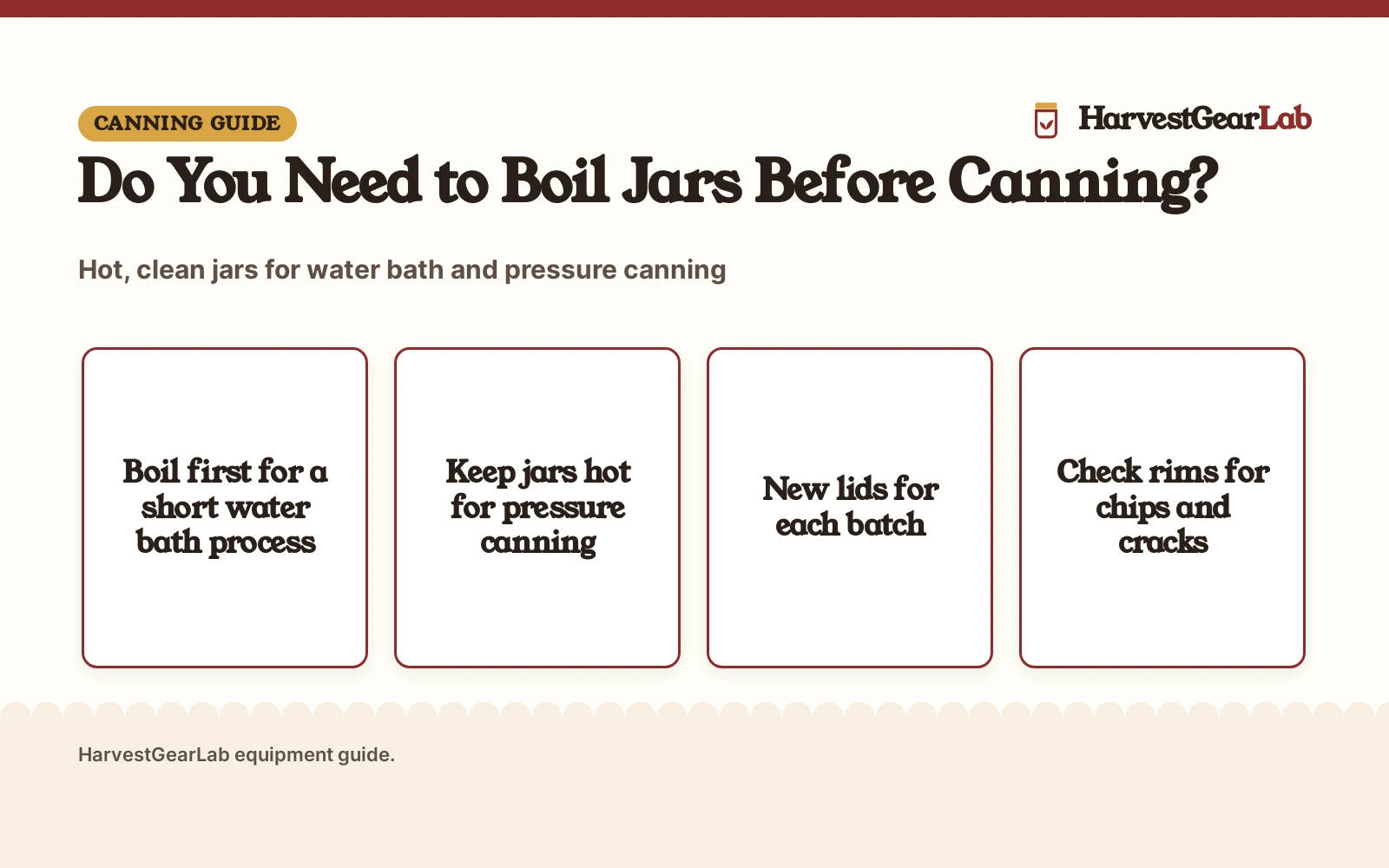
Do you need to boil jars before canning? The short answer is that it depends on the method: water bath jars need a full boil first when the process is short, while jars headed for a pressure canner only need to be washed and kept hot until filling. In each case the point is the same: clean jars that stay hot, so hot food can go straight in without a crack or a failed seal. The steps below cover washing, heating, lids and the mistakes to skip.
Runners-up to consider
 24 oz Wide Mouth Mason JarsCheck price on Amazon
 Ball Wide Mouth Glass Mason Jars with Lids and BandsCheck price on Amazon
 Ball Regular Mouth Glass Mason Jars with Lids and BandsCheck price on Amazon
 Ball Regular Mouth Lids for Glass Mason JarsCheck price on Amazon
 Ball Glass Mason Jars Wide Mouth 16ozCheck price on Amazon
 Ball Wide Mouth Clear Glass Canning Quart 32 Oz Mason JarsCheck price on Amazon
HarvestGearLab earns a commission when you buy through links on this site, at no extra cost to you. As an Amazon Associate I earn from qualifying purchases. Affiliate disclosure.
Do You Need to Boil Jars Before Canning? The Short Answer
The method decides the prep. Water bath canning uses boiling water around the jars, so jars that face a short process get a full boil first; jars that face a longer process can go in washed and hot. Pressure canning runs longer still, so the jars need washing and steady heat until filling. Either way, a cold jar meeting hot food is the risk to avoid, since the sudden change can crack the glass and spoil the batch.
| Method | What the jars need | Why |
|---|---|---|
| Water bath canning, short process | A full boil before filling | Short heat may not reach every part of the jar |
| Water bath canning, longer process | Wash and keep hot | The process itself heats the jar through |
| Pressure canning | Wash and keep hot | The long process heats the jar through |
When in doubt, boil the jars: extra heat before filling harms nothing, while a cold or dirty jar can cost the batch.
Wash and Inspect Every Jar First
Boiling cannot fix a dirty or damaged jar, so washing comes first. Scrub jars in hot, soapy water, rinse them clean, and check the rim and glass for chips, cracks or rough spots. A jar with a chipped rim will not seal well, and a jar with a crack can break in the canner, so set damaged jars aside for dry storage or recycling.
Canning jars come in many sizes, so match the size the maker states to the recipe. The WECK 743 jar (on Amazon) holds 3/4 liter and comes in a 2 pack, while the Harfuyee wide-mouth (on Amazon) jar holds 24 oz and comes in a 12 pack, so check the capacity before ordering. Sizes of jars are compared in the sizes of canning jars guide, and jar shapes are covered in the types of canning jars guide.
How to Heat Jars for Water Bath Canning
Fill the canner with water and set the rack in place, then lower the washed jars into the water and bring it to a boil. Let the jars sit in the hot water until filling time, and lift them out with a jar lifter, letting the water drain back into the pot. Fill each jar while it is still hot, wipe the rim clean, and set the lid and band in place right away. A jar that cools on the counter before filling has lost the heat it needs.
Most canning tool kits include the lifter with the funnel and bubble remover. The best canning tool kit comparison lines up the sets by pieces and materials, and what is a water bath for canning explains the method in full.
How to Heat Jars for Pressure Canning
Pressure canning skips the separate boil: wash the jars, then keep them hot in the canner water or in a pot of hot water while the food cooks. Lift each jar out with the jar lifter, fill it while it is still hot, and return it to the canner without delay. Because the canner runs hot for the whole process, jars that went in clean and hot come out heated through, with no need to boil them on their own first.
The best pressure canner guide compares the options by stated capacity, and the best water bath canner guide does the same for water bath pots.
Lids and Bands: What to Heat and What to Replace
Jars and bands can serve for many seasons when they stay free of chips, cracks and rust, but flat lids with sealing compound are not meant to seal again, so buy new lids for each batch. Wash bands, check them for rust, and set aside any band that has lost its shape. Heat the lids in hot water as the lid maker directs, since makers differ on how hot their lids should get, and never reuse a flat lid that has already sealed a jar.
Fit matters as much as heat: lids and bands need to match the mouth size of the jar. The how to seal mason jar lids guide walks through the seal step, and where can I buy mason jar lids lists places to stock up.
New Jars, Used Jars and Jars from Storage
New jars need washing before the first use, even when they look clean straight from the box. Wash them in hot, soapy water, rinse well, and heat them as the method calls for. Jars pulled from storage deserve the same wash plus a close check for chips and cracks, and bands from storage need a check for rust. Glass that has spent time in a cold pantry or garage should warm up with the water rather than meeting hot food straight from the shelf, so warm the jar with the water and fill it while it is hot.
What to Skip or Check Again
- Processing jars in the oven: skip it. Dry oven heat is not a safe way to process canning jars.
- Electric pressure cookers: do not use an electric pressure cooker for canning unless the maker states it is made for pressure canning.
- Reused flat lids: buy new flat lids each season; a lid that has already sealed may not seal again.
- Chipped or cracked jars: set them aside for dry storage or recycling, and never fill a jar with a nicked rim.
- Cold jars and hot food: fill jars while they are still hot, and keep filled jars warm until they go into the canner.
- Guessing at the method: check current USDA and National Center for Home Food Preservation guidance for the food in the jar.
What This Guide Does Not Cover
This is a jar prep guide. It does not give recipes, processing times, pressures, headspace figures or altitude changes. Take those from current USDA and National Center for Home Food Preservation guidance, and follow them exactly for each food. Every canning guide on the site is collected in the canning section.
FAQ: preserving at home
Do you need to boil jars before canning jam?
Jam goes in a water bath, so the jars need a full boil first when the process is short, and washed, hot jars when it runs longer. Check current USDA guidance for the recipe in the jar.
Do you need to boil jars before pressure canning?
No separate boil is needed. Wash the jars and keep them hot in the canner water or a pot of hot water until filling, since the canner heats them through during the process.
Can I wash canning jars in the dishwasher instead of boiling them?
Washing and heating are different jobs. A dishwasher can wash jars, and the WECK 743 jar is dishwasher safe, as the maker states, but the jars still need to stay hot until filling, so heat them in the canner water first.
Do new canning jars need to be boiled before the first use?
Wash new jars in hot, soapy water before the first use, then heat them as the method calls for: a full boil first for a short water bath process, or washed and hot for pressure canning.
Can I reuse canning jars and lids?
Jars and bands can be reused as long as they have no chips, cracks or rust. The flat lids with sealing compound are not meant to seal again, so buy new lids for each batch.
More preserving guides
See every canning jars guide and all canning guides.
More picks: types of canning jars, sizes of canning jars, how to sanitize canning jars and are mason jars reusable.