
On this page
Top picks at a glance
As an Amazon Associate I earn from qualifying purchases.
- 1
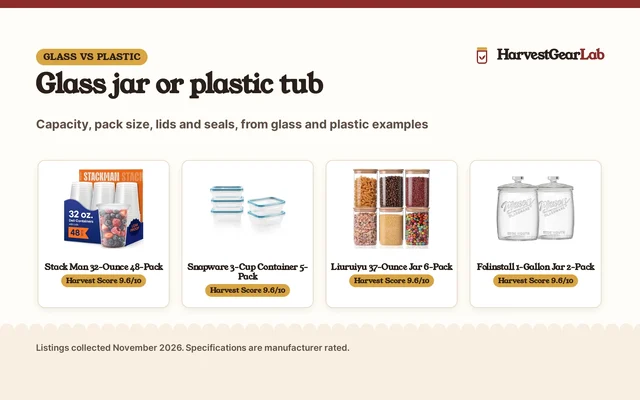
 Folinstall 1 Gallon Glass Jar with Airtight Lid9.6/10View on Amazon
- 2
 FastRack 1 Gallon Glass Jar with Lid9.6/10View on Amazon
- 3
 Fermentaholics Certified Organic Vinegar Pickling Kit9.5/10View on Amazon
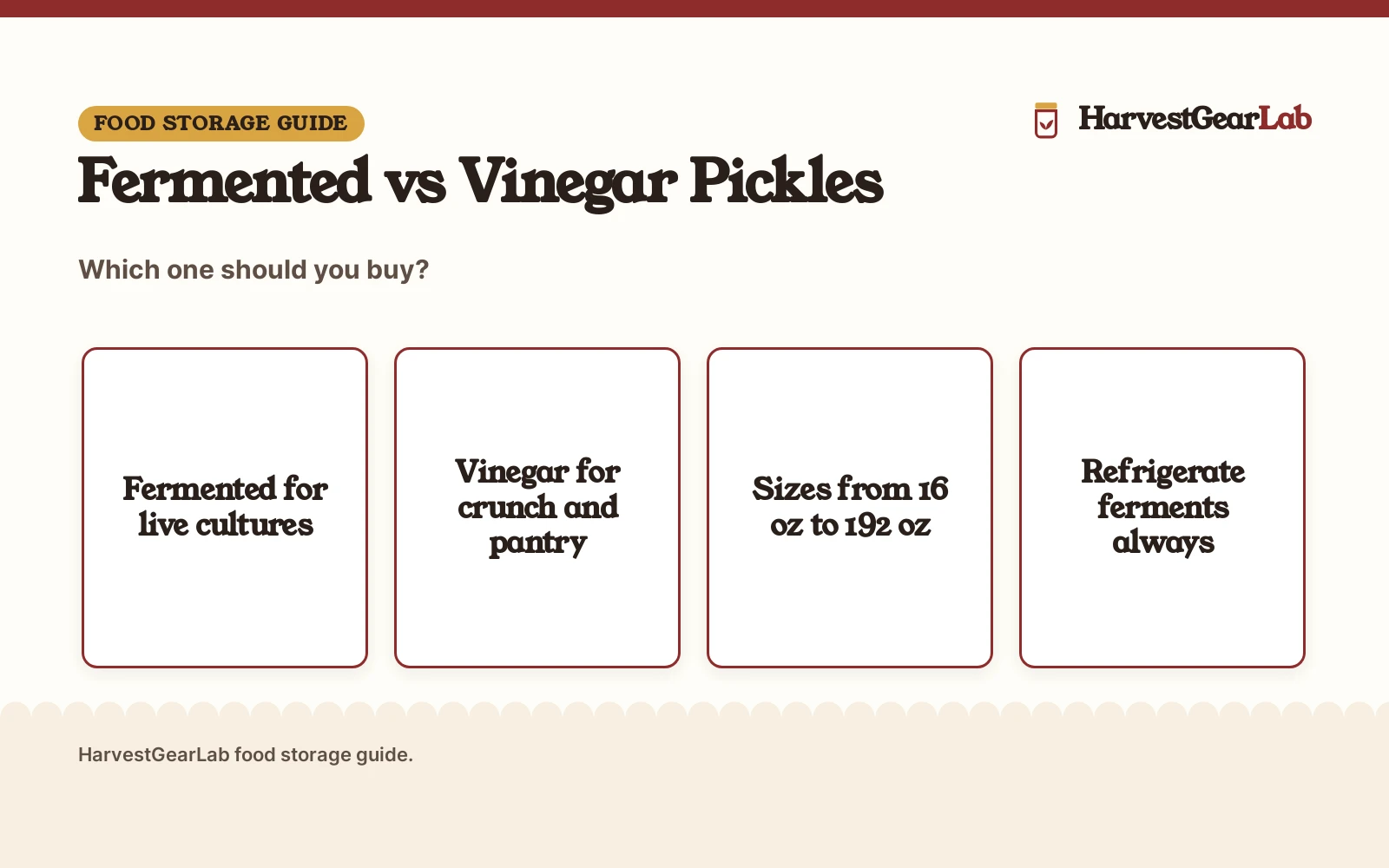
The fermented vs vinegar pickles question has a short answer: buy fermented pickles for live cultures and deep, tangy flavor, and buy vinegar pickles for crisp texture and pantry storage. Fermented pickles like Bubbies (33 oz) and Olive My Pickle (32 oz bags) list probiotics and digestive enzymes; vinegar pickles like the 365 organic spears (24 fl oz) are heat-processed and shelf-stable. This guide explains how each is made, how they taste, how to store them and which to make at home. Where a number appears, it comes from a product listing we compared.
HarvestGearLab earns a commission when you buy through links on this page, at no extra cost to you. As an Amazon Associate I earn from qualifying purchases. Affiliate disclosure.
Fermented vs vinegar pickles: which one should you buy?
Buy fermented pickles if you want live cultures: the Olive My Pickle bundles and the Wise Goat sauerkraut list probiotics right on the label. Buy vinegar pickles if you want crunch and convenience: they keep in the pantry until opened and taste the same jar after jar. For a first batch at home, vinegar pickles are the easier start; fermentation rewards patience with flavor no vinegar jar matches.
| Fermented pickles | Vinegar pickles | |
|---|---|---|
| How made | Salt brine, live cultures | Vinegar brine, heat-processed |
| Probiotics (listings) | Yes: Olive My Pickle, Wise Goat | Not stated |
| Example sizes | 32 oz bags, 33 oz jars, 16 oz jars | 24 fl oz, 32 fl oz |
| Storage | Refrigerated | Pantry until opened |
| Flavor | Tangy, complex | Sharp, consistent |
What fermented pickles are
Fermented pickles are cucumbers (or cabbage, beets, kimchi) preserved in salt brine by live bacteria, no vinegar involved. The listings show the category well: Olive My Pickle sells fermented kosher dill in 32 oz bags, in 96 oz 3-packs and 192 oz 6-packs, listing probiotics and digestive enzymes; Bubbies sells a 33 oz jar of kosher dills; Wise Goat sells 16 oz jars of raw organic fermented sauerkraut listing vegan, gluten-free, non-GMO and probiotic; Cleveland Kitchen sells 16 oz lightly fermented kimchi pickle chips. The cultures do the preserving, and they keep working in the jar, which is why fermented pickles live in the fridge.
What vinegar pickles are
Vinegar pickles are vegetables packed in a vinegar brine and heat-processed, which stops all biological activity. The 365 organic kosher dill spears (24 fl oz, USDA organic) and Grillo’s pickles (32 fl oz) are the listing examples. Nothing is alive in the jar, so they sit in the pantry for months and taste identical every time. The trade is flavor depth: vinegar gives a clean, sharp sourness, but none of the funky complexity of a ferment.
Flavor and texture
Fermented pickles taste tangy and layered; the flavor keeps developing in the jar. Vinegar pickles taste bright and predictable, and they stay crisper, because the heat process firms the vegetable while fermentation slowly softens it. If crunch is the priority, buy vinegar. If character is the priority, buy fermented. The Cleveland Kitchen kimchi chips split the difference, lightly fermented for crunch with a fermented edge.
Storage and shelf life
Vinegar pickles are the pantry champions: sealed, heat-processed jars keep at room temperature until opened. Fermented pickles need the cold chain: refrigeration slows the cultures so the pickles hold their flavor instead of turning soft and over-sour. Once opened, both types live in the fridge. Buy fermented in sizes you will finish: a 192 oz 6-pack is a commitment, while 16 oz jars suit small households.
What the labels tell you
Look for the words that matter. “Fermented” and “probiotic” on the Olive My Pickle and Wise Goat listings mean live cultures. “Raw” on the Wise Goat means unpasteurized, so the cultures survived. Vinegar pickle labels list vinegar in the brine and no culture claims. If a label says neither, it is almost certainly a vinegar pickle.
Which to make at home
Vinegar pickles are the beginner project: pack vegetables in hot vinegar brine, process the jars, done. Fermentation needs salt, time and attention to temperature, plus gear like weights and airlocks. Start with vinegar pickles for quick results; graduate to ferments when you want the hobby. For gear, see our pickle jar for fermenting picks and the fermenting vs canning vegetables guide.
In the Preserving Kitchen
- Buy fermented for live cultures; buy vinegar for crunch and pantry storage.
- Read the label: “probiotic” and “raw” mean live cultures survived.
- Keep fermented pickles refrigerated; vinegar pickles keep in the pantry until opened.
- Match the jar size to the household: 16 oz jars for small kitchens, multi-packs for big ones.
FAQ: preserving at home
Are fermented pickles probiotic?
The Olive My Pickle and Wise Goat listings say so, listing probiotics and, on the Olive My Pickle, digestive enzymes. Vinegar pickles make no such claim.
Do vinegar pickles need refrigeration?
Not until opened. Heat-processed vinegar pickles are shelf-stable; fermented pickles need refrigeration from the start.
What sizes do these pickles come in?
The listings run 16 oz jars to 33 oz jars, 32 oz bags, and multi-packs of 96 oz and 192 oz.
More preserving guides
Also see our fermenting vs canning vegetables. Also see our best pickle jar for fermenting. Also see our fermentation kit vs fermentation crock.
More picks: fermentation weights for crocks, canning labels for pickles and fermentation weights vs airlock lids.