
On this page
Top picks at a glance
As an Amazon Associate I earn from qualifying purchases.
- 1
 Cuisipro Deluxe Stainless Steel Food Mill9.7/10View on Amazon
- 2
 Küchenprofi Stainless Steel Food MillView on Amazon
- 3
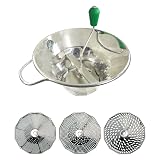 Louis TellierView on Amazon
- 4
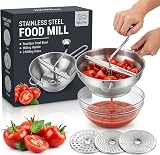 Food Mill with 3 Grinding Milling DiscsView on Amazon
- 5
 Hungry Artisan 3-Disc Food Mill for ApplesauceView on Amazon
- 6
 Mirro 50024 Foley Stainless Steel Healthy Food Mill CookwareView on Amazon
Food mill vs food processor is really a question about what you want to skip: the mill purees and strains in one step, holding back skins and seeds, while the processor chops and blends but leaves the skins and seeds in. For smooth applesauce and tomato sauce, the mill does the job the processor cannot; for everything else, the processor is faster.
Runners-up to consider
 Küchenprofi Stainless Steel Food MillCheck price on Amazon
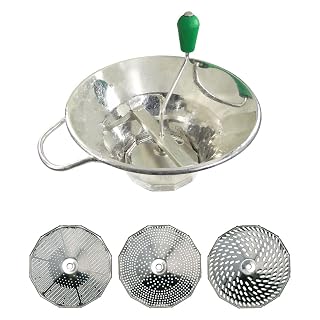 Louis TellierCheck price on Amazon
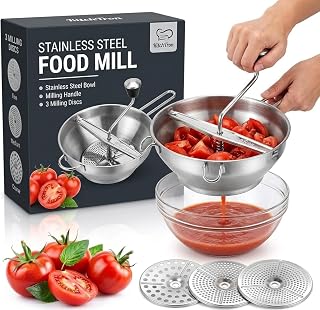 Food Mill with 3 Grinding Milling DiscsCheck price on Amazon
 Hungry Artisan 3-Disc Food Mill for ApplesauceCheck price on Amazon
 Mirro 50024 Foley Stainless Steel Healthy Food Mill CookwareCheck price on Amazon
HarvestGearLab earns a commission when you buy through links on this page, at no extra cost to you. As an Amazon Associate I earn from qualifying purchases. Affiliate disclosure.
Food mill vs food processor: the short answer
A food mill pushes cooked food through perforated discs so puree falls through and skins and seeds stay behind; a food processor blades everything into smaller pieces, skins included. Mills suit sauce making; processors suit chopping, mixing and small prep jobs. If the goal is smooth applesauce without peeling, the mill wins.
What a food mill does
A food mill is a hand-cranked bowl with interchangeable discs. Cooked tomatoes or apples go in, the crank turns, and strained puree comes out while skins and seeds stay in the bowl. The Louis Tellier N.3 listing gives a 5 Qt capacity, 3 discs of 1.5, 2.5 and 4 mm, and up to 3.3 lbs/min; the commercial N.5 listing doubles the milling to up to 11 lbs/min with a 3 mm disc. Disc sizes set texture: the Küchenprofi listing names discs of 1.3 mm, 2.5 mm, 3 mm and 5 mm, from extra fine to coarse. Mills double as mashers and ricers for potatoes. For canning-oriented mills, our food mill for canning guide compares options.
What a food processor does
A food processor is an electric chopper: blades spin in a bowl and everything becomes smaller pieces. The Cuisinart SG-10 listing in the reference set rates a small electric grinder at 200 watts with a 90 g capacity and a 16 ounce item weight, which shows the scale: processors suit prep batches, not harvest batches. A processor makes chunky salsa and pesto quickly, but it cannot separate skins and seeds, so tomato sauce needs peeling or straining afterward.
Applesauce texture: the deciding factor
This is where the two tools split. Run cooked apples through a food mill with a fine disc and you get smooth applesauce with the skins held back; no peeling needed. Run the same apples through a processor and you get chunky sauce with bits of skin, unless you peel first. The mill’s straining step is the difference. For the jars the sauce goes into, our canning jars for applesauce guide compares options.
Which one for your kitchen
Count the sauce first. Occasional small batches of sauce suit a mill: the Küchenprofi at 0.4 kg and 15.5 by 8.75 by 4.75 inches is bowl-sized. Big harvests suit electric straining: the VEVOR listing rates 800W max with 300W rated power and 88 lbs/H throughput through screens of 1, 1.5, 3 and 6 mm. Everyday chopping suits a processor. Many kitchens own both: the mill for sauce season, the processor for daily prep.
| Feature | Food mill | Food processor |
|---|---|---|
| Separates skins and seeds | Yes, one step | No, chop only |
| Batch speed | Up to 11 lbs/min (Louis Tellier N.5) | Quick, small batches (90 g grinder listed) |
| Texture control | Discs from 1.3 to 5 mm (Küchenprofi) | Blade time, one texture |
| Power | Hand crank or 300W rated electric | Electric (200W small grinder listed) |
| Other uses | Mashing, ricing, applesauce | Chopping, mixing, pesto |
What this guide does not cover
This guide covers mills and processors only, not the canners and jars that turn sauce into shelf goods, and it gives no recipes or processing times. Follow current USDA and National Center for Home Food Preservation guidance for those. For peeling the apples first, our apple peeler for canning applesauce guide lists options.
FAQ: preserving at home
Can a food processor replace a food mill for applesauce?
Only for chunky sauce: a processor cannot separate skins and seeds, so smooth applesauce needs peeling first or a mill afterward.
What disc size should I use for smooth sauce?
The Küchenprofi listing offers discs from 1.3 mm (extra fine) to 5 mm (coarse); the Louis Tellier N.3 includes 1.5, 2.5 and 4 mm discs. Finer discs give smoother sauce.
How fast can a food mill process?
The Louis Tellier N.3 listing states up to 3.3 lbs/min and the commercial N.5 up to 11 lbs/min; the VEVOR electric strainer rates 88 lbs/H.
Does a food mill work on raw produce?
Mills generally want cooked, softened food to crank easily. Processors handle raw produce for chopping.
More preserving guides
See every food mills guide and all harvest and processing guides.
More picks: best food mill, food mill for tomato sauce and stainless steel food mill for canning.