
On this page
Top picks at a glance
As an Amazon Associate I earn from qualifying purchases.
- 1
 Cuisipro Deluxe Stainless Steel Food Mill9.7/10View on Amazon
- 2
 Weston 1 Gallon Tomato Strainer with 1.5mm Screen and Dual9.7/10View on Amazon
- 3
 Cuisinart 3-Piece Stainless Steel Mesh Strainer Set9.6/10View on Amazon
- 4
 Küchenprofi Stainless Steel Food MillView on Amazon
- 5
 Louis TellierView on Amazon
- 6
 Weston Deluxe Electric Tomato StrainerView on Amazon
- 7
 Hungry Artisan 3-Disc Food Mill for ApplesauceView on Amazon
- 8
 Stainless Steel Food Mills With 3 Milling DiscsView on Amazon
- 9
 Stainless Steel Food Mill With 3 Milling DiscsView on Amazon
Food mill vs tomato strainer comes down to how much sauce you make and how you like to work. A food mill is a hand-cranked bowl with perforated discs that purees and strains in one step; a tomato strainer (also called a sauce maker) separates skins and seeds from pulp, often faster and in bigger batches. For a few pots of sauce, a food mill does the job; for bushels of tomatoes, a strainer keeps up.
Runners-up to consider
 Küchenprofi Stainless Steel Food MillCheck price on Amazon
 Louis TellierCheck price on Amazon
 Weston Deluxe Electric Tomato StrainerCheck price on Amazon
 Hungry Artisan 3-Disc Food Mill for ApplesauceCheck price on Amazon
 Stainless Steel Food Mills With 3 Milling DiscsCheck price on Amazon
 Stainless Steel Food Mill With 3 Milling DiscsCheck price on Amazon
HarvestGearLab earns a commission when you buy through links on this page, at no extra cost to you. As an Amazon Associate I earn from qualifying purchases. Affiliate disclosure.
Food mill vs tomato strainer: the short answer
A food mill purees cooked food through interchangeable discs while holding back skins and seeds; a tomato strainer presses raw or cooked tomatoes through a screen to separate juice and pulp from skins and seeds. Mills suit small batches and many foods; strainers suit big tomato harvests. If you only make sauce once a year, the mill is the simpler buy.
What a food mill does
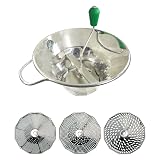
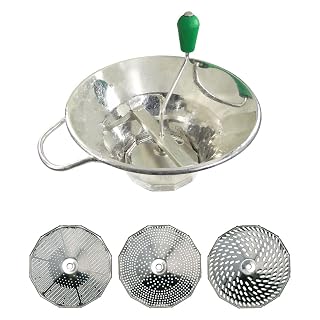
A food mill is a bowl with a hand crank and a perforated disc at the bottom. You load cooked tomatoes, apples or potatoes, turn the crank, and puree falls through while skins and seeds stay behind. Disc sizes set the texture: the Küchenprofi listing names discs of 1.3 mm, 2.5 mm, 3 mm and 5 mm, from extra fine to coarse. Capacities stay modest: one listing gives 2Qt/2L, and a Louis Tellier listing gives an 8-quart capacity that rests on pots and bowls from 10-1/4 in to 24 in in diameter. Mills are also mashers and ricers, so one tool covers potatoes, applesauce and baby food. For grain milling, which is a different job, see our food mill for grains guide.
What a tomato strainer does
A tomato strainer is built for one job: turning lots of tomatoes into sauce fast. Manual models clamp to the table and crank tomatoes through a screen; electric models do it with a motor. The VEVOR listing rates its electric tomato strainer at 800W max with a rated power of 300W and a throughput of 88 lbs/H. That speed is the whole point: where a mill handles pot-sized batches, a strainer keeps pace with a big harvest day. Strainers also work for berries, salsa and purees, but they are single-purpose tools that need storage space the rest of the year.
Which one for your harvest
Count the tomatoes first. A few plants for fresh eating and a pot of sauce now and then suit a food mill: it is cheaper, smaller and useful year-round. A big paste-tomato bed meant for dozens of jars suits a strainer, especially an electric one rated by the hour. Many keepers own both: the mill for small jobs and the strainer for harvest weekend. For the jars the sauce goes into, our mason jars for tomato sauce guide compares options.
| Feature | Food mill | Tomato strainer |
|---|---|---|
| Batch size | 2Qt/2L to 8-quart bowls (listings) | Up to 88 lbs/H electric (VEVOR) |
| Texture control | Discs from 1.3 mm to 5 mm (Küchenprofi) | Screen, one texture per pass |
| Power | Hand crank | Manual or electric (300W rated) |
| Other uses | Mashing, ricing, applesauce | Berries, salsa, purees |
| Storage | Bowl-size, nests in a pot | Bulky, single-purpose |
What this guide does not cover
This guide covers mills and strainers only, not the canners, jars and lids that turn sauce into shelf goods. It gives no recipes, processing times or pressures; follow current USDA and National Center for Home Food Preservation guidance for those. For the hand tools around the pot, our tools for canning tomatoes guide lists the rest.
FAQ: preserving at home
Can a food mill replace a tomato strainer?
For small batches, yes: a mill purees and strains in one step. For big harvests, a strainer like the VEVOR at 88 lbs/H keeps pace far better.
What disc size should I use for tomato sauce?
The Küchenprofi listing offers discs from 1.3 mm (extra fine) to 5 mm (coarse). Finer discs give smoother sauce; coarser discs pass pulp faster.
Do tomato strainers work on uncooked tomatoes?
Strainers press raw or cooked tomatoes through a screen to separate skins and seeds. Mills generally want cooked, softened food to crank easily.
How much power does an electric tomato strainer use?
The VEVOR listing rates 800W max with a rated power of 300W.
More preserving guides
See every food mills guide and all harvest and processing guides.
More picks: tomato strainer for sauce, tomato strainer for Kitchenaid and electric tomato juicer for canning.