
On this page
Top picks at a glance
As an Amazon Associate I earn from qualifying purchases.
- 1
 NutriMill Harvest Electric Stone Grain Mill9.8/10View on Amazon
- 2
 Grain Mill Grinder 750g High Speed Electric Stainless SteelView on Amazon
- 3
 Kitchen Crop Grain Mill Wheat Flour GrinderView on Amazon
- 4
 Grain Mill 550gView on Amazon
Grain mill vs blender for flour comes down to fineness and volume: a grain mill grinds whole grain into consistent flour with adjustable settings, while a blender can grind small batches but gives a coarser, less even result. Pick the mill if you bake with fresh flour regularly, and pick the blender for the occasional small batch.
Runners-up to consider
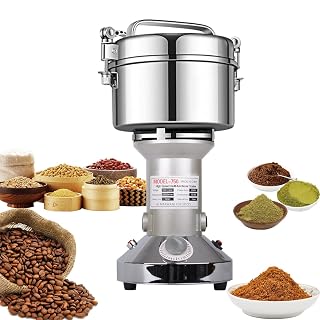 Grain Mill Grinder 750g High Speed Electric Stainless SteelCheck price on Amazon
 Kitchen Crop Grain Mill Wheat Flour GrinderCheck price on Amazon
 Grain Mill 550gCheck price on Amazon
HarvestGearLab earns a commission when you buy through links on this site, at no extra cost to you. As an Amazon Associate I earn from qualifying purchases. Affiliate disclosure.
What a grain mill does
A grain mill crushes whole grain between burrs or plates into flour. The KitchenAid KGM attachment fits any household KitchenAid stand mixer, offers 12 grind levels from coarse to fine, and holds 10 cups. The listing says it grinds low-moisture grains such as wheat, corn and rice, and includes a cleaning brush. Mills are built for this one job, so the grind stays even batch after batch.
What a blender does
A blender spins blades at high speed to pulverize whatever is in the jar. The Hamilton Beach Power Elite lists 700 watts, 12 functions and a 40-ounce glass jar, while the BLACK+DECKER lists 552 watts at peak and a 48-ounce jar. That power handles smoothies and ice, but flour needs a fine, even grind that blades struggle to give: the result runs coarser and the jar heats up with long runs.
Grain mill vs blender for flour: side by side
| Grain mill | Blender | |
|---|---|---|
| Grind | Adjustable; 12 levels on the KitchenAid KGM | One speed range, coarser result |
| Batch size | 10 cups in the KGM hopper | 40 to 48 oz jars |
| Heat | Low | Blades warm the flour on long runs |
| Best for | Regular flour making | Occasional small batches |
How fine can each go
Fineness is the mill’s whole point: the KitchenAid KGM lists 12 grind levels, so you can dial from cracked grain to fine flour. A blender has no grind setting, only speed, so flour comes out uneven no matter how long you run it. If your recipe needs fine flour, the mill wins.
Which one fits your baking
Bake weekly with fresh flour and the mill pays for itself in consistency: the KGM’s 12 levels and 10-cup capacity cover a bread batch. Bake rarely and the Hamilton Beach’s 700 watts already in your kitchen can grind a cup of grain in a pinch. For storing what you grind, see our mylar bags for flour storage picks.
Read the blender’s specs before grinding grain
If the blender route tempts you, check its figures first. The Hamilton Beach Power Elite lists 700 watts, 12 functions, a 40-ounce glass jar, 5.6 pounds and a 3-year warranty, while the BLACK+DECKER lists 552 watts at peak, a 48-ounce jar and 10-speed settings at 6.3 pounds. A full-size jar and several hundred watts suit the occasional flour batch far better than a small stick blender: the Bonsenkitchen immersion blender lists 500 watts and 20 speeds with turbo mode, and the UTALENT lists 300 watts with an ETL listing, but both are built for sauces and soups, not grain. Grain is hard on blades and motors, so grind in short bursts and let the motor rest between them.
Warranties tell you what the maker expects the machine to survive. The Hamilton Beach blender lists a 3-year warranty, the BLACK+DECKER a limited warranty, and the KitchenAid KGM mill a hassle-free 1-year warranty. Using a machine for grain it was not designed for may fall outside its warranty terms, so check before you start.
The mill needs a mixer first
The KitchenAid KGM is an attachment, not a standalone mill: it fits any household KitchenAid stand mixer, so the mill only makes sense if you own or plan to buy the mixer. Its listing describes 12 grind levels from coarse to fine, a 10-cup hopper, low-moisture grains such as wheat, corn and rice, and a cleaning brush in the box. For reference, the Kitchen in the box stand mixer lists 3.2 quarts, 300 watts and 6 speeds: a different machine from a different maker, included here only to show what a small mixer looks like on paper. Match the mill to a mixer you already run every week.
FAQ: preserving at home
Can a blender make flour?
Yes, in small batches, but the grind is coarser and less even than a mill’s. The Hamilton Beach lists 700 watts and a 40-ounce jar for general blending.
What grains can the KitchenAid mill grind?
The listing says low-moisture grains such as wheat, corn and rice, from coarse to fine across 12 grind levels.
Does a blender overheat when grinding grain?
Long runs warm the jar and the flour. A mill grinds cooler because it crushes rather than whipping at blade speed.
Do I need a stand mixer for the KitchenAid mill?
Yes. The KGM is an attachment that fits any household KitchenAid stand mixer; it is not a standalone mill.
More preserving guides
See every grain mill guide and all harvest and processing guides.
More picks: hand crank vs electric grain mill, grain mill for rye flour and grain mill for barley.