
On this page
Top picks at a glance
As an Amazon Associate I earn from qualifying purchases.
- 1
 MARCATO Atlas 1509.7/10View on Amazon
- 2
 MZTOGR 3-in-1 Pasta Maker9.6/10View on Amazon
- 3
 WICHEMI Electric Pasta Maker9.6/10View on Amazon
- 4
 GVODE Electric Pasta Maker9.6/10View on Amazon
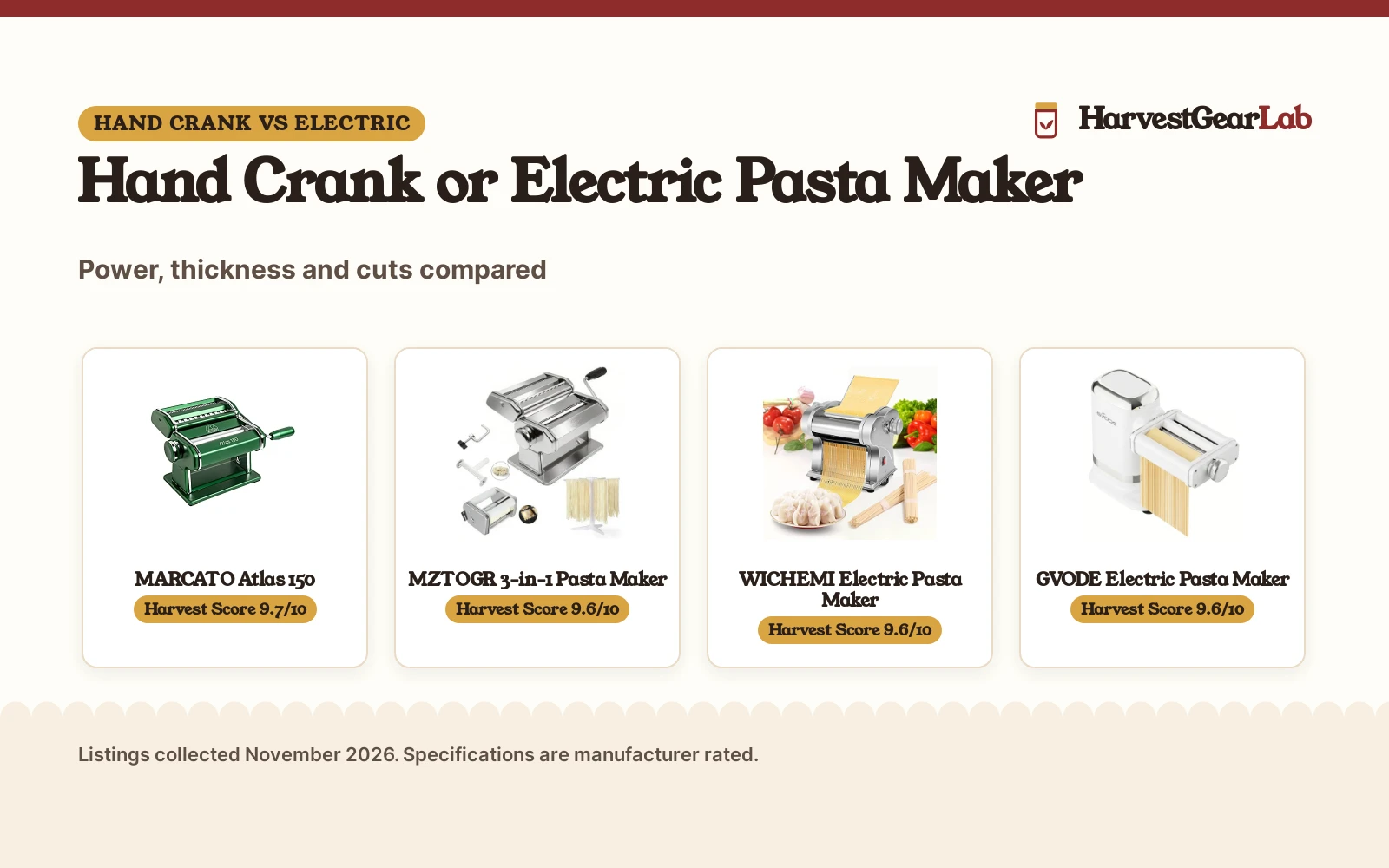
Hand crank vs electric pasta maker is a choice between arm work and motor work, and the right side depends on how much pasta the kitchen makes. A hand crank machine rolls dough with a handle and a clamp that grips the counter edge, while an electric machine rolls and cuts with a motor and a switch.
HarvestGearLab earns a commission when you buy through links on this page, at no extra cost to you. As an Amazon Associate I earn from qualifying purchases. Affiliate disclosure.
Quick verdict: choose a hand crank machine for small batches and control over the roll; the MARCATO Atlas 150 example rolls dough up to 150 millimeters wide in 10 thicknesses and carries a 10-year warranty. Choose an electric machine for frequent pasta and motor rolling; the GVODE example runs at 700W maximum power with 8 thickness settings, while the WICHEMI example runs at 135W and cuts 1.5mm and 4mm flat noodles.
The pasta makers
| # | Product | Harvest Score | Buy |
|---|---|---|---|
| 1 | MARCATO Atlas 150 | 9.7/10 | Buy on Amazon |
| 2 | MZTOGR 3-in-1 Pasta Maker | 9.6/10 | Buy on Amazon |
| 3 | WICHEMI Electric Pasta Maker | 9.6/10 | Buy on Amazon |
| 4 | GVODE Electric Pasta Maker | 9.6/10 | Buy on Amazon |

MARCATO Atlas 150
A hand crank pasta machine made in Italy that rolls dough up to 150 millimeters wide in 10 thicknesses and cuts 3 pasta shapes, with a 10-year warranty.
Pros
- Rolls dough up to 150 millimeters wide with 10 thicknesses from 0.6 to 4.8 millimeters
- Makes 3 pasta shapes and takes a Pasta Drive motor and 12 cutting accessories
- Made in Italy, with a hand crank, clamp and instructions included
- 10-year manufacturer's warranty is stated
Cons
- Hand crank only, so rolling is manual work
- Pasta Drive motor is sold separately
- 12 cutting accessories are sold separately
- No drying rack is included

MZTOGR 3-in-1 Pasta Maker
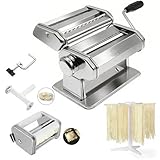
A hand crank 3-in-1 pasta maker with 9 thickness settings from 0.5mm to 2.5mm, a dual cutter, a ravioli attachment and a drying rack.
Pros
- 9 thickness settings from 0.5mm to 2.5mm with an easy-lock dial
- 3-in-1 kit with a roller, dual cutter, ravioli attachment and drying rack
- Dual cutter gives 2mm spaghetti and 7mm fettuccine, plus 3cm square ravioli
- Stainless steel body with carbon steel rollers and a clamp for steady rolling
Cons
- Hand crank only, so rolling is manual work
- No warranty term is stated
- Ravioli attachment makes 3cm square ravioli only
- The thinnest setting is 0.5mm, so thinner sheets are out of reach

WICHEMI Electric Pasta Maker
An electric 2-in-1 pasta maker in 304 food grade stainless steel that presses dough and cuts 1.5mm and 4mm flat noodles at 135W.
Pros
- 2-in-1 electric machine presses dough and cuts noodles automatically
- 304 food grade stainless steel body that resists rust
- Cuts 1.5mm and 4mm flat noodles, and makes dumpling and wonton skins
- Rated efficiency of 11 lb/h at 135W, with a one key switch
Cons
- 16 pounds, the heaviest machine in this guide
- 135W, the lowest power in this guide
- Only 1.5mm and 4mm flat noodle cuts
- Rated for a 110V US plug, so the outlet must match

GVODE Electric Pasta Maker
An electric pasta maker with 700W maximum power, 8 thickness settings from 0.4 to 2 mm, two speeds plus reverse, and metal drive gears.
Pros
- 700W maximum power with two speeds plus reverse
- 8 thickness settings from 0.4 to 2 mm for angel hair to lasagna sheets
- Metal drive gears hold roller alignment batch after batch
- Compact size lifts onto the counter and back into a cupboard
Cons
- Plastic housing instead of a steel body
- Runs in 15-minute batches with a 5-minute cool-down between
- No warranty term is stated
- No drying rack is included
As an Amazon Associate I earn from qualifying purchases.
Runners-up to consider
 3-in-1 Pasta MakerCheck price on Amazon
 Sailnovo 3-in-1 Pasta Maker with 9-Setting Pasta Roller &Check price on Amazon
 Pasta Maker DeluxeCheck price on Amazon
 Dyna-Living 135W Electric Pasta Maker Thickness AdjustableCheck price on Amazon
 Shule Electric Pasta Maker with MotorCheck price on Amazon
 Pasta Maker Attachment for Kitchenaid/ Cuisinart MixersCheck price on Amazon
Hand crank vs electric pasta maker: side by side
| Pasta maker | Harvest Score | Side | Power | Thickness | Cuts | Weight | Amazon |
|---|---|---|---|---|---|---|---|
| MARCATO Atlas 150 | 9.7/10 | Hand crank | Manual | 0.6 to 4.8 mm | 3 pasta shapes | 3.0 lb | View on Amazon |
| MZTOGR 3-in-1 Pasta Maker | 9.6/10 | Hand crank | Manual | 0.5 to 2.5 mm | 2mm, 7mm, ravioli | Not stated | View on Amazon |
| WICHEMI Electric Pasta Maker | 9.6/10 | Electric | 135W | 1 to 3.5 mm dough | 1.5mm and 4mm flat noodles | 16 lb | View on Amazon |
| GVODE Electric Pasta Maker | 9.6/10 | Electric | 700W | 0.4 to 2 mm | Spaghetti, fettuccine, lasagna | Around 8 lb | View on Amazon |
Specs below are what each maker states on its listing (gathered 14 November 2026).
What each side is for
A hand crank machine needs no power outlet: the MZTOGR listing says no electricity is needed, and the clamp holds the machine to the counter edge while the cook turns the handle. That suits a kitchen that makes pasta now and then, or a cook who wants to feel the dough thin with each pass. The MARCATO Atlas 150 adds a Pasta Drive motor mount, so it can gain a motor later, sold separately.
An electric machine trades the handle for a switch. The GVODE machine runs at 700W maximum power with two speeds plus reverse, so dough that bunches can back out of the rollers, and the WICHEMI machine runs at 135W with a one key switch for pressing dough and cutting noodles. That suits a kitchen that makes pasta often. Both electric listings need a power outlet, and the WICHEMI listing names a 110V US plug.
Thickness and cuts
Thickness settings decide how thin a sheet goes. The MARCATO Atlas 150 rolls dough up to 150 millimeters wide with 10 thicknesses from 0.6 to 4.8 millimeters. The MZTOGR machine gives 9 settings from 0.5mm to 2.5mm with an easy-lock dial, and the GVODE machine gives 8 settings from 0.4 to 2 mm. The WICHEMI machine makes 1.5mm and 4mm flat noodles, and dumpling and wonton skins from dough of 1 to 3.5 mm.
The MZTOGR dual cutter gives 2mm spaghetti and 7mm fettuccine cuts, plus a ravioli attachment for 3cm square ravioli with wavy edges. The MARCATO machine makes 3 pasta shapes and takes 12 cutting accessories, sold separately. The GVODE machine cuts spaghetti, fettuccine and lasagna sheets, and dough goes through the sheet roller 3-4 times on progressively thinner settings before cutting. The WICHEMI machine cuts 1.5mm and 4mm flat noodles with a built-in knife.
Power, weight and the counter
Power is the clearest split. The GVODE machine lists 700W maximum power, and the WICHEMI machine lists 135W, with a rated efficiency of 11 lb/h. The hand crank machines list no watts, since the cook supplies the power.
Weight and size decide where the machine lives. The MARCATO Atlas 150 weighs 3.0 pounds and measures 8.0 by 5.5 by 8.0 inches. The WICHEMI machine weighs 16 pounds and measures 8.66 by 7.87 by 8.46 inches, the heaviest machine in this guide, and its 304 food grade stainless steel body suits a fixed spot. The GVODE machine has a plastic housing and metal drive gears, and it lifts onto the counter and back into a cupboard without a struggle.
Listing gaps to check
Only the MARCATO Atlas 150 states a 10-year manufacturer’s warranty; the MZTOGR, GVODE and WICHEMI listings state none. The GVODE maker gives two weights, around 8 lb and 5.24 pounds, so this guide uses 8 lb. The WICHEMI maker gives two sizes, 8.66 by 7.87 by 8.46 inches and 1.13 by 0.94 by 0.96 inches, so this guide uses the larger size.
Which should you choose?
Choose a hand crank machine if the kitchen makes pasta in small batches, the cook wants control over each pass and no outlet is needed. Compare more hand crank options in the best pasta making machine guide.
Choose an electric machine if the kitchen makes pasta often and wants the motor to do the rolling, with two speeds and reverse. Start with the best electric pasta maker guide.
Whichever side wins, add a drying rack; the best pasta drying rack for home kitchen guide lines up the racks.
In the Preserving Kitchen
- Clamp each hand crank machine to a counter edge before rolling, so it stays steady while the handle turns.
- Wipe the MARCATO machine with a dry brush or cloth after rolling, and wipe the GVODE smooth shell in one pass.
- Keep the vents on the GVODE motor base clear while the motor runs.
- Store the GVODE machine in a cupboard between batches, and keep the MZTOGR drying rack with it.
How the Harvest Score played out
| Product | Harvest Score | Perf. /35 | Build /25 | Value /25 | Safety /10 | Warranty /5 |
|---|---|---|---|---|---|---|
| MARCATO Atlas 150 | 9.7 | 32 | 22 | 20 | 5 | 3 |
| MZTOGR 3-in-1 Pasta Maker | 9.6 | 30 | 21 | 21 | 5 | 0 |
| WICHEMI Electric Pasta Maker | 9.6 | 29 | 21 | 20 | 6 | 0 |
| GVODE Electric Pasta Maker | 9.6 | 30 | 20 | 20 | 5 | 0 |
Point totals are rescaled to the 9.2 and 9.8 end points in a straight line, so two tools keep the same order they earned on points.
The Harvest Score weighs performance, build, value, safety and warranty. For pasta makers, safety covers the clamp that holds a hand crank machine steady, the food grade steel on the WICHEMI body, the reverse gear on the GVODE machine, and the vents that must stay clear. The MARCATO machine leads on warranty with its 10-year term, and the MZTOGR machine leads on value with its 3-in-1 kit and drying rack. How we pick explains the weights.
FAQ: preserving at home
Do hand crank pasta makers need electricity?
No. The MZTOGR listing says no electricity is needed, and the MARCATO Atlas 150 runs from a hand crank and a clamp. Both machines roll dough by hand.
How thin can each machine roll dough?
The MARCATO Atlas 150 rolls 0.6 to 4.8 millimeters in 10 thicknesses, the MZTOGR machine 0.5mm to 2.5mm in 9 settings, and the GVODE machine 0.4 to 2 mm in 8 settings. The WICHEMI machine makes dumpling and wonton skins from dough of 1 to 3.5 mm.
Which electric pasta maker has more power?
The GVODE machine lists 700W maximum power, against 135W for the WICHEMI machine.
Can an electric pasta maker cut different noodle widths?
Yes. The WICHEMI machine cuts 1.5mm and 4mm flat noodles with a built-in knife, and the GVODE machine cuts spaghetti, fettuccine and lasagna sheets.
Does any pasta maker in this guide carry a warranty?
Only the MARCATO Atlas 150, with a 10-year manufacturer’s warranty stated; the others state no warranty term.
More preserving guides
See every pasta makers guide and all bread and pasta making guides.
More picks: automatic pasta makers, pasta maker attachment vs standalone, pasta roller vs extruder and do you need a pasta drying rack.