
On this page
Top picks at a glance
As an Amazon Associate I earn from qualifying purchases.
- 1
 Overnight Oats Containers with LidsView on Amazon
- 2
 ComSaf Flour Sugar Storage Containers 4 QtView on Amazon
- 3
 ComSaf Large Square Glass Jars with Airtight Lids 78 oz 3View on Amazon
- 4
 ComSaf Large Glass Jars with Airtight Lid 1.1 Gallon 2 PackView on Amazon
- 5
 Bormioli Rocco Fido Glass Storage JarView on Amazon
- 6
 YEBODA 16 oz Mason Jars with Lids and BandsView on Amazon
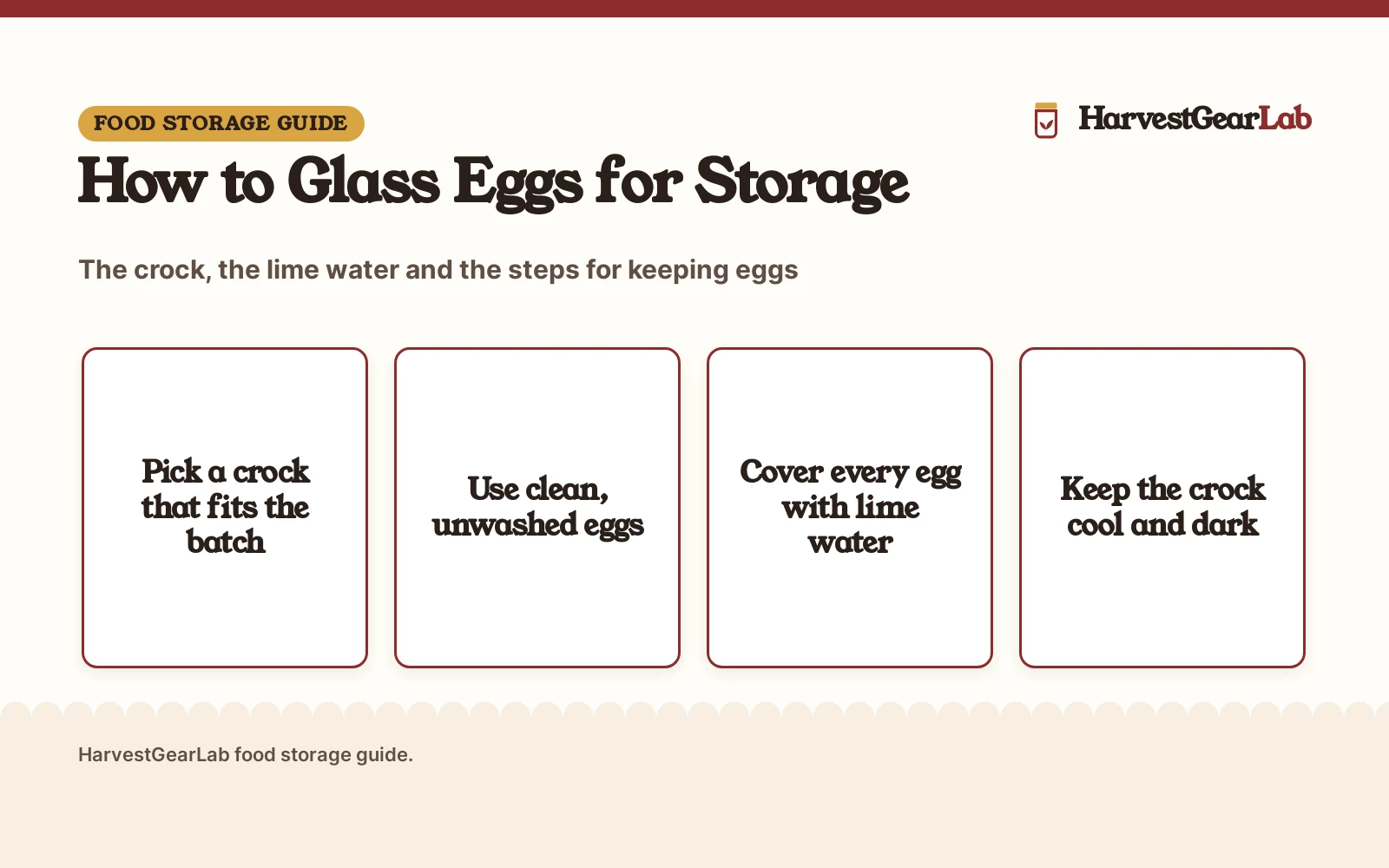
When the hens lay faster than the kitchen can use the eggs, the basket on the counter fills and the question turns to keeping the surplus for the stretch when laying slows. How to glass eggs for storage has a plain answer: set clean, unwashed eggs in a crock, cover them with lime water, and keep the crock covered in a cool, dark place. The lime water seals the shells so air stays out, and the eggs stay ready for cooking and baking while the flock rests. This guide walks through the crock, the eggs, the lime water and the checks.
Runners-up to consider
 Overnight Oats Containers with LidsCheck price on Amazon
 ComSaf Flour Sugar Storage Containers 4 QtCheck price on Amazon
 ComSaf Large Square Glass Jars with Airtight Lids 78 oz 3Check price on Amazon
 ComSaf Large Glass Jars with Airtight Lid 1.1 Gallon 2 PackCheck price on Amazon
 Bormioli Rocco Fido Glass Storage JarCheck price on Amazon
 YEBODA 16 oz Mason Jars with Lids and BandsCheck price on Amazon
HarvestGearLab earns a commission when you buy through links on this site, at no extra cost to you. As an Amazon Associate I earn from qualifying purchases. Affiliate disclosure.
How to glass eggs for storage: the short version
Water glassing is a pantry method, not a canning method: the eggs stay raw in the shell, held under lime water in a crock. The table below gives the shape of the job at a glance, and the sections after it fill in each part.
| Stage | What to do | Check |
|---|---|---|
| Crock | Pick a clean stoneware or ceramic crock with a lid | Room for the eggs and the lime water above them |
| Eggs | Use clean, unwashed eggs with sound shells | No cracks, no washing, no dirt on the shells |
| Lime water | Mix pickling lime into water and pour it over the eggs | Every egg stays under the water line |
| Storage | Set the covered crock in a cool, dark place | Water level holds and the lid stays on |
| Use | Lift out only the eggs needed for the meal | Rinse each egg before cracking it open |
Glassed eggs suit cooking and baking: take them from the crock as needed and leave the rest undisturbed under the water.
Pick a crock that fits the batch
The crock is the whole method: it must hold the eggs, hold the lime water above them, and take a lid. Stoneware preserving crocks suit the job, and the maker lists sizes that show the range. An Ohio Stoneware 3 gallon preserving crock weighs 16.0 pounds and measures 11.0 inches x 11.0 inches x 11.25 inches, while the Ohio Stoneware 4 gallon preserving crock weighs 21.0 pounds and measures 16.13 inches x 16.13 inches x 15.65 inches. The larger crock holds a bigger batch, and the heavier crock needs a firm shelf when full of water and eggs.
Small jars do not suit eggs. A 500ml ceramic fermentation jar weighs 1.15 pounds and measures 5.28 inches x 4.25 inches x 4.25 inches, which leaves no room for eggs under water. A ZHOUXIAO 9KG porcelain fermentation jar measures 20.0 Centimeters on each side, which gives more room, but a preserving crock with a wide mouth and a lid made for the job is the simpler pick.
Eggs that suit glassing
Use eggs from the flock on the day they are laid, or as close to it as the basket allows. The shell carries a natural coating that keeps air and microbes out, and washing strips that coating away, so the eggs for glassing go into the crock unwashed. Pick eggs with clean shells and no cracks: a dirty shell can be set aside for the kitchen, and a cracked shell has no place in the crock, since the lime water can seep in and spoil the batch.
Eggs from a shop have usually been washed before sale, which leaves the coating gone and the shells open to the water. Home flocks give the unwashed eggs this method needs. Keep nest boxes clean and lined so shells come in clean, and gather through the laying season so the eggs for the crock are fresh.
Lime water, step by step
Pickling lime is the mineral that turns plain water into lime water. The steps below use no heat and no special tools beyond the crock, a spoon for stirring and a clean container for mixing:
- Mix: stir pickling lime into cool water until it dissolves, then let the mix settle.
- Set: lay the clean, unwashed eggs in the crock with the narrow end down.
- Pour: pour the lime water over the eggs until the water stands above the top layer.
- Cover: set the lid on the crock and move the crock to its storage spot.
- Watch: look in on the crock now and then and top up the lime water if the level drops and eggs show above the line.
Keep the eggs under the water at all times. An egg that rises above the line loses its seal and should come out for the kitchen rather than going back under.
Where to keep the crock
A cool, dark place suits the crock: a pantry shelf, a cellar corner or a cupboard away from the stove. Heat and light work against the seal, and a spot that stays cool through the day gives the steadiest keep. Set the crock where it will not be knocked, and where the lid can stay on undisturbed between uses. A label on the crock keeps the batch clear from the rest of the pantry.
What to skip or double-check
- Heating jars in the oven: skip it. Dry oven heat is not a safe way to handle jars for canning.
- Washed eggs: do not glass eggs that have been washed, since the coating that seals the shell is gone.
- Cracked shells: check every egg before it goes in, and keep cracked eggs out of the crock.
- Eggs above the water: if an egg shows above the lime water, top up the water or lift the egg out for the kitchen.
- Cloudy water or a sour smell: if the water turns cloudy or smells off, take the eggs out and start the batch again with fresh lime water.
- Old guidance: follow current USDA and National Center for Home Food Preservation guidance for egg storage.
What this guide does not cover
This is a method guide. It does not give recipes, lime ratios, or keeping times: those belong to current USDA and National Center for Home Food Preservation guidance, to follow exactly for eggs. Every food storage guide on the site is collected in the long term storage section.
FAQ: preserving at home
What is water glassing?
Water glassing is the pantry method of keeping eggs in a crock under lime water. The lime water seals the shells so air stays out, and the eggs stay ready for cooking and baking while the flock lays less.
Do eggs need washing before glassing?
No. Glassing uses clean, unwashed eggs, since washing strips the natural coating that seals the shell. Pick eggs with clean shells, set dirty eggs aside for the kitchen, and keep cracked eggs out of the crock.
What size crock suits a household batch?
A preserving crock in the range the makers list suits a household batch: the Ohio Stoneware 3 gallon crock measures 11.0 inches x 11.0 inches x 11.25 inches, and the 4 gallon crock measures 16.13 inches x 16.13 inches x 15.65 inches. Small 500ml jars leave no room for eggs under water, so a crock is the right vessel.
How long do glassed eggs keep?
The method is meant to carry eggs through the stretch when hens lay less, and the exact span turns on the eggs, the lime water and the storage spot. Follow current USDA and National Center for Home Food Preservation guidance for egg storage rather than a fixed span.
Can glassed eggs be used for baking?
Yes. Lift out only the eggs needed, rinse each egg before cracking it open, and use them in cooking and baking as usual. An egg that sat above the water line or smells off should be set aside rather than used.
More preserving guides
See every egg storage containers guide and all long term storage guides.
More picks: egg storage containers, containers for long term food storage, mason jars for long term storage and canning jars for long term storage.