
On this page
Top picks at a glance
As an Amazon Associate I earn from qualifying purchases.
- 1
 Dwbligt 1 Gallon Glass Fermenting Jar Kit With 640g Glass9.7/10View on Amazon
- 2
 Chedin 6 Pack 304 Stainless Steel Screen Strainer Lid for9.6/10View on Amazon
- 3
 Authentic Crazy Korean Cooking Kimchi Container 0.9 GalView on Amazon
- 4
 LockandLock Press Plate Leakproof Airtight Pickle KimchiView on Amazon
- 5
 1 Gallon Glass Container with Airtight LidsView on Amazon
A crock of napa cabbage ready for salting is when the kimchi container vs mason jar question matters: a kimchi container wins for fermenting, because its adjustable inner lid presses the vegetables down and keeps air out, while a mason jar works for storage but has no pressing lid. All four listings we compared are kimchi containers built on the Korean onggi principle, so this guide compares the two ideas and then ranks the actual gear on size, lids and materials.
Runners-up to consider
 Authentic Crazy Korean Cooking Kimchi Container 0.9 GalCheck price on Amazon
 LockandLock Press Plate Leakproof Airtight Pickle KimchiCheck price on Amazon
 1 Gallon Glass Container with Airtight LidsCheck price on Amazon
HarvestGearLab earns a commission when you buy through links on this page, at no extra cost to you. As an Amazon Associate I earn from qualifying purchases. Affiliate disclosure.
Kimchi container vs mason jar: the short answer
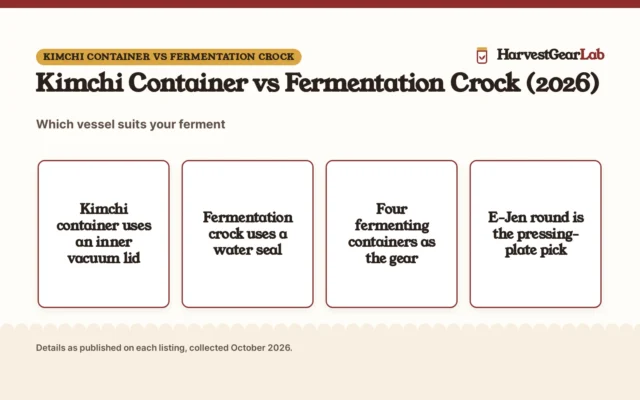
A kimchi container wins for fermenting kimchi, sauerkraut and pickled vegetables. The adjustable inner pressing lid minimizes air inside the container, which the listings say promotes the anaerobic state that benefits probiotic growth, and the double-lid design contains odors. A mason jar wins for plain storage after fermentation, or when you only make small amounts and already own the jars. None of the four listings we compared is a mason jar, which tells you what the market sells for this job.
If you want scored fermenting picks, our glass vs plastic fermentation jar comparison lines up more options.
The gear: four kimchi containers compared
| Listing | Capacity | Lids | Material note |
|---|---|---|---|
| Crazy Korean Cooking 0.9 Gal, 2 pack | 0.9 gallons (3.4L) each | Adjustable inner vacuum lid | Polypropylene with 7-10% natural clay |
| e-jen 3 liter | 3 liters | Adjustable inner pressing plate, double lids | Polypropylene, earthenware principles |
| e-jen 1.7 liter | 1.7 liters | Inner lid stated | Polypropylene, earthenware brown |
| Crazy Korean Cooking 0.4 Gal | 0.4 gallons | Adjustable inner vacuum lid | Polypropylene with 7-10% natural clay |
Crazy Korean Cooking 0.9 Gal, 2 pack
The Crazy Korean Cooking 2 pack is the most generous listing of the four: two 0.9 gallon (3.4L) containers in sandy brown, each with an adjustable inner vacuum lid that minimizes air inside and keeps food fresh. The listing says the high quality polypropylene is mixed with 7-10% natural clay for optimal porosity, following the ancient Korean onggi principle, and that the design protects the surface of the food while keeping texture and color. Two containers for the price of one listing gives it the top rank.
e-jen 3 liter
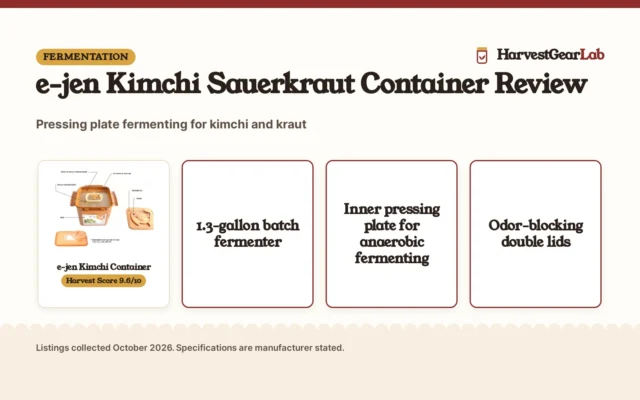
The e-jen 3 liter container lists an adjustable inner pressing plate that minimizes air inside, promoting the anaerobic state that benefits probiotic growth, plus double lids including an inner lid that contains odors. The listing describes modern technology combining ancient Korean earthenware principles with high quality polypropylene plastic, in earthenware brown. It is the largest single container here, which puts it second.
e-jen 1.7 liter
The e-jen 1.7 liter container weighs 15.2 ounces and is listed as food safe, dishwasher safe, freezer safe and microwave safe, in earthenware brown. The listing calls it essential for kimchi, pickling vegetables and sauerkraut, and notes it also stores dry goods like grains, beans, flours and pasta. The smaller size and the broadest stated safe-use list put it third.
Crazy Korean Cooking 0.4 Gal
The Crazy Korean Cooking 0.4 gallon container is the smallest of the four, with the same sandy brown color, adjustable inner vacuum lid and 7-10% natural clay polypropylene as its 0.9 gallon sibling. The listing says the lid keeps food fresh and slows the decomposition process while maximizing texture and color. It suits small batches, which puts it fourth.
What the listings agree on
Every listing builds on the same idea: a pressing inner lid that keeps air away from the ferment, in a brown container inspired by Korean earthenware. Capacities run from 1.7 liters to 3.4 liters per container, and all four use polypropylene, with the Crazy Korean Cooking pair mixing in 7-10% natural clay. None of the four states a warranty term, a price or a review count, so the ranking rests on stated capacity, lid design and material detail.
Sizes and the pressing lid
Pick the size by batch: the 0.4 gallon and 1.7 liter containers suit a first batch or a small household, while the 3 liter e-jen and the 0.9 gallon 2 pack suit a cabbage harvest. The pressing lid is the feature that separates these from a mason jar: the e-jen listings call it an adjustable inner pressing plate, and the Crazy Korean Cooking listings call it an adjustable inner vacuum lid. Both do the same job of minimizing air inside the container.
For the weights that hold vegetables under the brine, our glass vs plastic fermentation weights comparison covers that gear.
What this guide does not cover
This guide covers fermenting containers only. It does not cover fermentation times, salt ratios or recipes, and it does not cover canning: fermented foods are not canned foods. Follow a current, reputable fermentation recipe for your batch.
FAQ: preserving at home
Can I ferment kimchi in a mason jar?
You can, but a kimchi container’s pressing inner lid keeps air away from the ferment better than a plain mason jar lid. Use a mason jar for storage after fermenting.
What size kimchi container do I need?
The four listings run 1.7 liters, 3 liters, 0.4 gallons and 0.9 gallons per container. Match the size to your batch, and remember the 0.9 gallon listing ships two containers.
What is the inner lid for?
The adjustable inner lid or pressing plate minimizes air inside the container, which the listings say promotes the anaerobic state that benefits probiotic growth, and the double-lid design contains odors.
Are these containers dishwasher safe?
The e-jen 1.7 liter listing states food safe, dishwasher safe, freezer safe and microwave safe. The other three listings state no dishwasher safety, so check before buying.
More preserving guides
See every fermentation kit guide and all food storage guides.
More picks: fermentation crocks for fish sauce, quart vs gallon fermentation jars and wide vs regular mouth fermentation lids.