
On this page
Top picks at a glance
As an Amazon Associate I earn from qualifying purchases.
- 1
 Rotary Food Mill Potato Ricer9.5/10View on Amazon
- 2
 Cuisipro Deluxe Stainless Steel Food Mill9.7/10View on Amazon
- 3
 Gemfino Stainless Steel Food Mill with 3 Discs and 8-Piece9.7/10View on Amazon
- 4
 Premium Stainless Steel Food Mill with 3 Interchangeable DiscsView on Amazon
- 5
 Stainless Steel Food MillView on Amazon
- 6
 Food Mill Stainless SteelView on Amazon
- 7
 Oumefar Manual Tomato Strainer Food MillView on Amazon
- 8
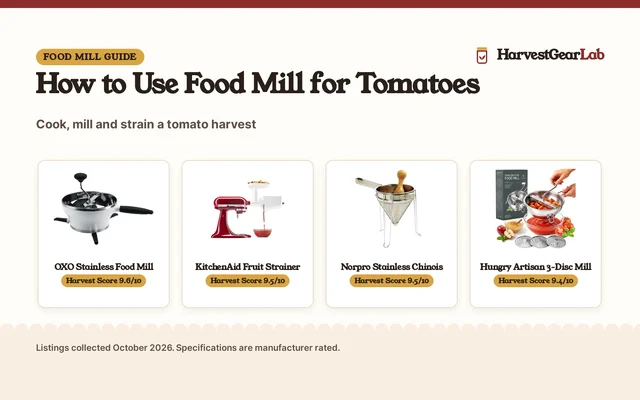
 OXO Good Grips Stainless Steel Food Mill For Purees 2.3 QtView on Amazon
- 9
 Hungry Artisan 3-Disc Food Mill for ApplesauceView on Amazon
A manual food mill earns its place on the counter when the tomatoes come in by the basket and the apples pile up beside the sink. It turns cooked fruit into smooth sauce and puree while the skins and seeds stay behind in the bowl, with no plug and no motor. This guide explains how to choose a mill for the job, fit it on the bowl, use it well, and clean and store it after the harvest.
Runners-up to consider
 Premium Stainless Steel Food Mill with 3 Interchangeable DiscsCheck price on Amazon
 Stainless Steel Food MillCheck price on Amazon
 Food Mill Stainless SteelCheck price on Amazon
 Oumefar Manual Tomato Strainer Food MillCheck price on Amazon
 OXO Good Grips Stainless Steel Food Mill For Purees 2.3 QtCheck price on Amazon
 Hungry Artisan 3-Disc Food Mill for ApplesauceCheck price on Amazon
HarvestGearLab earns a commission when you buy through links on this page, at no extra cost to you. As an Amazon Associate I earn from qualifying purchases. Affiliate disclosure.
Manual food mill: the short list
A manual food mill has a small set of parts, and each part does a plain job. The table shows what each part does and what to look for when buying.
| Part | What it does | What to look for |
|---|---|---|
| Hopper and bowl | Holds the cooked fruit while it is milled | Wide opening, steady rim |
| Discs | Set the texture of the puree | Swap discs for a coarse or fine texture |
| Crank and blade | Push food through the disc | Smooth turn, firm grip |
| Legs or hooks | Hold the mill over a bowl or pot | Fit the bowls and pots in the kitchen |
| Handle | Turns the blade | Comfortable grip, steady hold |
Start with the job, not the mill
Before buying a mill, sort out what it will do most often. Tomato sauce and applesauce are the classic jobs: cooked fruit goes in, skins and seeds stay behind, and smooth puree comes out the bottom. Soups and mashed vegetables are the same job with a different pot. A mill also strains berries for jelly and presses cooked pumpkin for pie filling. If the harvest is mostly sauce and puree, a mill is the right tool; if the job is mostly juice, a press or a juicer may suit it better. The fruit press vs food mill comparison walks through the difference.
Pick the mill by the food
Mills come in sizes from small countertop models to large ones that sit over a stockpot, and the right size is the size that matches the batch. A small mill suits a cook who makes sauce a pot at a time; a large mill suits a gardener putting up the harvest in big batches. Look at the disc set: a fine disc gives a smooth sauce, a coarse disc leaves more texture for soups and mashes. Stainless steel resists stains and holds up to acidic fruit; wood handles stay cool and suit a traditional kitchen. The wood vs stainless steel food mill guide compares the materials, and the best food mill guide lines up mills by size and disc set.
Check the fit on the bowl
A mill is only useful if it sits steady over the bowl or pot that catches the puree. Check the legs or hooks against the bowls and pots already in the kitchen: the mill should rest level, with the disc clear of the puree as it collects. A mill that wobbles or tips when the crank turns is the wrong fit for that bowl, even if the mill itself is well made. Try the fit before the harvest rush, when there is time to swap the bowl or the mill.
Use the mill
Cook the fruit until soft, then ladle it into the hopper in small amounts so the crank turns freely. Turn the crank at a steady pace and let the blade push the puree through the disc; skins, seeds and stems stay in the bowl to be emptied when the crank starts to drag. Scrape the puree from under the disc now and then so it keeps flowing. When the hopper is empty, refill it and keep going until the batch is done. For a finer texture, run the puree through the mill again with the fine disc fitted.
Clean and store the mill
Take the mill apart and wash each part with hot soapy water, then rinse and dry it fully before putting it away. Food left in the disc holes or under the blade dries hard and clogs the next batch, so check the holes and the blade edge while washing. Dry the parts on a rack or a clean towel, then store the mill with the discs stacked inside the bowl and the crank in place, ready for the next harvest. A dry mill keeps its finish and its smooth turn from season to season.
What this guide does not cover
This is a guide to choosing and using a manual food mill. It does not give recipes, processing times, pressures, headspace figures or altitude changes. Take those from current USDA and National Center for Home Food Preservation guidance, or from a current edition of a trusted canning guide, and follow them exactly for each food. Every food mill guide on the site is collected in the food mills section.
FAQ: preserving at home
What does a manual food mill do?
It pushes cooked fruit and vegetables through a disc, leaving skins, seeds and stems behind and giving a smooth puree for sauces, soups and jams.
What is the difference between a food mill and a sieve?
A mill uses a crank and a blade to push food through the disc, while a sieve needs a spoon and more arm work for the same job. A mill also sits over the bowl on legs or hooks, leaving hands free for the crank and the ladle.
Do I need different discs?
Discs set the texture: a fine disc gives a smooth sauce, while a coarse disc leaves more texture for soups and mashes. Swap the disc to match the dish, and keep the spare discs with the mill so they are there when needed.
Can a food mill handle uncooked fruit?
No. Cook the fruit until soft before milling, since a mill is made for soft cooked food and will not break down raw hard fruit. Hard fruit can also strain the crank and the blade.
How do I clean a manual food mill?
Take it apart, wash each part with hot soapy water, rinse, and dry it fully before storing. Check the disc holes and the blade edge while washing, since dried food there clogs the next batch.
More preserving guides
See every food mill guide and all harvest and processing guides.
More picks: food mills, food mills for peppers, preserving pans for tomato sauce and cider presses.