
On this page
Top picks at a glance
As an Amazon Associate I earn from qualifying purchases.
- 1
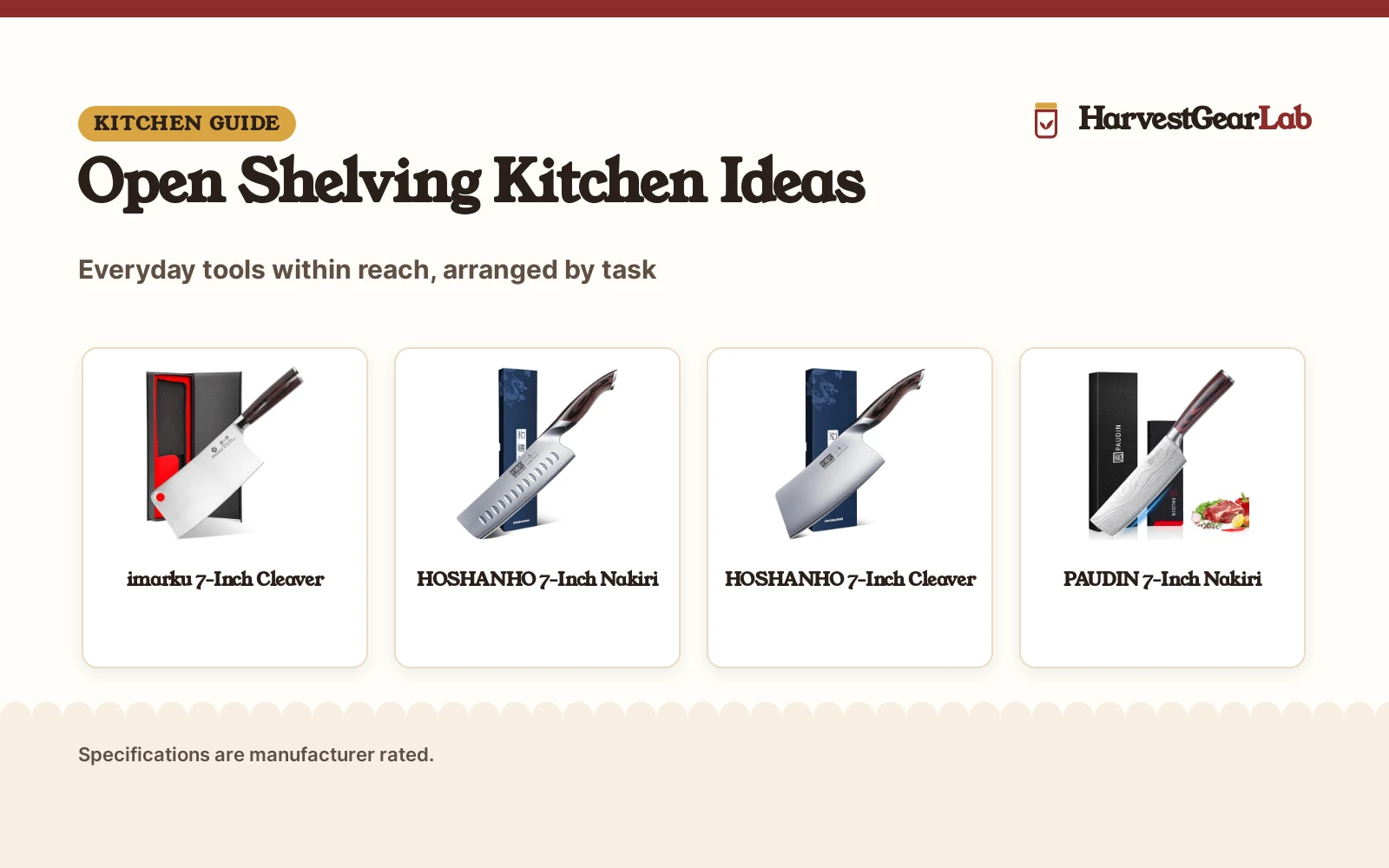
 imarku 7-Inch Cleaver9.6/10View on Amazon
- 2
 HOSHANHO 7-Inch Nakiri9.5/10View on Amazon
- 3
 HOSHANHO 7-Inch Cleaver9.5/10View on Amazon
- 4
 PAUDIN 7-Inch Nakiri9.4/10View on Amazon
Open shelving kitchen ideas work when the tools and dishes you reach for every day live out where you can see them, and everything else stays behind a door. The shelf earns its keep when the everyday pieces sit at arm height, grouped by the task they serve, with enough open space to wipe the shelf down. This guide lays out the ideas that hold up in a working kitchen, and the gear below covers the prep knives that earn a spot within reach.
HarvestGearLab earns a commission when you buy through links on this page, at no extra cost to you. As an Amazon Associate I earn from qualifying purchases. Affiliate disclosure.
| # | Product | Harvest Score | Buy |
|---|---|---|---|
| 1 | imarku 7-Inch Cleaver | 9.6/10 | Buy on Amazon |
| 2 | HOSHANHO 7-Inch Nakiri | 9.5/10 | Buy on Amazon |
| 3 | HOSHANHO 7-Inch Cleaver | 9.5/10 | Buy on Amazon |
| 4 | PAUDIN 7-Inch Nakiri | 9.4/10 | Buy on Amazon |

imarku 7-Inch Cleaver
A 7 inch cleaver for chopping, mincing, slicing and boning that earns a spot on the open shelf beside the cutting board.
Pros
- 7 inch blade forged from Japanese high carbon stainless steel at 57+1 HRC
- Hand-sharpened to a 15° double-side angle with a 2.4mm blade
- FSC certified Pakkawood handle shaped for right-handed and left-handed users
Cons
- 12.0 inch overall length needs a full shelf slot
- At 0.74 pounds it is heavier than the PAUDIN nakiri
- 57+1 HRC sits below the 60 HRC of the HOSHANHO nakiri

HOSHANHO 7-Inch Nakiri
A 7 inch nakiri for slicing, dicing and chopping vegetables that handles daily prep from the open shelf.
Pros
- 60 HRC blade hardness, the highest stated here
- Hand-polished 15 degree edge for slicing, dicing and chopping
- Scallop-shaped hollow pits on the blade side for non-stick cutting
Cons
- Heavier than the PAUDIN nakiri
- 10.0 inch overall length needs a full shelf slot
- Built for vegetables rather than heavy chopping

HOSHANHO 7-Inch Cleaver
A 7 inch cleaver for fish, chicken and vegetables that covers heavy chopping from the open shelf.
Pros
- 58+2 HRC blade with a 15° edge on each side
- Japanese 10Cr15CoMoV stainless steel for hardness and wear resistance
- 2.3mm blade thickness for fish, chicken and vegetables
Cons
- No warranty term is stated
- At 1.0 pound it is the heaviest pick here
- Hand washing and regular whetstone sharpening are needed

PAUDIN 7-Inch Nakiri
A 7 inch nakiri for slicing, dicing, chopping and mincing that covers everyday prep from the open shelf.
Pros
- Wave pattern decreases food friction and eases cleaning
- Soft pakkawood handle balanced at the pinch point
- Easy to re-sharpen, clean and maintain
Cons
- No warranty term is stated
- 56+ hardness is the lowest stated here
- Steel is not Damascus despite the wave pattern
As an Amazon Associate I earn from qualifying purchases.
Open shelving kitchen ideas that work
Start with the daily routine. The pieces that get used at every meal, the cutting board, the prep knives, the mixing bowls and the plates, belong on the open shelves, while the platters and gadgets that come out rarely belong behind doors. Group each shelf by task, so the prep shelf holds the board and the knives, and the serving shelf holds the plates and bowls. Leave open space on each shelf, since a crowded shelf is hard to wipe and hard to use.
Put the daily pieces where hands land without stretching, and keep the display pieces up high where they stay clean. A shelf that holds only what gets used stays tidy, while a shelf loaded with decoration turns into dusting work.
What goes on the shelves
Everyday dishes and glasses earn the open spots, since they go through the wash and back to the shelf each day. Prep tools come next: the cutting board, the knives and the mixing bowls, because they move from shelf to counter and back all day. Keep the heavy pieces low, where a shelf can hold them without strain, and keep the light pieces high.
The gear for the prep work
Prep work at the cutting board is the step that needs a knife within reach, so the four knives below cover chopping, slicing, dicing and mincing from the open shelf.
How to choose the best open shelving kitchen ideas
Match the blade to the prep
A cleaver handles chopping, mincing, slicing and boning, while a nakiri handles slicing, dicing and chopping vegetables. The HOSHANHO cleaver cuts fish, chicken and vegetables, and the imarku cleaver covers meat, fruits and large vegetables. Pick the blade that matches the prep you do most, and read the cleaver vs butcher knife guide before deciding.
Check the handle, edge and weight
Every knife here lists a 7 inch blade, and the imarku cleaver, the HOSHANHO nakiri and the PAUDIN nakiri list a Pakkawood handle. The HOSHANHO nakiri lists the hardest blade at 60 HRC with a hand-polished 15 degree edge, while the imarku cleaver lists 57+1 HRC and the HOSHANHO cleaver lists 58+2 HRC. The PAUDIN nakiri lists the lowest stated weight, and the HOSHANHO cleaver is the heaviest at 1.0 pound.
FAQ: preserving at home
What is a meat cleaver used for?
A meat cleaver chops, minces, slices and bones meat, and cuts fruits and large vegetables. The imarku cleaver and the HOSHANHO cleaver both list those uses, with the HOSHANHO cleaver also listing fish and chicken.
What is the difference between a cleaver and a nakiri?
A cleaver covers chopping, mincing, slicing and boning, with the HOSHANHO cleaver listing a 2.3mm blade for fish, chicken and vegetables. A nakiri is the vegetable blade: the HOSHANHO nakiri lists scallop-shaped hollow pits for non-stick cutting, and the PAUDIN nakiri lists a wave pattern that decreases food friction.
What goes on open kitchen shelves?
Put the pieces you use at every meal on the open shelves: the cutting board, the prep knives, the mixing bowls and the plates. Keep the platters and gadgets that come out rarely behind doors, so the open shelves hold only the daily pieces.
How to care for a cleaver after use?
The HOSHANHO cleaver lists hand washing with clean water, wiping dry with a dry cloth, and sharpening regularly with a whetstone or a suitable sharpener. The imarku cleaver lists easy resharpening, cleaning and maintenance, and the PAUDIN nakiri lists easy re-sharpening, cleaning and maintenance.
More preserving guides
See every meat processing guide and all game and fish processing guides.
More picks: meat processing knife sets, meat processing cutting boards, cleaver vs butcher knife and meat processing kits.