
On this page
Top picks at a glance
As an Amazon Associate I earn from qualifying purchases.
- 1
 MARCATO Atlas 1509.6/10View on Amazon
- 2
 MARCATO 24 Round Ravioli Mold9.6/10View on Amazon
- 3
 MARCATO 12 Large Ravioli Mold9.5/10View on Amazon
The pasta maker vs ravioli maker choice starts with the same dough and ends with different tools: a sheet of fresh pasta needs rolling and cutting, while a tray of filled ravioli needs pressing in a mold. This comparison covers Marcato tools on both sides, from a hand-crank roller and cutter to two molds.
HarvestGearLab earns a commission when you buy through links on this page, at no extra cost to you. As an Amazon Associate I earn from qualifying purchases. Affiliate disclosure.
Quick verdict: choose the pasta maker side if you want fresh sheets and cut pasta; the Marcato Atlas 150 example rolls and cuts dough with a hand crank and carries a 10-year warranty. Choose a ravioli maker if you want filled pieces in one press; the 24-piece mold shapes 24 round pieces at once, each 1.6 by 1.6 inches, while the 12-piece mold shapes 12 larger pieces, each 2.2 by 2.2 inches.
Three examples
| # | Product | Harvest Score | Buy |
|---|---|---|---|
| 1 | MARCATO Atlas 150 | 9.6/10 | Buy on Amazon |
| 2 | MARCATO 24 Round Ravioli Mold | 9.6/10 | Buy on Amazon |
| 3 | MARCATO 12 Large Ravioli Mold | 9.5/10 | Buy on Amazon |
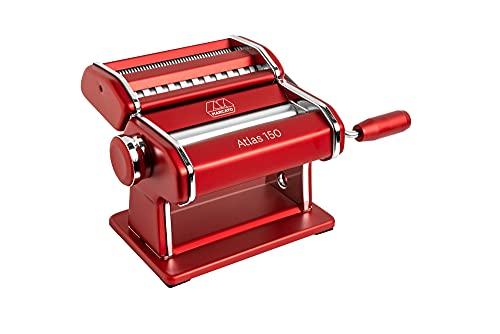
MARCATO Atlas 150
A hand-crank pasta machine that rolls and cuts dough, made from anodized aluminum with a pasta cutter and crank included.
Pros
- Rolls and cuts pasta dough with a hand crank
- Includes a pasta cutter, hand crank and instructions
- 10-year warranty, the only stated warranty among the three
- Anodized aluminum body, wipe clean with a dry cloth
Cons
- Makes no filled pasta on its own; ravioli needs a mold or hand shaping
- Hand-crank operation, so every sheet is rolled by hand
- Weighs 5.07 pounds, heavier than either mold
- Measures 7.87 by 8.15 by 6.1 inches, the largest of the three

MARCATO 24 Round Ravioli Mold
A die cast aluminum mold that shapes 24 round ravioli pieces at once, each 1.6 by 1.6 inches, with a solid wood rolling pin.
Pros
- Shapes 24 round ravioli pieces at once
- Die cast aluminum body stated as a solid food-safe material
- Solid wood rolling pin included
- Made and assembled in Italy
Cons
- Makes ravioli only; it does not roll or cut plain pasta sheets
- No warranty term is stated
- Pieces are 1.6 by 1.6 inches, smaller than the 12-piece mold
- Cleaning needs residue to dry first, then a dry brush

MARCATO 12 Large Ravioli Mold
A die cast aluminum mold that shapes 12 large round ravioli pieces at once, each 2.2 by 2.2 inches, with a solid wood rolling pin.
Pros
- Shapes 12 large round ravioli pieces at once
- Each piece measures 2.2 by 2.2 inches
- Die cast aluminum body stated as a solid food-safe material
- Solid wood rolling pin included
Cons
- Makes ravioli only; it does not roll or cut plain pasta sheets
- No warranty term is stated
- 12 pieces per press, fewer than the 24-piece mold
- Cleaning needs residue to dry first, then a dry brush
As an Amazon Associate I earn from qualifying purchases.
Pasta maker vs ravioli maker: side by side
| Pasta Tool | Harvest Score | Side | Pieces at Once | Piece Size | Material | Warranty | Amazon |
|---|---|---|---|---|---|---|---|
| MARCATO Atlas 150 | 9.6/10 | Pasta maker | Not stated | Not stated | Anodized aluminum | 10-Year | View on Amazon |
| MARCATO 24 Round Ravioli Mold | 9.6/10 | Ravioli maker | 24 | 1.6 x 1.6 in | Die cast aluminum | Not stated | View on Amazon |
| MARCATO 12 Large Ravioli Mold | 9.5/10 | Ravioli maker | 12 | 2.2 x 2.2 in | Die cast aluminum | Not stated | View on Amazon |
Numbers in this comparison come from the maker as the listing shows them, checked 21 November 2026.
What each side is for
A pasta maker rolls dough into sheets and cuts it into strands or shapes. The Atlas 150 example does both jobs with a hand crank, and the box includes a pasta cutter, a hand crank and instructions. A ravioli maker presses filled dough into shaped pieces, and both Marcato molds shape round pieces in one press, with a solid wood rolling pin included to press the sheet into the mold.
The sides do not cover each other. The Atlas 150 shapes no ravioli on its own, and neither mold rolls a plain sheet or cuts strands. A cook who wants both fresh sheets and filled pasta needs a tool from each side.
Pieces per press and piece size
The molds differ in count and size. The 24-piece mold creates 24 round ravioli pieces at once, each 1.6 by 1.6 inches. The 12-piece mold creates 12 large round ravioli pieces at once, each 2.2 by 2.2 inches. Piece counts do not apply to the Atlas 150, because it rolls sheets rather than portions.
Count and size pull in opposite directions here. Match the count to the batch and the size to the filling.
Materials, weight and size
The Atlas 150 is made from anodized aluminum with oxidation coloring, and it weighs 5.07 pounds at 7.87 by 8.15 by 6.1 inches. Both molds use die cast aluminum bodies, stated as a solid food-safe material, and each includes a solid wood rolling pin. The 24-piece mold weighs 1.04 pounds at 4.72 by 0.79 by 12.6 inches, and the 12-piece mold weighs 1.12 pounds at 6.69 by 1.18 by 14.76 inches.
The Atlas 150 weighs 5.07 pounds, while the 24-piece mold weighs 1.04 pounds and the 12-piece mold weighs 1.12 pounds.
Warranty and cleaning
Only the Atlas 150 states a warranty, a 10-year term. Neither mold states a warranty term. Cleaning differs too: the Atlas 150 wipes clean with a dry cloth, while each mold needs pasta residue to dry before cleaning with a dry brush.
The maker gives dry cleaning steps for all three: a dry cloth for the Atlas 150 and a dry brush for each mold, after residue dries. Keep the dry cloth with the Atlas 150 and the dry brush with the molds.
Which should you choose?
Choose a pasta maker if you want fresh sheets and cut pasta from one machine, with a hand crank and a 10-year warranty on the Atlas 150 example. Compare roller attachments in the best pasta maker for Kitchenaid guide.
Choose a ravioli maker if you want filled pieces in one press, with 24 small pieces or 12 large pieces per press from the Marcato molds. See the best ravioli making tools guide for more mold options.
Whichever side you pick, remember the sides do not overlap: the Atlas 150 rolls and cuts sheets but shapes no ravioli, and the molds shape filled pieces but roll no sheets.
In the Preserving Kitchen
- Wipe the Atlas 150 with a dry cloth after use, as the maker directs.
- Let pasta residue dry on a mold before cleaning with a dry brush.
- Keep the solid wood rolling pin with its mold, since it arrives in the box with the mold.
- Keep the Atlas 150 hand crank and pasta cutter with the machine, since all three arrive in the box.
How the Harvest Score played out
| Product | Harvest Score | Perf. /35 | Build /25 | Value /25 | Safety /10 | Warranty /5 |
|---|---|---|---|---|---|---|
| MARCATO Atlas 150 | 9.6 | 30 | 21 | 21 | 0 | 4 |
| MARCATO 24 Round Ravioli Mold | 9.6 | 29 | 21 | 21 | 5 | 0 |
| MARCATO 12 Large Ravioli Mold | 9.5 | 28 | 21 | 20 | 5 | 0 |
Harvest Scores sit on a narrow band from 9.2 up to 9.8. Each tool’s weighted points are converted onto it proportionally, and a higher total always gives a higher number.
The Harvest Score weighs performance, build, value, safety and warranty. For pasta tools, safety covers the food-safe material stated for the molds; no safety feature is stated for the Atlas 150, so it earns no safety points. The Atlas 150 scores highest for its 10-year warranty and its roll-and-cut range, while the 24-piece mold scores ahead of the 12-piece mold for its higher piece count. Only one of the three states a warranty term.
FAQ: preserving at home
Can a pasta maker make ravioli?
Not on its own. The Atlas 150 rolls and cuts dough but shapes no ravioli, so filled pasta needs a mold or hand shaping. The molds shape filled pieces but roll no sheets.
How many ravioli does each mold make at once?
The 24-piece mold creates 24 round pieces at once, each 1.6 by 1.6 inches. The 12-piece mold creates 12 large round pieces at once, each 2.2 by 2.2 inches.
Which of these Marcato tools has a warranty?
Only the Atlas 150, with a 10-year warranty. Neither mold states a warranty term.
How do you clean these pasta tools?
Wipe the Atlas 150 with a dry cloth. For each mold, let pasta residue dry, then clean with a dry brush.
What is the difference between the two ravioli molds?
The 24-piece mold makes 24 round pieces at 1.6 by 1.6 inches, while the 12-piece mold makes 12 large round pieces at 2.2 by 2.2 inches.
More preserving guides
See every pasta makers guide and all bread and pasta making guides.
More picks: ravioli making tools, pasta makers for Kitchenaid, bronze vs Teflon pasta dies and stand mixer pasta roller attachments.