
On this page
Top picks at a glance
As an Amazon Associate I earn from qualifying purchases.
- 1
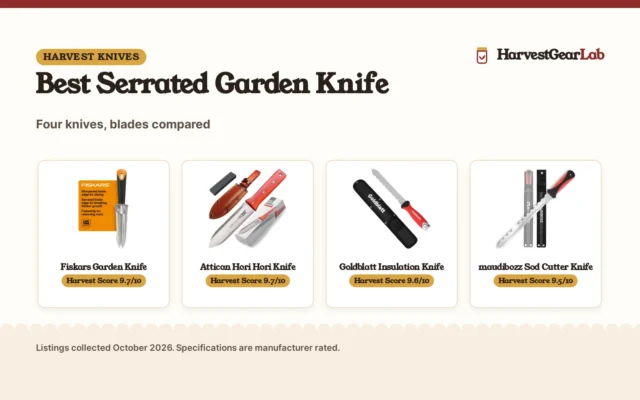
 Attican Hori Hori Garden Knife 7 Inches9.7/10View on Amazon
- 2
 HOUNEN Japanese Harvest Sickle 5.9-InchView on Amazon
- 3
 jawbush Professional Lettuce KnifeView on Amazon
- 4
 Messermeister 4.5” Serrated Tomato Knife with Matching SheathView on Amazon
- 5
 Tomato KnifeView on Amazon
The serrated vs smooth harvest knife question is really about how the blade meets the stem: teeth that grip and saw, or an edge that pushes and slices. A serrated harvest knife grabs slippery stalks and pulls through bunches in one motion. A smooth harvest knife slices cleanly through single stems and produce with a push. This guide compares the two edges step by step, using figures from serrated blade listings where they exist.
Runners-up to consider
 HOUNEN Japanese Harvest Sickle 5.9-InchCheck price on Amazon
 jawbush Professional Lettuce KnifeCheck price on Amazon
 Messermeister 4.5” Serrated Tomato Knife with Matching SheathCheck price on Amazon
 Tomato KnifeCheck price on Amazon
HarvestGearLab earns a commission when you buy through links on this page, at no extra cost to you. As an Amazon Associate I earn from qualifying purchases. Affiliate disclosure.
Serrated vs smooth harvest knife: the short answer
Choose a serrated harvest knife when you harvest by the bunch: lavender, herbs, grasses and crop stems, where the teeth grip and the pull cut moves through them. Choose a smooth harvest knife when you slice individual stems and produce: trimming, cutting rope and precise produce work, where a clean push cut matters. The listings we compared are all serrated, from 3.25-inch paring knives to 9.5-inch sickles, so the serrated side carries the figures and the smooth side is explained without them.
How a serrated edge cuts
A serrated edge is a row of teeth, and teeth grip. The HOUNEN example states that fine saw teeth hold slippery stalks as the pull cut moves through vegetables, flowers and crop stems, and the Zenport K202 example states that a curved hook blade easily pulls and slices through bunches of small stems. The Zenport K208P example adds that a 6.5-inch curved stainless steel blade with light serration gives controlled pull cuts for grass, weeds and plant stems. That is the serrated edge’s job: grab the bunch, pull once, cut through.
Serrated blades in the listings run 3.25 inches and 4 inches on the Victorinox paring examples, 4.3 inches on the Zenport K206P berry sickle, 5.9 inches on the HOUNEN sickle, 6.5 inches on the Zenport K208P and K202 examples, 6.6 inches on the KEYI example and 9.5 inches on the Barnel example. Teeth stay useful longer between sharpenings because the points do the work even as the edge dulls, though the HOUNEN listing says to clean and dry the teeth after use.
How a smooth edge cuts
No smooth-edge listings appear in the reference set, so this section carries no figures. A smooth edge cuts with a push: the full length of the blade meets the stem at once, giving a clean slice through a single stem, a vegetable or rope. It suits trimming and cutting tasks where one clean cut matters more than grabbing a bunch. The trade-off is maintenance: a smooth edge needs regular sharpening to stay clean-cutting, while serrated teeth keep grabbing long after the points wear.
Weight, handles and duty
Handle and weight matter as much as the edge for a full day in the field. The Zenport K202 example weighs 3.04 ounces at 11.5 inches with a notched wooden handle that grips when wet. The Zenport K208P example weighs 3.68 ounces with a molded plastic handle. The HOUNEN example weighs 3.52 ounces with a wooden handle. The Victorinox paring examples are lighter kitchen-scale tools at 18.14 and 27.22 grams, with contoured handles built for control.
Warranties tilt toward the serrated field tools: the Victorinox examples state a lifetime warranty against defects, and the Zenport examples state a limited lifetime warranty. The KEYI example states a limited warranty. Warranties on hand tools cover defects, not dull edges, so read the terms.
Which edge for which harvest
Pick serrated for bunch work: the listings name lavender, berries, herbs, grasses and vegetables, where teeth grip slippery stems. Pick serrated for weeds and landscape work too: the Barnel 9.5-inch example and the Zenport K208P example are built for cutting and clearing. Pick smooth for produce trimming and cutting where a clean slice matters and you are willing to sharpen regularly.
For sheathed options on either edge, see our best harvest knife with sheath and best garden knife for harvesting guides. Either way, keep the blade clean and dry between uses: the listings repeatedly name cleaning after use and dry storage as the habit that keeps an edge cutting season after season.
FAQ: preserving at home
Which edge lasts longer between sharpenings?
Serrated. The teeth keep grabbing even as the points wear, though the HOUNEN listing says to clean and dry the teeth after use.
What size serrated blade suits lavender?
The Zenport K202 example is a 6.5-inch curved serrated blade built for one-handed lavender harvesting.
Is there a warranty on these knives?
The Victorinox examples state a lifetime warranty and the Zenport examples a limited lifetime warranty, per the listings.
Can a serrated knife handle weeds?
The listings name weed removal and grass trimming for the Zenport K208P and Barnel examples.
More preserving guides
See every harvest and processing guide.
More picks: harvest knives with sheath, garden knives for harvesting and garden knives with sheath.