
On this page
Top picks at a glance
As an Amazon Associate I earn from qualifying purchases.
- 1
 Bright Kitchen 14 x 14 Inch Edge Silicone Dehydrator Sheets9.7/10View on Amazon
- 2
 GUCUJI Pack of 5 Premium Non Stick Silicone Dehydrator SheetsView on Amazon
- 3
 Thenshop 8 Silicone Dehydrator Mats & 10 Mesh Dryer Mats andView on Amazon
- 4
 Set of 3-14" x 14" -Silicone Re-Usable Non-Stick UltraView on Amazon
- 5
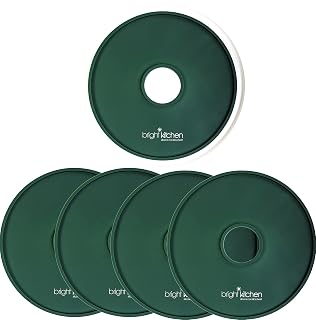
 4 Fruit Leather Silicone Dehydrator Sheets with EDGESView on Amazon
- 6
 View on Amazon
- 7
 6 Pack Silicone Dehydrator Trays Compatible with CosoriView on Amazon
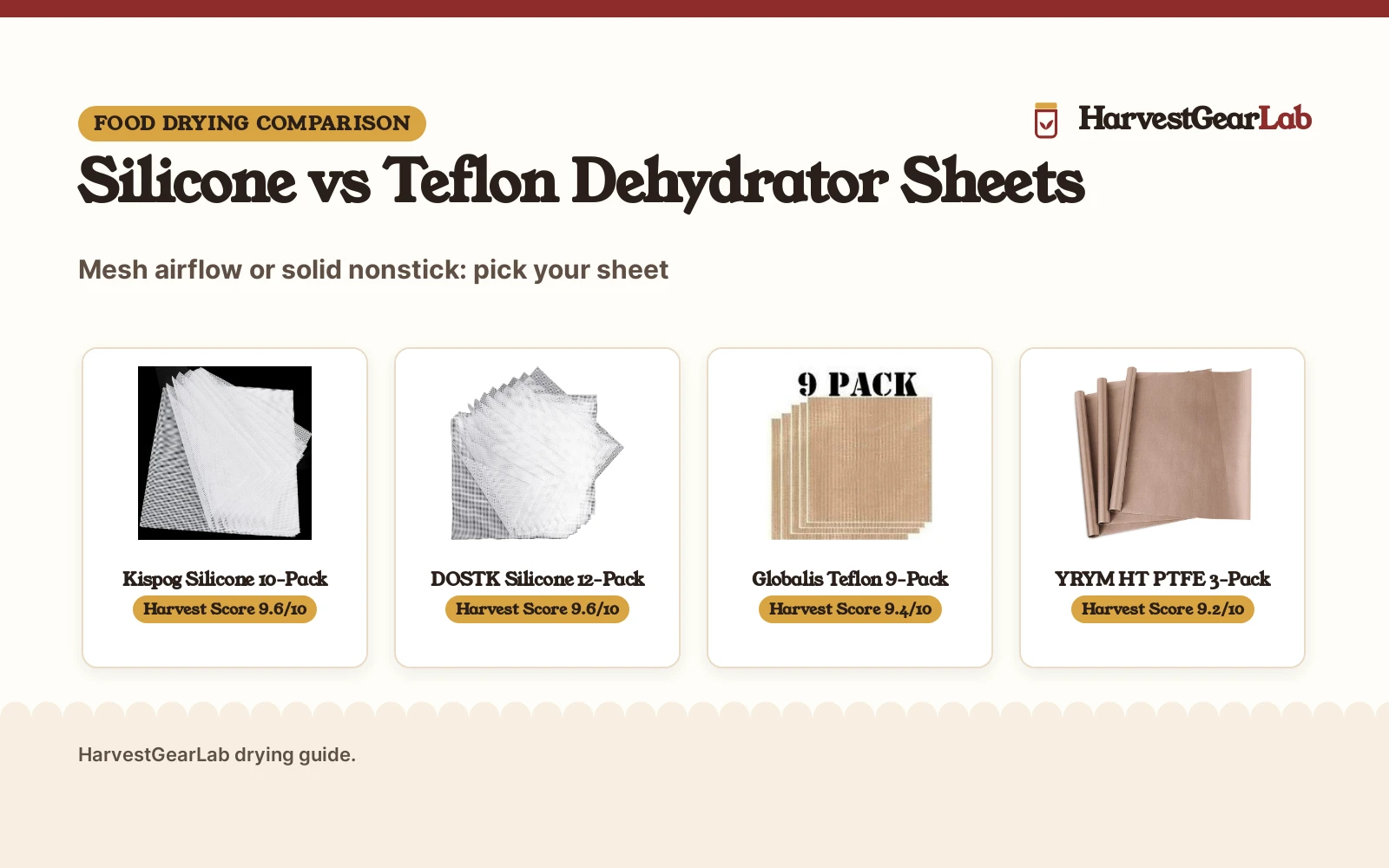
Silicone vs teflon dehydrator sheets comes down to airflow against containment. Pick silicone mesh sheets if you dry berries, herbs, seeds and jerky and want air moving around every piece. Pick teflon sheets if you want a solid nonstick surface that stops drips and protects the tray, especially for sticky or wet foods. This comparison uses four listings, two per side, as concrete examples.
Runners-up to consider
 GUCUJI Pack of 5 Premium Non Stick Silicone Dehydrator SheetsCheck price on Amazon
 Thenshop 8 Silicone Dehydrator Mats & 10 Mesh Dryer Mats andCheck price on Amazon
 Set of 3-14" x 14" -Silicone Re-Usable Non-Stick UltraCheck price on Amazon
 4 Fruit Leather Silicone Dehydrator Sheets with EDGESCheck price on Amazon
 6 Pack Silicone Dehydrator Trays Compatible with CosoriCheck price on Amazon
HarvestGearLab earns a commission when you buy through links on this page, at no extra cost to you. As an Amazon Associate I earn from qualifying purchases. Affiliate disclosure.
Silicone dehydrator sheets
Both silicone listings are mesh sheets: flexible silicone screens that sit on the tray. The Kispog 10-pack states 14×14 in sheets with an ultra-fine 1mm mesh, a temperature rating up to 450F, and BPA-free food-grade silicone, and the DOSTK 12-pack states 14×14 in sheets with mesh holes around 1x1mm and a -40 to 220C (-40 to 428F) rating, also BPA-free food-grade silicone. Both state the mesh gives airflow top and bottom while keeping small foods from falling through, both are stated dishwasher safe, and both trim with scissors to fit. The Kispog listing states its sheets are not suitable for oven use.
Teflon dehydrator sheets
The teflon side is split. The Globalis 9-pack is the genuine dehydrator sheet of the two: it states Dupont Teflon, 14×14 in sheets for Excalibur 2500, 2900, 3500, 3900 and 3926t trays, and a solid nonstick surface that prevents food from dripping from one tray to another and stops traces of liquid after drying. It states cleaning with warm soapy water or the dishwasher. The YRYM HT 3-pack is the odd listing out: it is marketed as a PTFE sheet for heat press and craft projects, 16×20 in, brown, with heat resistance up to 600F, and its listing never mentions dehydrators. It works as the teflon material example, but it is not sold as a dehydrator sheet.
Silicone vs teflon dehydrator sheets: head to head
| Aspect | Silicone (Kispog, DOSTK) | Teflon (Globalis, YRYM HT) |
|---|---|---|
| Form | Mesh screen | Solid sheet |
| Airflow | Air moves top and bottom, stated | Blocked; solid surface |
| Liquids and drips | Not for liquids; mesh lets them through | Globalis states it stops drips between trays |
| Stated temperature | Up to 450F (Kispog); -40 to 428F (DOSTK) | Globalis: not stated; YRYM HT: up to 600F for heat press |
| Material statement | BPA-free food-grade silicone, both | Dupont Teflon (Globalis); PTFE (YRYM HT) |
| Cleaning | Dishwasher safe, both | Dishwasher or warm soapy water (Globalis) |
| Fit | 14×14 in, trimmable, both | 14×14 in, cut to shape (Globalis); 16×20 in (YRYM HT) |
Figures as stated in each listing. The Globalis listing states no temperature rating, so the table leaves it unclear rather than calling it a win or a loss.
Two practical differences deserve emphasis. First, form decides the job: mesh suits anything small and dry that needs air, while solid suits anything wet or sticky that needs containment. The listings agree on this split, with the silicone pair stating airflow and the Globalis stating drip prevention. Second, reusability is stated on both sides: the silicone listings state dishwasher-safe reuse, and the Globalis states warm soapy water or dishwasher cleaning. Whichever side you pick, you are buying a reusable liner, not a disposable one.
Which should you buy?
Buy silicone mesh if
- You dry berries, herbs, seeds, jerky or small pieces and want maximum airflow.
- You want a stated temperature rating: up to 450F on the Kispog and -40 to 428F on the DOSTK.
- You value the BPA-free food-grade silicone statement both silicone listings carry.
Buy teflon if
- You dry sticky, wet or drippy foods and want a solid surface that stops drips between trays, as the Globalis states.
- You want to protect the tray from oil and moisture, which the Globalis lists as extending dehydrator life.
- You already own a PTFE craft sheet like the YRYM HT and only need a cut-to-size nonstick liner, though it is not sold as a dehydrator sheet.
Many dryers keep both: mesh for airy loads, solid teflon for sticky ones. Our mesh vs solid dehydrator sheets guide covers the form question in more depth,.
FAQ: preserving at home
Can I cut dehydrator sheets to fit my trays?
Yes for three of the four: the Kispog, DOSTK and Globalis listings all state the sheets trim or cut to size. The YRYM HT listing also states it can be cut to any size.
Which side suits fruit leather?
Teflon. The Globalis solid sheet states it prevents traces of liquid after drying, while mesh sheets let liquids through.
Do the listings state temperature ratings?
Three do: Kispog states up to 450F, DOSTK states -40 to 428F, and YRYM HT states up to 600F for heat press use. The Globalis listing states no temperature rating.
More preserving guides
See every food dehydrators guide and all food drying guides. Also see our mesh vs solid dehydrator sheets. Also see our best dehydrator for fruit leather.
More picks: dehydrators for fruit leather, dehydrators for liquids and food dehydrators.