
On this page
Top picks at a glance
As an Amazon Associate I earn from qualifying purchases.
- 1
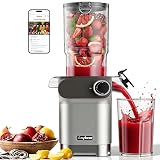 Anybear 200W Cold Press Juicer9.8/10View on Amazon
- 2
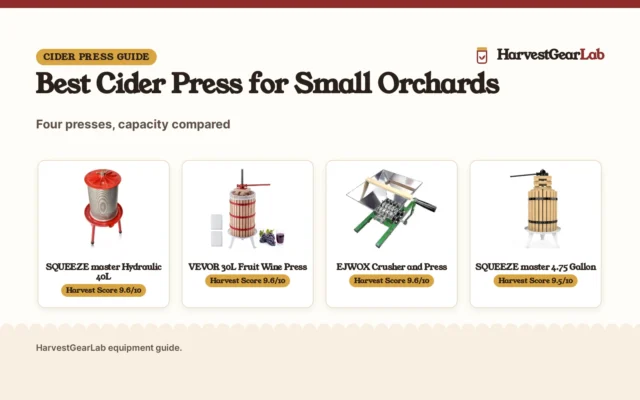
 SQUEEZE master Hydraulic Fruit Wine Apple Press 40L9.6/10View on Amazon
- 3
 VEVOR Fruit Wine Press 30L Manual Juice Maker9.6/10View on Amazon
- 4
 AMZCHEF Cold Press JuicerView on Amazon
- 5
 Aeitto Cold Press Juicer MachinesView on Amazon
- 6
 Kuvings AUTO10 Cold Press Juicer MachineView on Amazon
- 7
 Kuvings AUTO9 Cold Press Juicer MachineView on Amazon
Small vs large cider press comes down to how much fruit you press at once and where the press will live. The short answer: a 1.6-gallon press suits a family pressing a few batches a season on a small patio, while a 4.75-gallon press suits a bigger harvest where fewer, larger pressings save the afternoon. This guide compares basket size, footprint and batch size using figures from current listings, then covers the crusher and bags that go with either size.
Runners-up to consider
 AMZCHEF Cold Press JuicerCheck price on Amazon
 Aeitto Cold Press Juicer MachinesCheck price on Amazon
 Kuvings AUTO10 Cold Press Juicer MachineCheck price on Amazon
 Kuvings AUTO9 Cold Press Juicer MachineCheck price on Amazon
HarvestGearLab earns a commission when you buy through links on this page, at no extra cost to you. As an Amazon Associate I earn from qualifying purchases. Affiliate disclosure.
Small vs large cider press: the short list
Current manual presses cluster around three basket sizes. The table shows what each one gives you and who it suits.
| Press size | Example capacity | Footprint | Best for |
|---|---|---|---|
| Small | 1.6 gallons | 7.48 by 7.48 by 12.99 inches | Families, first presses, small patios |
| Medium | 3.2 gallons | 14.4 by 20.5 by 22.4 inches | Regular seasonal pressing |
| Large | 4.75 gallons | Larger, check the listing | Big harvests, fewer pressings |
What changes with basket capacity
Basket capacity is the number that matters most. The EJWOX line lists 1.6, 3.2 and 4.75-gallon presses with solid beech wood baskets, so the same design scales from a small batch to a large one. A bigger basket means fewer loads per pressing day, but it also means a heavier press and more pulp to handle between pressings. The listed presses use a breakaway basket design that allows quick removal of fruit pulp between pressings, which helps on a long day either way.
Match the basket to the harvest you actually have. If you press a few bushels from one or two trees, the 1.6-gallon press gets it done in more, smaller loads. If you press for a group or a small orchard, the 4.75-gallon press cuts the number of loads. Our best cider press guide lines up current listings by capacity.
Space and storage
Footprint grows with capacity. The 1.6-gallon EJWOX press measures 7.48 by 7.48 by 12.99 inches, small enough for a shelf or a corner of the garage. The 3.2-gallon press measures 14.4 by 20.5 by 22.4 inches, which needs a dedicated spot. Larger presses need a solid floor or bench: the listed EJWOX presses have screw holes in each foot for mounting, so you can bolt the stand down for steadier pressing. Measure the spot before you buy, and remember you also need room to stand beside the press and turn the handle.
Storage matters too. Wooden baskets must be cleaned and dried before they are put away; the listed presses are hand wash only. A small press that fits on a shelf gets cleaned and stored; a large press that blocks the garage may not.
The crusher question
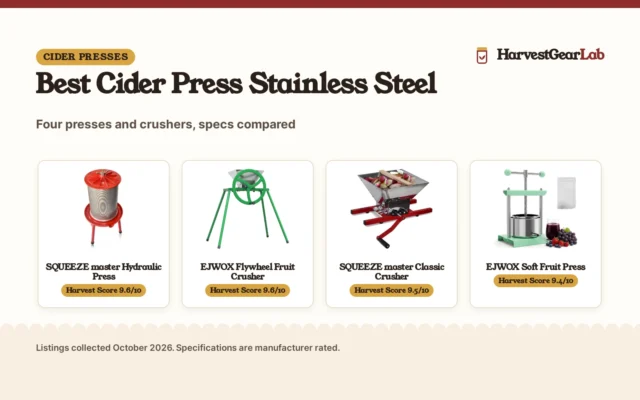
A press needs crushed fruit, not whole apples. The EJWOX fruit crusher lists a 7-liter (1.8-gallon) hopper and processes 35 to 45 kg of fruit per hour, while the Mosakar crusher grinds whole apples up to 3.35 inches (8.5 cm) in diameter into fine pulp at 330 to 550 pounds per hour. Both use 304 stainless steel for the parts that touch the fruit. A big press fed by a small crusher creates a bottleneck: the press waits while you grind. Size the crusher to the press, not the other way around.
The Mosakar unit weighs 54 pounds and measures 20.5 by 19.3 by 40.9 inches, so it is a piece of equipment in its own right. If you already own a crusher, check its hourly rate against your press basket before upgrading the press. See our apple crusher vs cider press comparison for how the two work together.
Bags and cleanup
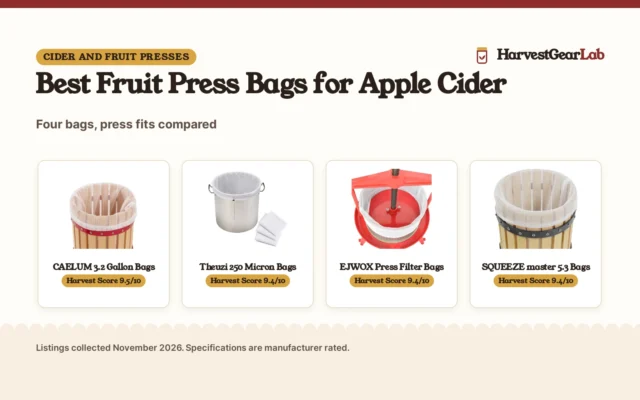
Press bags hold the pulp inside the basket and make cleanup faster. EJWOX lists a 2-pack of filter bags sized for its 4.75-gallon press, and the bags are dishwasher safe even though the press itself is hand wash only. For straining juice, fine mesh bags come in 24 by 32 inch and 31 by 31 inch sizes with 250-micron mesh; the SUNPRO bag fits kettles up to 20 inches in diameter and is listed as boil-safe to 250 degrees Fahrenheit. Match the bag to the basket or kettle you own, and rinse bags promptly so pulp does not dry into the mesh.
Which size should you buy
Buy the small press if you press a few times a season, store gear on shelves, and value easy cleanup. The 1.6-gallon size keeps the work light and the storage footprint small. Buy the large press if you press a big harvest, share pressing day with neighbors, or already own a crusher that can keep up. The 4.75-gallon size turns a day of many small loads into a day of a few big ones.
Either way, budget for the accessories: a crusher sized to the basket, bags that fit, and a sturdy spot to bolt the stand down. Our best cider press for home use guide covers small-batch picks, and the best cider press for small orchards guide covers the larger end.
FAQ: preserving at home
Can I press whole apples without crushing them first?
Crush first. Press listings describe loading crushed fruit into the basket, and crushers exist for exactly this step: the Mosakar crusher grinds whole apples up to 3.35 inches (8.5 cm) in diameter into fine pulp.
Do I need a press bag?
It helps. EJWOX lists a 2-pack of filter bags sized for its 4.75-gallon press, and 250-micron mesh bags in 24 by 32 inch and 31 by 31 inch sizes suit straining. The filter bags are dishwasher safe; the wooden presses are hand wash only.
How much fruit fits in a small press?
The smallest listed press holds 1.6 gallons of crushed fruit per load. The crusher hopper on the EJWOX unit holds 7 liters (1.8 gallons), a similar scale, so one hopper roughly fills one small basket.
Can a small press handle a big harvest?
Yes, with more loads. The breakaway basket design on the listed presses allows quick pulp removal between pressings. A big harvest just means more cycles, so a larger basket or a second pair of hands speeds the day.
More preserving guides
See every cider and fruit press guide and all harvest and processing guides.
More picks: cider presses, fruit presses for cider, crusher vs press and cider presses for home.