
On this page
Top picks at a glance
As an Amazon Associate I earn from qualifying purchases.
- 1
 HOPERAN 16-Tray Stainless Steel Food Dehydrator9.7/10View on Amazon
- 2
 Magic Mill Pro Food Dehydrator Machine9.7/10View on Amazon
- 3
 Magic Mill Premium Food Dehydrator Machine9.7/10View on Amazon
- 4
 OSTBA Food DehydratorView on Amazon
- 5
 Rosewill Food DehydratorView on Amazon
- 6
 Hamilton Beach Digital Food Dehydrator for FruitView on Amazon
- 7
 Nutrichef Electric Countertop Food DehydratorView on Amazon
- 8
 NutriChef Electric Countertop Food Dehydrator -900-WattView on Amazon
- 9
 Weston Food Dehydrator Machine for JerkyView on Amazon
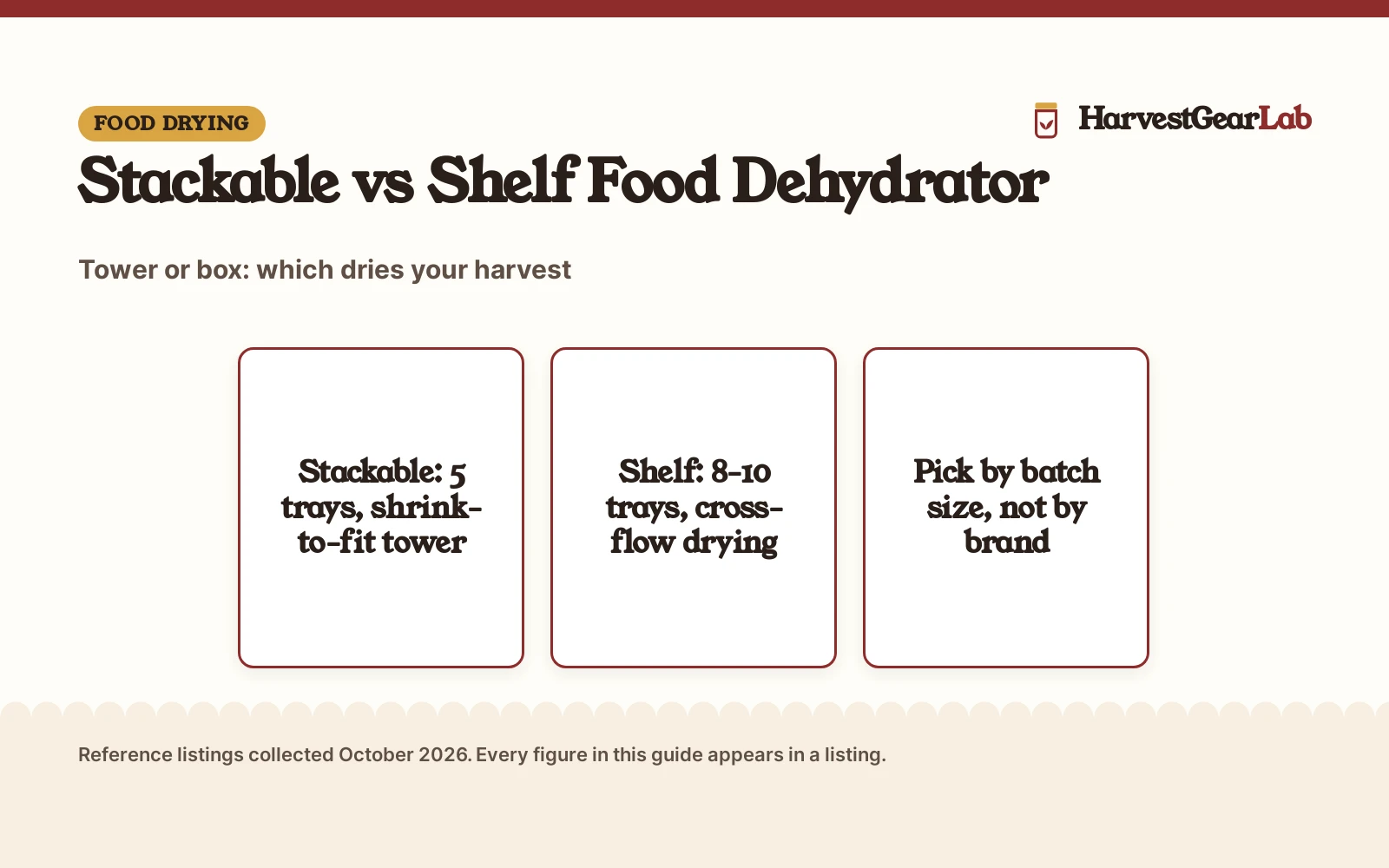
Stackable vs shelf food dehydrator comes down to how the trays sit and how big your batches are. A stackable dehydrator piles round trays on a base, so you add or remove trays to grow or shrink capacity; a shelf dehydrator is a box with trays that slide in like oven racks, so you get more drying area and more even heat in one footprint. Choose stackable for a small kitchen and small batches, and a shelf unit for big harvests and meat snacks in volume.
Runners-up to consider
 OSTBA Food DehydratorCheck price on Amazon
 Rosewill Food DehydratorCheck price on Amazon
 Hamilton Beach Digital Food Dehydrator for FruitCheck price on Amazon
 Nutrichef Electric Countertop Food DehydratorCheck price on Amazon
 NutriChef Electric Countertop Food Dehydrator -900-WattCheck price on Amazon
 Weston Food Dehydrator Machine for JerkyCheck price on Amazon
HarvestGearLab earns a commission when you buy through links on this page, at no extra cost to you. As an Amazon Associate I earn from qualifying purchases. Affiliate disclosure.
How a stackable dehydrator works
A stackable dehydrator is built like a tower: a base with the heating element and fan, and round plastic trays that stack on top of each other. The NutriChef listing describes 5 stackable trays on a 600W unit that reaches up to 180°F, in an 11″D x 11″W x 10.2″H tower. Warm air moves up through the stack, usually in a vertical flow from the base, and the top tray tends to run cooler than the bottom one. Because trays lift off, you dry one small batch in a single tray or a bigger one in all five, then wash the trays and nest the stack for storage.
The practical advantage is flexibility. The Elite Gourmet listing states 5 expandable BPA-free 11.4-inch trays that stack from 8.5″ to 10.75″ tall, so you raise the stack to fit thicker cuts. The OSTBA listing gives 5 BPA-free trays with adjustable tray height for thick-cut foods like beef jerky, bananas and mushrooms. If you dry different foods at different times, a stackable lets you right-size the machine to the batch instead of heating an empty box.
How a shelf dehydrator works
A shelf dehydrator is a box with a door: trays slide into slots like oven racks, and a rear or horizontal fan pushes air across every tray at once. The Rosewill listing describes a rectangular unit with 8 full-size stainless steel trays and a rear fan for even drying, measuring 12″D x 12.8″W x 12.6″H at 14.7 pounds. The Cosori listing states 10 stainless steel trays with 7.4 ft² of drying space, horizontal airflow and a 95-167°F range, in a 14.8″D x 12.3″W x 13″H box at 17 pounds. The fan layout is the point: air hits all trays at once, so you do not rotate trays mid-batch the way vertical-flow stackables sometimes need.
The trade-off is footprint. A shelf unit keeps one permanent size on the counter; you cannot shrink it for a one-tray batch the way you can a stackable. But for a full harvest it wins on volume: the Cosori listing says its 7.4 ft² of drying area fits up to 5.5 lbs of beef sliced to 5 mm, so you dry a family-sized load in fewer batches.
Capacity and footprint
Tray count in these listings runs from 5 to 10. The three stackables all state 5 trays: NutriChef, XGDARDER and Elite Gourmet. The shelf units state 8 (Rosewill) and 10 (Cosori) stainless steel trays. In weight, the Elite Gourmet stackable is 4.6 pounds against 17 pounds for the Cosori shelf unit, which tells you how each one lives: the stackable moves and nests easily, the shelf unit claims a permanent counter spot. For apartments, RVs and small kitchens, the XGDARDER listing pitches its 5-tray stackable as built for small kitchens, apartments and RVs; for a household that dries bushels, the shelf units’ tray area matters more than their footprint.
Even drying and airflow
Airflow is where the designs differ most. Stackables push air vertically through the tower; the OSTBA listing states 360° airflow for center-to-edge drying on its 5-tray stack. Shelf units push air across the trays: the Rosewill lists a rear fan and the Cosori lists horizontal airflow, both designed so every tray dries at the same rate without rotating. If you dry jerky, thick fruit slices or anything that needs uniform results, a shelf unit’s cross-flow design is the safer bet; if you dry mostly thin fruit slices and herbs in small loads, a stackable with adjustable tray height handles the job.
Temperature range and timers
Ranges in these listings run 95°F to 195°F at the extremes. The Rosewill shelf unit spans 95-195°F, the widest stated here; the NutriChef stackable reaches up to 180°F; the Cosori, XGDARDER and OSTBA list 95-167°F or 95-160°F bands. Both designs support long drying: the Rosewill, Cosori, OSTBA and XGDARDER listings all state a 48-hour timer, and the Rosewill and Cosori add automatic shut-off. Herbs dry at the low end of the range, jerky at the high end, so check that the unit you pick covers both ends of what you actually dry.
Trays, materials and cleaning
Stackable trays in these listings are plastic and BPA-free: the OSTBA, XGDARDER and Elite Gourmet listings all state BPA-free trays. Shelf units here use stainless steel trays: the Rosewill and Cosori listings both state stainless steel. Steel trays handle scrubbing and heavy meat loads; plastic stackable trays are lighter and the OSTBA listing states dishwasher-safe trays. Warranty terms stated run from 1 year (NutriChef, Rosewill, Elite Gourmet, and 12 months on the OSTBA) to 2 years on the Cosori.
Stackable vs shelf food dehydrator: which one should you buy
Buy a stackable if you dry small to medium batches in a small kitchen: 5 trays, an 11-inch-round footprint, and the option to shrink the tower to the batch. Buy a shelf dehydrator if you dry big harvests, whole-batch jerky or mixed loads you do not want to rotate: 8 to 10 stainless steel trays, cross-flow fans and up to 7.4 ft² of drying space in one box. Either way, match the temperature band to your foods and confirm the timer reaches your longest recipe before you buy. See our food dehydrator buying guide and our dehydrator for large family guide.
FAQ: preserving at home
Is a stackable or shelf dehydrator better for jerky?
A shelf unit suits jerky better: cross-flow fans dry thick meat evenly without rotating trays, and the Cosori listing states 7.4 ft² of space that fits 5.5 lbs of beef sliced to 5 mm. Stackables with adjustable tray height, like the Elite Gourmet at up to 10.75 inches tall, handle jerky in smaller loads.
Do I need to rotate trays in a stackable dehydrator?
Sometimes. Vertical-flow stackables can dry the top tray slower than the bottom one, so rotating trays mid-batch evens results. Shelf units with rear or horizontal fans are designed to dry every tray at the same rate without rotating.
Which type is easier to clean?
Both are manageable. The OSTBA stackable lists dishwasher-safe BPA-free trays, while shelf units here use stainless steel trays that handle scrubbing. Removable trays on either type keep the job simple.
More preserving guides
See every food dehydrator guide and all drying guides. Also see our mesh vs solid dehydrator sheets and our best dehydrator for fruit leather.