
On this page
Top picks at a glance
As an Amazon Associate I earn from qualifying purchases.
- 1
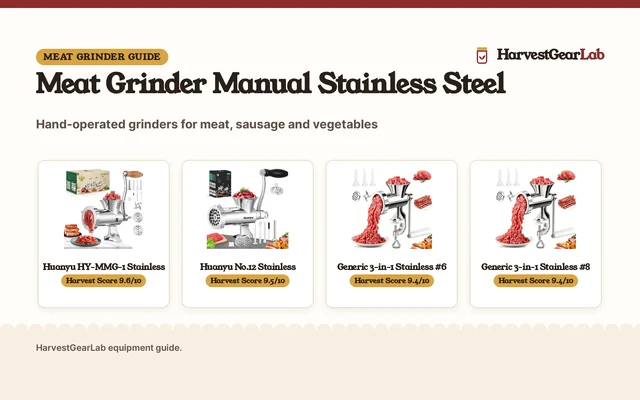
 Huanyu manual stainless steel meat grinder with sausage tubes9.6/10View on Amazon
- 2
 Huanyu No.12 stainless steel manual meat grinder with biscuit9.5/10View on Amazon
- 3
 Generic 3-in-1 Manual Meat Grinder9.4/10View on Amazon
A crate of fruit on the counter at the end of harvest season is the moment a manual juicer earns its place. A stainless steel manual juicer turns that fruit into juice by hand, with a lever, a press plate and a strainer doing the work that a motor does in an electric model. This guide explains the parts, the pressing steps, and how to clean and store the press so it is ready for the next batch.
HarvestGearLab earns a commission when you buy through links on this site, at no extra cost to you. As an Amazon Associate I earn from qualifying purchases. Affiliate disclosure.
Stainless steel manual juicer: the short list
A manual juicer has few parts, and each part has a job. The table below lists the parts and what to look for in each.
| Part | What it does | What to look for |
|---|---|---|
| Lever and handle | Carries hand pressure down to the press plate | A long, solid lever that moves smoothly |
| Press plate | Pushes the fruit against the strainer | A flat plate that covers the fruit fully |
| Strainer | Holds back pulp and seeds while juice runs through | Fine, even holes that rinse clean |
| Cup or bowl | Catches the juice under the strainer | A spout for pouring and a stable base |
| Base and feet | Keeps the press steady on the counter | A wide base with feet that grip |
Start with the fruit, not the press
Good juice starts before the press comes out of the cupboard. Pick fruit that is ripe and heavy for its size, with skin that gives a little under the thumb, and wash it well. Citrus fruit presses best when it is halved across the middle and seated cut side down on the cone or plate, so the rind forms a cup that holds the pulp while the juice runs out. Stone fruit needs the pit removed before pressing, and apples and pears need to be cut into pieces that fit under the plate, since a whole apple will not sit flat and the press cannot reach the flesh evenly. Fruit that is underripe gives little juice and a sharp taste, while fruit that is overripe can turn to mush and clog the strainer, so taste a piece before pressing a full batch.
How to use a stainless steel manual juicer
Set the press on a firm counter
Place the juicer on a flat, dry counter with the cup under the strainer and the feet planted. A damp cloth under the base keeps the press from sliding while the lever is pulled, and a tall glass or jug under the spout saves pouring the juice later. Keep the work area clear, since the lever swings in an arc and needs room to move.
Halve the fruit and seat it cut side down
Cut citrus across the middle and set a piece cut side down on the strainer or cone. For apples, pears and similar fruit, cut the fruit into wedges that fit inside the press bowl and lay them flat, skin side up, so the plate meets the flesh. Leave space around the edges, since fruit that hangs over the rim will slip out when the plate comes down.
Pull the lever with steady pressure
Grip the handle with the palm of the hand and pull down in a slow, even motion, letting the weight of the arm do the work rather than forcing the lever. Hold the press for a short pause at the bottom of the stroke so the last juice can run through the strainer, then lift the lever and check the pulp. Work through the fruit in small loads rather than piling the bowl high, since a full bowl presses unevenly and leaves juice behind.
Strain and pour
Lift the cup from under the strainer and pour the juice through the strainer into a glass or jug if the pulp is fine enough to pass through. Some presses have a strainer that lifts out, which makes it easy to tip the pulp into the compost and rinse the parts. Drink the juice soon after pressing, or chill it in a covered jug, since fresh juice changes flavour as it stands.
Parts to check before you buy
Stainless steel is the right material for a press that meets acidic juice every day, since it resists stains and odours and does not pass flavour to the juice. Look for a press where the steel feels thick and the joints are tight, with no wobble in the hinge when the lever is moved. A strainer with fine, even holes gives clear juice, while a coarse strainer lets pulp through and clogs less often, so the choice depends on whether the juice is drunk straight or used for cooking.
Cleaning and storage
Rinse the press as soon as the last fruit is pressed, since pulp dries hard on steel and in the strainer holes. Take the strainer out, run warm water over every part, and use a soft brush on the holes if pulp has lodged in them. A little washing up liquid on a cloth cleans the cup and plate, and every part should be dried fully before the press goes back in the cupboard, since water left in the hinge or under the plate can leave marks. Store the press where the lever cannot fall and catch on other gear, and keep the cup with the press so the set stays together.
What to skip or double-check
- Presses with a plastic strainer: plastic stains with citrus and berry juice and can hold odours, so a steel strainer is the safer choice for daily use.
- A base that rocks: if the press rocks on a flat counter, the lever will pull it across the surface and the juice will miss the cup.
- Fruit with pits left in: pits can crack the strainer and add a bitter note to the juice, so remove them before pressing.
- Pulp left to dry: dried pulp clogs the strainer and needs soaking to shift, so rinse the parts while the pulp is still wet.
- Juice left standing in the cup: fresh juice changes flavour as it stands, so pour it into a jug or glass soon after pressing.
What this guide does not cover
This is a guide to using a manual juicer. It does not give recipes, preserving methods or storage times for juice. For keeping juice beyond the day, follow current USDA and National Center for Home Food Preservation guidance, and use a method that the guidance covers for the fruit in question. Every harvest and preserving guide on the site is collected in the harvest section.
FAQ: preserving at home
Can a manual juicer handle whole fruit?
No, fruit needs to be cut to fit the press. Halve citrus across the middle, remove pits from stone fruit, and cut apples and pears into wedges that sit flat under the plate.
Is stainless steel better than plastic for a manual juicer?
For a press that meets acidic juice daily, yes. Stainless steel resists stains and odours and does not pass flavour to the juice, while plastic can stain and hold smells over time.
Do I need to peel fruit before pressing?
Citrus is pressed with the rind on, cut side down, so the rind forms a cup that holds the pulp. Apples and pears can be pressed with the skin on once they are cut into wedges, as long as the fruit is washed well.
How do I keep a manual juicer from rusting?
Rinse the press after each use, dry every part fully before storing it, and keep it in a dry cupboard. Water left in the hinge or under the plate is what leaves marks on the steel.
More preserving guides
See the how to use a manual juicer guide, the manual citrus press juicer guide and the manual hand press juicer guide.
More picks: manual fruit juicers, masticating juicers for home use, cider presses and stainless steel vs aluminum steam juicers.