
On this page
Top picks at a glance
As an Amazon Associate I earn from qualifying purchases.
- 1
 Syntus 30 Pcs Reusable Vacuum Sealer Bags9.7/10View on Amazon
- 2
 OutOfAir Gallon Vacuum Sealer Bags9.7/10View on Amazon
- 3
 O2frepak Gallon Vacuum Sealer Bags9.6/10View on Amazon
- 4
 Syntus 200 PCS Vacuum Sealer BagsView on Amazon
- 5
 Syntus 100 PCS Vacuum Sealer BagsView on Amazon
- 6
 Bonsenkitchen Precut Vacuum Sealer Bags 100 CountView on Amazon
- 7
 Vacuum Sealer Bags RollsView on Amazon
- 8
 FoodSaver Easy Fill 1-Gallon Vacuum Sealer BagsView on Amazon
- 9
 Potane Vacuum Sealer BagsView on Amazon
Textured vs smooth vacuum sealer bags is really a question about how your sealer pulls air out. The short answer: use textured (embossed) bags with a suction or clamp style sealer, because the channels give the air a path out; smooth bags are for chamber sealers or for jobs where the smooth side faces up. Every bag listing in this guide is a textured example, and the listings themselves explain which side goes where.
Runners-up to consider
 Syntus 200 PCS Vacuum Sealer BagsCheck price on Amazon
 Syntus 100 PCS Vacuum Sealer BagsCheck price on Amazon
 Bonsenkitchen Precut Vacuum Sealer Bags 100 CountCheck price on Amazon
 Vacuum Sealer Bags RollsCheck price on Amazon
 FoodSaver Easy Fill 1-Gallon Vacuum Sealer BagsCheck price on Amazon
 Potane Vacuum Sealer BagsCheck price on Amazon
HarvestGearLab earns a commission when you buy through links on this page, at no extra cost to you. As an Amazon Associate I earn from qualifying purchases. Affiliate disclosure.
Textured vs smooth vacuum sealer bags: what the texture does
Most home vacuum sealers are suction sealers: the bag’s open end sits in the machine, the machine draws the air out, and then it heat seals the end. For that to work, air must be able to travel from the food to the open end. On a perfectly smooth bag the plastic can press flat against itself and trap pockets of air. The textured side fixes that. Wevac states that its embossed channels increase suction, Bonsenkitchen describes 4 mil bags with embossed air-removal channels, and Syntus describes a single-side embossed dotted design that maximizes suction. The texture is a set of tiny air passages, not decoration.
Almost every bag here is textured on one side only. Bonsenkitchen states its bags have one side with a recess groove design and the other side glossy and transparent. Syntus gives the loading rule directly: orient the bag with the smooth side up and the textured side down, then insert the open end into the sealer. The smooth side still seals, and its job is to stay flat and clear against the heat bar while the textured side carries the air out. So the textured vs smooth question is not either-or: the winning bag has both, one on each face.
| Side | What it is | How to load it | Watch for |
|---|---|---|---|
| Textured (embossed) | Raised channels or dots that keep air passages open | Textured side down in the sealer | Must face the suction side of your machine |
| Smooth (glossy) | Flat, clear face that meets the heat bar | Smooth side up in the sealer | Alone, without texture, it can trap air in a suction sealer |
When smooth matters on its own
There are jobs where the smooth side does the real work. Syntus tells you to leave at least 3 inches of space at the top of the bag so the opening lies flat in the sealer; a smooth, flat opening seals more reliably than a wrinkled one. Potane warns that wrinkles at the bag opening can compromise the seal and advises smoothing them out before sealing, especially with new rolls. Chamber sealers, which pull air from the whole chamber rather than through the bag mouth, can use smooth bags, but the listings here all assume a suction machine. Our best vacuum sealer guide lines up the machine types side by side.
Sizes and formats in the listings
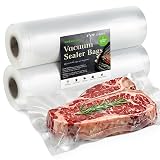
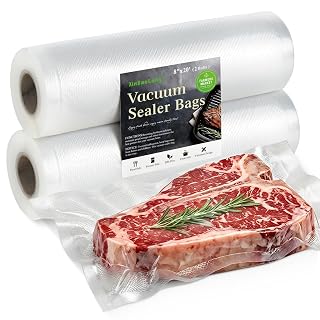
These listings come in two formats. Precut bags are ready to seal: Wevac lists 11 by 16 inch gallon bags and 6 by 10 inch pint bags in 100 counts, Bonsenkitchen lists 8 by 12 inch quart bags in a 200 count, and Syntus lists a 150 bag combo with 50 each of the 8 by 12, 11 by 16 and 6 by 10 inch sizes. Rolls let you cut the length you need: Bonsenkitchen lists 2 packs of 11 inch by 20 foot rolls, Syntus lists 3 rolls of 8 inch by 20 feet plus 3 rolls of 11 inch by 20 feet for 120 feet total, Potane lists the same 120 foot combination in a 6 pack, EverFresh lists 4 packs of 11 inch by 25 foot rolls for 100 feet, O2frepak lists 2 packs of 11 inch by 50 foot rolls for 100 feet total, and Wevac lists a single 11 inch by 150 foot roll with a cutter box.
Thickness is stated in mils. Bonsenkitchen, Syntus and O2frepak all list 4 mil bags, and Potane describes a thickened 7-layer design. EverFresh gives the most detail: a 15 mil embossed layer with 15 percent thicker embossing and a 3.5 mil smooth layer. Temperature ratings vary by listing: Bonsenkitchen rates its rolls for sous vide up to 230 degrees F (110 degrees C) and its precut bags up to 195 degrees F (90 degrees C), while Syntus rates its bags from minus 20 degrees C to 100 degrees C (minus 4 degrees F to 212 degrees F). Match the rating to the job before you boil or sous vide in a bag.
Matching bags to your sealer
All of these listings state compatibility with suction or clamp style sealers, and most name the major brands. Two warnings in the listings are worth reading. Syntus states its bags are not compatible with handheld vacuum sealers, which work differently from desktop machines. Potane notes that some entry-level or older vacuum sealers may not be fully compatible with its bags and might not achieve an optimal seal. O2frepak phrases it positively: its bags are compatible with all clamp style vacuum sealer machines. If your sealer is old or handheld, check the bag listing against the machine manual rather than assuming fit. For storage after sealing, see our best mylar bags for vacuum sealer guide and the vacuum sealers section.
FAQ: preserving at home
Do textured vacuum sealer bags work with any sealer?
They work with suction and clamp style desktop sealers, which every listing here names. Syntus states its bags are not compatible with handheld vacuum sealers, and Potane warns that some entry-level or older sealers may not seal its bags optimally.
Which side of the bag goes up in the sealer?
Smooth side up, textured side down. Syntus states this orientation directly: the textured side carries the air out while the smooth side meets the heat bar.
Can I use fully smooth bags in a suction sealer?
The listings here do not sell a fully smooth bag, and they describe the embossed channels as what increases suction. A smooth bag can press flat and trap air, so stick with textured bags for suction machines.
How much headspace should I leave at the top of the bag?
Syntus advises leaving at least 3 inches of space at the top so the open end inserts evenly and does not interfere with the seal. Potane adds that the opening should be smooth and flat, with no wrinkles.
What temperatures can these bags handle?
It depends on the listing. Syntus rates its bags from minus 4 degrees F to 212 degrees F. Bonsenkitchen rates its rolls for sous vide up to 230 degrees F and its precut bags up to 195 degrees F. Check your bag’s listing before boiling or sous vide cooking.
More preserving guides
See every vacuum sealers guide and all food storage guides.
More picks: vacuum sealers, vacuum sealers for bulk meat, mylar bags for vacuum sealer and vacuum sealer bags for freezing.