
On this page
Top picks at a glance
As an Amazon Associate I earn from qualifying purchases.
- 1
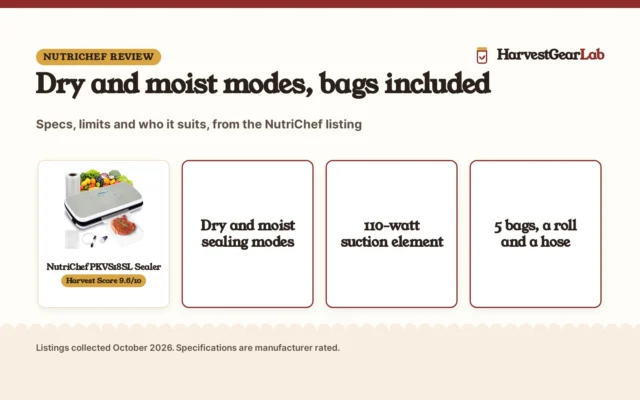
 NutriChef PKVS18SL Automatic Vacuum Sealer9.6/10View on Amazon
- 2
 MAGIC SEAL MS175 Nozzle Vacuum Sealer for Mylar Bags9.3/10View on Amazon
- 3
 FoodSaver Vacuum Sealer FSFRSH0053 FreshSaver HandheldView on Amazon
- 4
 FoodSaver® Handheld+ 2-in-1 Vacuum Sealing SystemView on Amazon
- 5
 FoodSaver Vacuum Sealing System Handheld Sealer Single HandedView on Amazon
The counter is full of dried beans and the freezer needs filling, and the question is how to pack it all, because vacuum sealing vs mylar bags is really a question about the freezer or the pantry. This guide compares the two methods: what each one does to the food, what the mylar listings state about sizes and thickness, and when each method makes sense. Every number below comes from an Amazon listing for a mylar bag we read for this guide.
Runners-up to consider
 FoodSaver Vacuum Sealer FSFRSH0053 FreshSaver HandheldCheck price on Amazon
 FoodSaver® Handheld+ 2-in-1 Vacuum Sealing SystemCheck price on Amazon
 FoodSaver Vacuum Sealing System Handheld Sealer Single HandedCheck price on Amazon
HarvestGearLab earns a commission when you buy through links on this site, at no extra cost to you. As an Amazon Associate I earn from qualifying purchases. Affiliate disclosure.
Vacuum sealing vs mylar bags: the short answer
Use vacuum sealing for the freezer and for short-term pantry packing, and use mylar bags for long-term dry storage in the pantry. A vacuum sealer pulls the air out of a bag so the plastic shrinks onto the food. Mylar bags are foil pouches that block light, air and moisture; you heat-seal them shut and add oxygen absorbers for the long haul. Neither method makes food shelf stable or safe for a set time on its own. Pick the method by where the food will live.
If you would rather go straight to the products, our best mylar bags for food roundup scores the bag options on these points.
What the mylar listings state
Mylar bag listings state the size, the thickness in mil and the pack count. The Home Sensei listing states 60 one-quart bags at 7 by 10 in, 10 mil thick (5 mil on each side), with 60 labels included. Wallaby lists a 1-quart bag at 12 mil (6 mil each side) in a 50 pack and a 2-quart bag at 14 mil (7 mil each side) in a 50 pack. The LOKQING listing states 200 stand-up bags at 5 by 8 in, 7.5 mil thick (3.75 mil each side). Smaller pouches run from 2.4 by 3.9 in (Jetmore, 300 pcs) to 3 by 4.7 in (FUNFERY, 100 pcs) to 4.7 by 7.9 in (FireKylin, 100 pcs).
| Listing | Stated size | Thickness | Pack |
|---|---|---|---|
| Home Sensei | 1 quart, 7 by 10 in | 10 mil, 5 each side | 60 |
| Wallaby 1-quart | 1 quart | 12 mil, 6 each side | 50 |
| Wallaby 2-quart | 2 quart | 14 mil, 7 each side | 50 |
| LOKQING | 5 by 8 in | 7.5 mil, 3.75 each side | 200 |
| FireKylin | 4.7 by 7.9 in | Not stated | 100 |
| FUNFERY | 3 by 4.7 in | Not stated | 100 |
| Jetmore | 2.4 by 3.9 in | Not stated | 300 |
Thicker bags cost more per bag but resist punctures better, which is why the Wallaby listing pairs its 12 and 14 mil bags with emergency preparedness. Our 7 mil vs 5 mil mylar bags comparison walks through the thickness question in more detail.
How vacuum sealing differs
A vacuum sealer removes the air and the bag conforms to the food. Mylar bags do the opposite: the Wallaby listing warns that its bags “may NOT shrink like a vacuum bag when the oxygen has been removed”, because oxygen absorbers remove oxygen, which is only 21 percent of the air, so about 1/5 of the air volume is gone and 4/5 remains. If you want a tight, conforming package for the freezer, vacuum sealing is the method. If you want a light-blocking, moisture-blocking pouch that stands on a shelf, mylar is the package.
Vacuum sealing also works with bags and rolls from many brands; see our vacuum sealers section for the sealer options.
Oxygen absorbers: mylar’s other half
Mylar bags and oxygen absorbers are sold as a pair in the listings, but the absorbers are usually separate. The Wallaby 1-quart listing recommends 200 to 300cc absorbers, and the 2-quart listing recommends 300cc, with absorbers sold separately in both. Add the absorbers before the final seal, since they start working as soon as they meet air. One caution from the listings: the YHJZ listing says not to use its bags for hot food or anything at temperature, so let cooked and dried foods cool first.
Heat sealing and resealing
Mylar bags close two ways. The Home Sensei listing says to zip seal and reseal the 1-quart bag, or heat-seal it for long-term food storage. The Wallaby bags are heat-sealable, and the FireKylin listing describes a resealable stand-up pouch you can open and close repeatedly. The LOKQING listing says its bags cannot be heated, so do not run that brand through a heat sealer. If you plan to heat-seal, read our best impulse heat sealer for mylar bags guide before you buy the bags.
What this guide does not cover
This is an equipment guide. It does not give recipes, processing times, canning pressures, altitude changes, salt ratios or storage times. Take those from current USDA and National Center for Home Food Preservation guidance, and follow them exactly for each food.
FAQ: preserving at home
Can you vacuum seal mylar bags?
Not like vacuum bags. The Wallaby listing warns that mylar bags may not shrink like a vacuum bag when the oxygen is removed, because absorbers remove only the oxygen, which is 21 percent of the air, leaving about 4/5 of the air volume in place.
What thickness mylar bag do I need?
The listings we read state 10 mil (Home Sensei), 12 mil (Wallaby 1-quart), 14 mil (Wallaby 2-quart) and 7.5 mil (LOKQING). Thicker bags resist punctures better for long-term pantry storage.
Do mylar bags need oxygen absorbers?
The Wallaby listings recommend 200 to 300cc absorbers for 1-quart bags and 300cc for 2-quart bags, sold separately. The bags block light, air and moisture, and the absorbers handle the oxygen left inside.
More preserving guides
See every vacuum sealer guide and all food storage guides.
More picks: mylar bags with oxygen absorbers, mylar bags for vacuum sealer, 7 mil vs 5 mil mylar bags and impulse heat sealers.