
On this page
Top picks at a glance
As an Amazon Associate I earn from qualifying purchases.
- 1
 FoodSaver Vacuum Sealer FSFRSH0053 FreshSaver HandheldView on Amazon
- 2
 FoodSaver® Handheld+ 2-in-1 Vacuum Sealing SystemView on Amazon
- 3
 FoodSaver Vacuum Sealing System Handheld Sealer Single HandedView on Amazon
- 4
 Hand Impulse Sealer Heat Seal Machine Poly Sealing WithView on Amazon
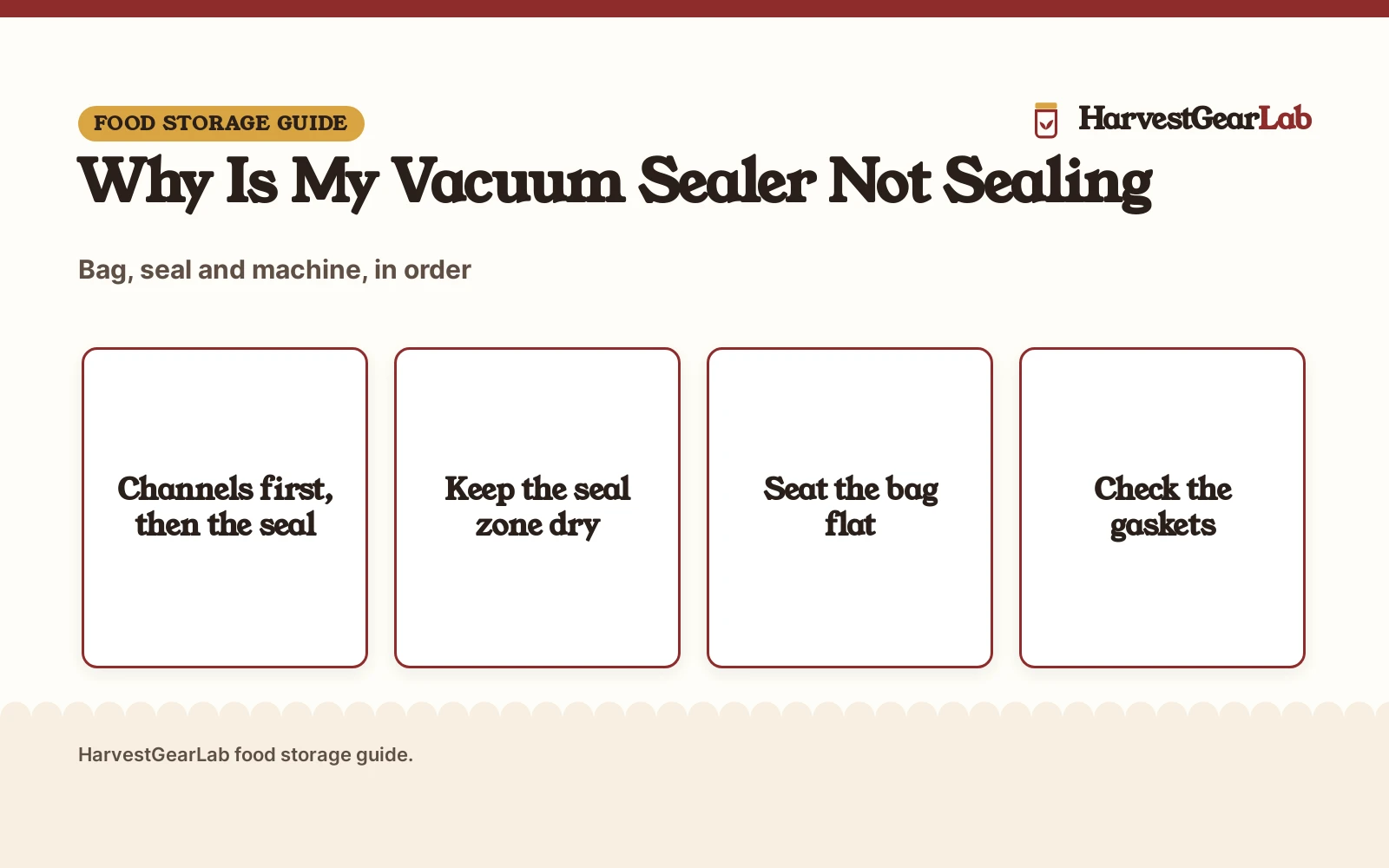
Why is my vacuum sealer not sealing is usually a bag problem before it is a machine problem: the bag has to have air channels, sit flat in the vacuum channel, and stay dry and clean where the seal forms. When one of those fails, the machine pulls air but the bag never tightens, or the seal looks closed and opens later. This guide walks through the checks in order, from the bag to the machine, so you can find the cause before you buy parts.
Runners-up to consider
 FoodSaver Vacuum Sealer FSFRSH0053 FreshSaver HandheldCheck price on Amazon
 FoodSaver® Handheld+ 2-in-1 Vacuum Sealing SystemCheck price on Amazon
 FoodSaver Vacuum Sealing System Handheld Sealer Single HandedCheck price on Amazon
 Hand Impulse Sealer Heat Seal Machine Poly Sealing WithCheck price on Amazon
HarvestGearLab earns a commission when you buy through links on this site, at no extra cost to you. As an Amazon Associate I earn from qualifying purchases. Affiliate disclosure.
Why is my vacuum sealer not sealing: the short list
Most sealing failures come down to a short list of causes. The table shows each one, what you see, and the first thing to check.
| Cause | What you see | Check first |
|---|---|---|
| Wrong bag | The machine runs but the bag stays loose | Whether the bag has embossed air channels |
| Bag not seated | Air pulls from one side only, or not at all | Whether the open end sits flat in the vacuum channel |
| Wet seal zone | The seal looks closed, then opens later | Whether the inside of the bag is dry where it seals |
| Wrinkles in the seal | Air leaks back in along a fold | Whether the bag lies flat across the seal bar |
| Bag too short | The bag pulls out of the channel as it vacuums | Whether enough bag sits past the seal bar |
| Worn gaskets | The lid will not hold a vacuum at all | Whether the gaskets are cracked, flat or dirty |
Start with the bag
A suction sealer needs a bag with air channels, and a smooth bag will not vacuum no matter how long the machine runs. The listings here all state embossed or textured channels: Syntus lists a single-side textured dot pattern, Bonsenkitchen lists embossed air-removal channels with deeper air passages, and the Wevac roll (on Amazon) lists embossed channels with a cutter box. Look for the texture on one side of the bag; if both sides are smooth, the bag is made for a chamber sealer, not a suction sealer.
Match the bag to the sealer type as well. The Syntus precut bags state they work with desktop vacuum sealers and do not work with handheld vacuum sealers, since they have no air valve. A handheld sealer needs valve bags, and a desktop sealer needs channel bags. The Syntus set comes in three sizes, 6 by 10 inches, 8 by 12 inches and 11 by 16 inches, with 50 of each size in a 150 piece set, so pick the size that fits the food with room left past the seal bar.
Seat the bag and keep the seal dry
Open the bag, smooth it flat, and lay the open end across the vacuum channel so it sits past the seal bar. Close the lid and hold it down until the machine starts pulling; if the bag slips, open the lid and reseat it. A fold or wrinkle across the seal bar leaves a gap the air comes back through, so smooth the bag flat with your hands before you close the lid.
Moisture is the other common cause. Liquid or crumbs in the seal zone stop the bag from bonding, and the seal opens once the bag is back on the shelf. Wipe the inside of the bag dry where it seals, and keep food back from the opening. For wet food like soup or marinade, freeze it in the bag first so the surface is firm, then vacuum and seal. Leave room for the food to settle and for the seal to form on a clean, dry strip of bag.
When the machine is the problem
If a fresh channel bag still will not seal, look at the machine. The gaskets around the vacuum chamber wear flat over time, and a flat gasket lets air in faster than the pump pulls it out. Wipe the gaskets clean, check them for cracks, and replace them when they no longer spring back. A dirty seal bar does the same job in reverse: crumbs and melted plastic on the bar keep the bag from bonding, so let the bar cool and wipe it clean.
Try a new bag from a different part of the roll before you blame the machine, since a damaged section of bag can fail on its own. The Wevac roll is 11 inches by 150 feet with a cutter box, and the EverFresh rolls (on Amazon) are 11 inches by 25 feet in a 4 pack, so cutting a fresh length costs little and rules the bag out. If a fresh bag, a clean bar and clean gaskets still do not seal, the pump or the seal bar itself needs a repair shop.
What to skip or double-check
- Smooth bags on a suction sealer: skip them. The bag needs embossed channels, like the 4 mil bags in the listings here.
- Sealing liquids as they are: freeze wet food first, so liquid does not get pulled into the seal zone.
- Reusing a failed seal: cut the bag open past the old seal and make a fresh seal on clean bag, rather than sealing over the same spot.
- Overfilling: leave room past the seal bar, or the bag pulls out of the channel as it vacuums.
- Wrong bag size: the Bonsenkitchen and Syntus quart bags measure 8 by 12 inches, so check the bag size against the food before you fill it.
What this guide does not cover
This is a troubleshooting guide. It does not give recipes or storage times. Take those from current USDA and National Center for Home Food Preservation guidance, or from a current edition of a trusted preserving guide, and follow them exactly for each food. Every food storage guide on the site is collected in the food storage section.
FAQ: preserving at home
Why does my vacuum sealer run but the bag stays loose?
The bag usually has no air channels, or it is not seated in the vacuum channel. Channel bags like the Syntus and Bonsenkitchen listings here have an embossed texture on one side that lets the air out; a smooth bag will not vacuum on a suction sealer. Reseat the open end flat in the channel and check that the bag is a channel bag.
Can I use any plastic bag in a vacuum sealer?
No. A suction sealer needs bags with embossed air channels, and the listings here state 4 mil bags with a textured side. The Syntus precut bags state they work with desktop vacuum sealers and do not work with handheld vacuum sealers, which need valve bags instead.
Why does the seal open after a day?
Moisture or a wrinkle in the seal zone is the usual cause. Liquid or crumbs stop the bag from bonding, and the seal lets go once the bag sits. Cut the bag open past the old seal, wipe the new seal zone dry, smooth it flat, and seal again on clean bag.
How thick should a vacuum sealer bag be?
The listings here state 4 mil bags, with embossed channels for air removal. EverFresh states 15% thicker embossing on its rolls. Thickness helps the bag resist punctures from bones, but the channels matter more: a thick smooth bag still will not vacuum on a suction sealer.
More preserving guides
See every vacuum sealers guide and all food storage guides.
More picks: vacuum sealers, vacuum sealer bags and bags for sous vide and freezer storage.