
On this page
Top picks at a glance
As an Amazon Associate I earn from qualifying purchases.
- 1
 Electric Grain Mill 1000g Flour Mill9.7/10View on Amazon
- 2
 Kitchen Crop Grain Mill Wheat Flour Grinder9.7/10View on Amazon
- 3
 Moongiantgo Grain Mill Grinder9.6/10View on Amazon
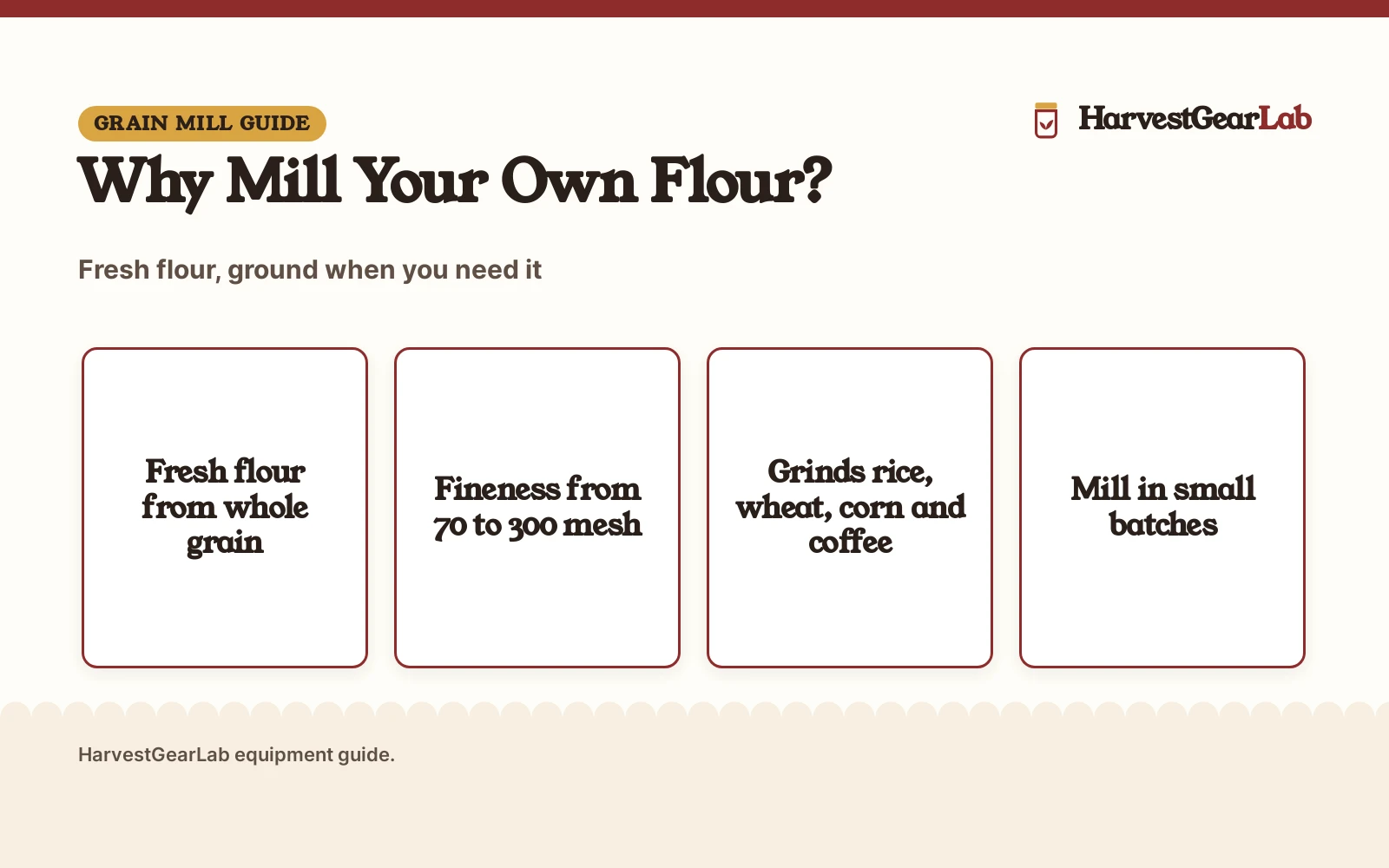
Why mill your own flour? Because milling at home gives you fresh flour from whole grain, ground to the fineness you want, in the amount you need for the batch. A grain mill turns whole wheat, rice, corn and other dry grains into flour in under a minute, so you mill what you bake and keep the grain whole until you need it. This guide explains why home milling suits a baker, what a mill does, and how to pick a mill that fits the kitchen.
HarvestGearLab earns a commission when you buy through links on this page, at no extra cost to you. As an Amazon Associate I earn from qualifying purchases. Affiliate disclosure.
Why mill your own flour: the short answer
Milling your own flour means grinding whole grain into flour at home, just before you bake. The grain stays whole until you mill it, so the flour is fresh, and you choose the fineness, from coarse meal to ultra-fine flour. A mill also grinds rice, corn, coffee and dry spices, so it does more than flour. The table shows what a mill does and what it needs.
| Step | What it does | What you need |
|---|---|---|
| Mill the grain | Grinds whole grain into flour | Bone-dry grain |
| Choose the fineness | Sets the texture from coarse to ultra-fine | A mill with a mesh range |
| Mill a batch | Makes flour for the recipe | A jar that fits the batch |
| Clean the mill | Keeps the mill ready for the next batch | A dry cloth or brush |
Fresh flour, ground when you need it
Freshness is the main reason to mill your own flour. Whole grain keeps well in the pantry, and milling turns it into flour just before you bake, so the flour is fresh for the batch. A mill grinds the grain in under a minute, so you mill what you need and keep the rest of the grain whole. The Yaofafa mill (on Amazon) in the reference listing grinds rice, wheat, corn, coffee and dry spices, so it covers baking staples and seasonings from the same jar.
Mill in small batches, since a batch is best used soon after milling. The Yaofafa mill has a 750g jar, so a batch fits the jar, and the maker says never to exceed 2/3 of the jar. Run the mill in 3-minute intervals and rest 5 to 10 minutes between runs, since the maker gives that as the best practice for the motor. Use only bone-dry materials, since wet grain will not mill well.
Control over fineness
Fineness is another reason to mill your own flour. A mill lets you choose the texture, from coarse meal for rustic bread to ultra-fine flour for cakes and pastries. The Yaofafa mill grinds to 70 to 300 mesh, so it covers fine-to-coarse textures from the same machine. The triple-blade system and the 2000W copper motor turn corn, soy, millet and hard grains into ultra-fine flour, so the mill handles hard grains as well as soft ones.
Choose the fineness for the recipe. A coarse grind suits rustic bread and porridge, while an ultra-fine grind suits cakes and pastries. The mesh range tells you how fine the mill can go: 70 mesh is coarse, and 300 mesh is ultra-fine. Check the mesh range before you buy, since a mill that only grinds coarse will not make fine flour for cakes. Compare grain mills for flour to see the mesh ranges on offer.
What a grain mill grinds
A grain mill grinds more than wheat. The Yaofafa mill grinds rice, wheat, corn, coffee and dry spices, and the large jar handles dry grains, beans, pepper, rosemary, coffee beans, nuts and herbs. Use it as a spice grinder for seasonings or a grain mill for flour for baking staples, so it replaces a spice grinder and a flour mill in the kitchen. The mill is built from 304 stainless steel for food-grade durability, and it includes automatic overload protection with a red reset button and a built-in timer.
Use only bone-dry materials in the mill, since the maker says to use only bone-dry materials and never to exceed 2/3 of the jar. Grind rice or dry tea first to help remove any new-motor smell, since the maker gives that as a tip for a new mill. Close the lid fully before starting, since the lid keeps the grain in the jar while the blades run.
How to run the mill
Running a grain mill is simple: load the jar, close the lid, set the timer and let the blades run. The Yaofafa mill has a timer switch and powerful blades, so you set the timer and the mill grinds the grain. Run the mill in 3-minute intervals and rest 5 to 10 minutes between runs, and never exceed 2/3 of the jar. The motor is 2000W, so it grinds hard grains in under a minute, but the rest between runs protects the motor.
Clean the mill after each session, since the maker says to wipe the interior with a dry cloth or brush after each session and never to rinse with water. Air dry the mill thoroughly before storing it, so the interior stays dry for the next batch. The mill measures 7.87 by 7.87 by 14.57 inches, so check that it fits the countertop before you buy. Compare grain mills for bread to see the sizes on offer.
What to skip or double-check
- Wet grain: use only bone-dry materials, as the maker says.
- Overfilling: never exceed 2/3 of the jar.
- Running without rest: run in 3-minute intervals and rest 5 to 10 minutes between runs.
- Rinsing with water: never rinse the interior with water; wipe it with a dry cloth or brush and air dry it.
- Loose lid: close the lid fully before starting.
What this guide does not cover
This guide covers why to mill your own flour and how a grain mill works. It does not give recipes, milling ratios or storage times for flour. Take recipes from a current baking guide, and store flour as the recipe or the mill manual says.
FAQ: preserving at home
Why mill your own flour?
Because milling at home gives you fresh flour from whole grain, ground to the fineness you want, in the amount you need. A mill grinds whole wheat, rice, corn and other dry grains into flour in under a minute, so you mill what you bake.
What grains can a grain mill grind?
The Yaofafa mill grinds rice, wheat, corn, coffee and dry spices, and the jar handles dry grains, beans, pepper, rosemary, coffee beans, nuts and herbs. Use only bone-dry materials.
How fine can a grain mill grind?
The Yaofafa mill grinds to 70 to 300 mesh, from coarse meal to ultra-fine flour. Choose the fineness for the recipe: coarse for rustic bread, ultra-fine for cakes and pastries.
How is a grain mill cleaned?
Wipe the interior with a dry cloth or brush after each session, never rinse with water, and air dry it thoroughly before storing. Grind rice or dry tea first to help remove any new-motor smell.
Can a grain mill grind coffee?
Yes. The Yaofafa mill grinds coffee beans, and it works as a coffee bean grinder for bone-dry beans. Use it for small-batch coffee prep as well as flour.
More preserving guides
See every grain mills guide and all harvest and processing guides.
More picks: grain mills for flour, grain mills for bread, grain mills for fine flour and food mills.