
On this page
Top picks at a glance
As an Amazon Associate I earn from qualifying purchases.
- 1
 Ziploc Food Storage and Sandwich Bags Variety Pack9.5/10View on Amazon
- 2
 Ziploc Gallon Freezer Bags with Stand-Up Bottom9.4/10View on Amazon
- 3
 ANZNKU Holographic 5x7 Inch Mylar Bags9.6/10View on Amazon
- 4
 Syntus 200 PCS Vacuum Sealer BagsView on Amazon
- 5
 Bonsenkitchen Precut Vacuum Sealer Bags 100 CountView on Amazon
- 6
 Vacuum Sealer Bags RollsView on Amazon
- 7
 Syntus 100 PCS Vacuum Sealer BagsView on Amazon
- 8
 FoodSaver Easy Fill 1-Gallon Vacuum Sealer BagsView on Amazon
- 9
 Potane Vacuum Sealer BagsView on Amazon
The freezer is full of garden beans and the last of the summer corn, and the box of zipper bags is right there on the shelf. Can you use Ziploc bags in a vacuum sealer? In most desktop vacuum sealers, no: a smooth zipper bag will not hold a vacuum, because the sealer needs a textured bag to pull the air out. This guide explains why the bag matters, which sealers work with zipper bags, and what to reach for instead.
Runners-up to consider
 Syntus 200 PCS Vacuum Sealer BagsCheck price on Amazon
 Bonsenkitchen Precut Vacuum Sealer Bags 100 CountCheck price on Amazon
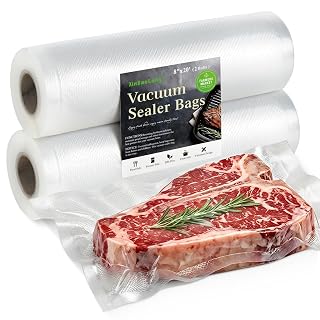 Vacuum Sealer Bags RollsCheck price on Amazon
 Syntus 100 PCS Vacuum Sealer BagsCheck price on Amazon
 FoodSaver Easy Fill 1-Gallon Vacuum Sealer BagsCheck price on Amazon
 Potane Vacuum Sealer BagsCheck price on Amazon
HarvestGearLab earns a commission when you buy through links on this site, at no extra cost to you. As an Amazon Associate I earn from qualifying purchases. Affiliate disclosure.
Can you use Ziploc bags in a vacuum sealer: the short answer
For a standard desktop vacuum sealer, the answer is no. The sealer pulls air out through the open mouth of the bag, and a smooth bag collapses flat and closes the mouth before the air is out. A textured vacuum bag keeps a path open: one side carries embossed dots or channels that let air keep moving until the sealer heat-seals the mouth shut. That is why vacuum bags carry a textured side, and why a plain zipper bag, with smooth film on each side and a zipper that was never made for a heat-seal bar, will not hold a vacuum in that machine.
The table sums up the three bag styles a home cook meets most.
| Bag style | Air path | Desktop sealer | What the listing states |
|---|---|---|---|
| Smooth zipper bag | None, smooth film on each side | Will not hold a vacuum | Zipper made for hand closing, not a heat seal |
| Textured precut bag | Embossed dots or channels on one side | Yes | Syntus lists 4 mil bags in 6 x 10, 8 x 12 and 11 x 16 |
| Textured roll | Embossed channels, cut to length | Yes | Wevac lists an 11 inch by 150 feet roll with a cutter box |
Why a smooth bag will not hold a vacuum
A desktop vacuum sealer works by suction: it draws air out of the open mouth of the bag, then heat-seals the mouth shut. For that to work, air needs a path from the far end of the bag to the mouth while the sealer pulls. A smooth bag has no such path. As the air leaves, the smooth sides press together and close the mouth, so the sealer finishes with air still trapped inside and a weak seal. A textured bag solves this with embossed channels on one side. The channels stay open under suction and carry air to the mouth, so the bag draws down flat around the food before the heat-seal bar closes. Syntus describes a single-side textured dot pattern that enhances suction, and Bonsenkitchen describes embossed air-removal channels on 4 mil bags.
Thickness matters for a different reason. A thin bag can puncture on a bone or a sharp edge, and a puncture breaks the vacuum. The listings state 4 mil material for the Syntus and Bonsenkitchen precut bags (on Amazon), and EverFresh states a 15Mil embossed layer with a 3.5Mil smooth layer. A thicker bag resists punctures better, but thickness alone will not make a smooth bag work: without channels, the air still has no path out.
Which sealers work with zipper bags
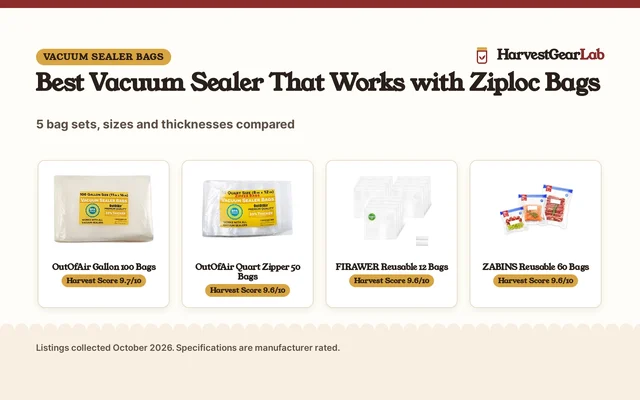
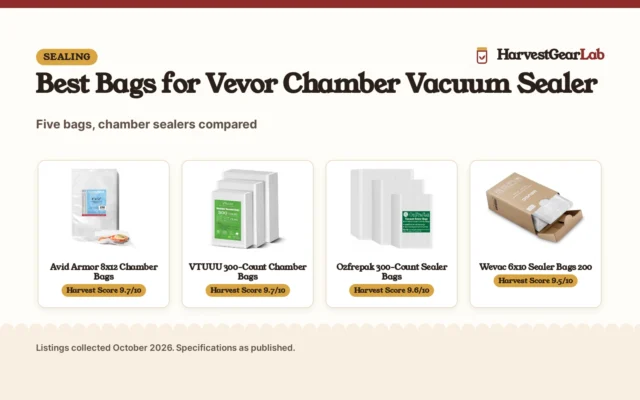
Some sealers are built for zipper bags, and some are not. A chamber sealer pulls the air out of a whole chamber, so the bag inside does not need channels, and a smooth bag can work there. A handheld sealer made for zipper bags with a valve can also work, since the valve gives the air a way out. A standard desktop suction sealer is the one that needs textured bags. The Syntus listings state this plainly: the precut bags have no zipper or air valve and cannot be used with handheld vacuum sealers, and the bags are designed for traditional desktop vacuum sealer machines. If the goal is to keep using zipper bags, look for a sealer made for them: the best vacuum sealer that works with Ziploc bags guide compares the options.
What to use instead
Use textured vacuum bags made for a desktop sealer. Precut bags come ready to fill: Syntus lists a 150-count set with 50 each of 11 x 16, 8 x 12 and 6 x 10, and a 200-count set of 8 x 12 quart bags. Each set uses 4 mil material with a single-side textured pattern. Bonsenkitchen lists a 200-count set of 8 x 12 quart bags, also 4 mil, with embossed air-removal channels. Rolls suit odd sizes: Wevac lists an 11 inch by 150 feet roll with a cutter box, and EverFresh lists a 4 pack of 11 x 25 feet rolls with 15% thicker embossing. Pick the size that fits the food, and check the bag sizes chart in the vacuum sealer bag sizes guide before ordering.
Compare the current bag options in the best vacuum sealer bags guide, and see the roll options in the best 11 inch vacuum sealer rolls guide.
How to seal with a textured bag
Fill the bag, leaving room at the open end for the sealer to grip, then wipe the inside of the mouth clean so food or liquid does not sit where the heat seal will form. Lay the open end flat in the sealer channel, close the lid, and run the seal cycle. When the cycle ends, check the seal line: it should look flat and even from edge to edge, with no gaps or wrinkles. If the seal looks weak, cut the end off and seal again on a fresh edge. The how to vacuum pack food guide walks through the same steps with more detail on packing different foods.
FAQ: preserving at home
Can you use Ziploc bags in a chamber vacuum sealer?
Yes, in most cases. A chamber sealer removes air from the whole chamber, so a smooth bag does not need channels to let the air out. Check the sealer manual for the bag styles it accepts before buying bags for it.
Why do vacuum sealer bags have a textured side?
The texture gives air a path out of the bag while the sealer pulls a vacuum. Syntus describes a single-side textured dot pattern that enhances suction, and Bonsenkitchen describes embossed air-removal channels on 4 mil bags.
Can you reuse vacuum sealer bags?
Some bags can be washed and used again. Bonsenkitchen states its bags can be microwaved, frozen, re-used, washed, boiled and dishwasher safe, and EverFresh states that washed and dried bags can be used again. See the can you reuse vacuum seal bags guide for the limits.
What size vacuum sealer bag fits the food?
Match the bag to the food. Syntus lists precut bags in 6 x 10 pint, 8 x 12 quart and 11 x 16 gallon sizes, and Wevac lists an 11 inch by 150 feet roll for cutting to length. See the sizes in the vacuum sealer bag sizes guide.
Can you sous vide in a vacuum sealer bag?
Yes, with bags made for it. Bonsenkitchen states its bags can be used for sous vide in water at any temperature up to 195°F/90°C, and Syntus states its bags are suitable for boiling and sous vide cooking. EverFresh states to puncture the bag before using it in the microwave.
More preserving guides
See every vacuum sealers guide and all food storage guides.
More picks: vacuum sealer bags, sealers that work with Ziploc bags, reusing vacuum seal bags and 11 inch vacuum sealer rolls.