
On this page
Top picks at a glance
As an Amazon Associate I earn from qualifying purchases.
- 1
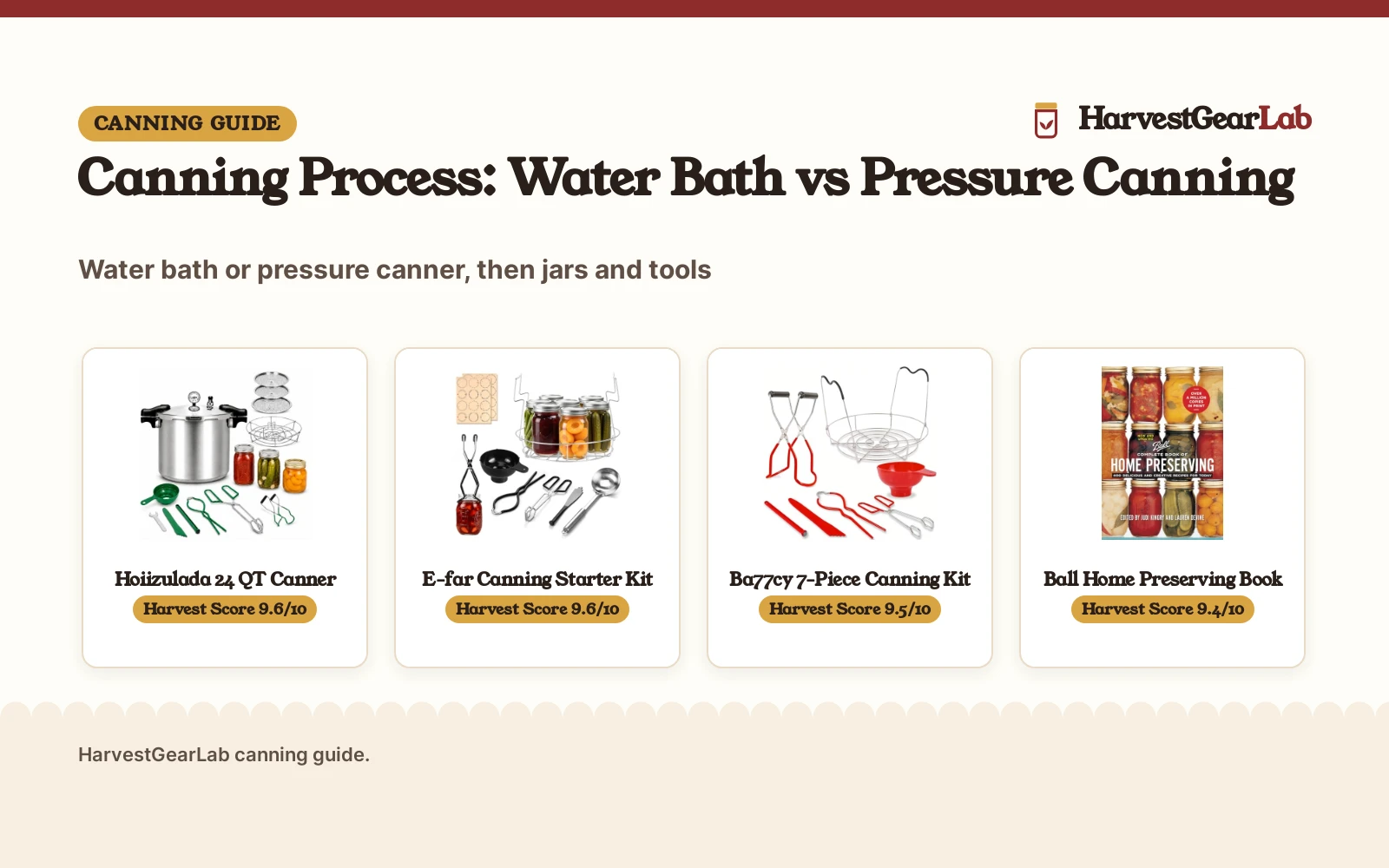
 Hoiizulada 24 QT Canner9.6/10View on Amazon
- 2
 E-far Canning Starter Kit9.6/10View on Amazon
- 3
 Ba77cy 7-Piece Canning Kit9.5/10View on Amazon
A counter full of tomatoes and the first apples of the season mean the pantry needs filling, and the canning process is how that harvest becomes jars on a shelf. It comes down to a boiling water bath for high-acid foods such as jams, pickles and acidified tomatoes, and a pressure canner for low-acid foods such as plain vegetables, meat and stock. This guide walks through both methods in order, then shows the gear that handles each step.
HarvestGearLab earns a commission when you buy through links on this page, at no extra cost to you. As an Amazon Associate I earn from qualifying purchases. Affiliate disclosure.
| # | Product | Harvest Score | Buy |
|---|---|---|---|
| 1 | Hoiizulada 24 QT Canner | 9.6/10 | Buy on Amazon |
| 2 | E-far Canning Starter Kit | 9.6/10 | Buy on Amazon |
| 3 | Ba77cy 7-Piece Canning Kit | 9.5/10 | Buy on Amazon |
| 4 |  Ball Home Preserving Book | 9.4/10 | Buy on Amazon |

Hoiizulada 24 QT Canner
A 24 quart pressure canner with a gauge, a regulator and 3 steamer racks for low-acid foods such as plain vegetables, meat and stock.
Pros
- 24 quart capacity with 3 steamer racks included
- Built-in gauge and regulator stated for pressure control
- Induction, gas and electric compatible base
Cons
- No warranty term is stated
- No jar count is stated for the 24 quart interior
- No weight is stated in the listing

E-far Canning Starter Kit
A stainless steel starter kit with a rack that holds 6 quart jars or 7 pint jars, plus the ladle, funnel, tongs, jar lifter, wrench and lid lifter for filling and moving hot jars.
Pros
- Rack holds 6 quart jars or 7 pint jars and fits water bath canners 12.4 inches or larger
- 24 canning labels included with the kit
- Stainless steel tools with heat-resistant, rubber-coated handles
Cons
- No warranty term is stated
- Rack fits only canners 12.4 inches or larger, so measure the pot first
- No canner or jars are included

Ba77cy 7-Piece Canning Kit
A 7-piece stainless steel canning tool set with a steamer rack, funnel, jar lifter, wrench, tongs, lid lifter and bubble remover for filling and handling hot jars in both pressure and water bath canning.
Pros
- 7 tools in one set, including steamer rack, funnel, jar lifter, wrench, tongs, lid lifter and bubble remover
- Stainless steel construction throughout the set
- Magnetic lid lifter lifts hot lids without touching the sealing strips
Cons
- No warranty term is stated
- No rack size or jar count is stated for the steamer rack
- No canner or jars are included

Ball Home Preserving Book
A home preserving reference book to consult for the method to follow before a batch, alongside the canner and tool kits in this guide.
Pros
- Complete home preserving reference from Ball
- Measures 7.0 by 1.25 by 10.0 inches, a shelf-sized reference
- A printed reference to check before a batch, without a screen
Cons
- A book, not gear: it preserves nothing on its own
- Released in 2020, so check it against current USDA and National Center for Home Food Preservation guidance
- No canner, jars or tools are included
As an Amazon Associate I earn from qualifying purchases.
Canning process: the short answer
Pick the method by the food. High-acid foods go in a boiling water bath; low-acid foods need a pressure canner, because boiling water alone does not get hot enough for them. Jars, new lids and bands, and hand tools serve both methods.
| Method | Foods | Gear | Amazon |
|---|---|---|---|
| Water bath | Jams, jellies, pickles, acidified tomatoes | Water bath canner with rack, jars, lids, hand tools | |
| Pressure | Plain vegetables, meat, poultry, seafood, stock | Pressure canner with gauge, jars, lids, hand tools |
Water bath canning
Fill clean jars with the food, leaving the headspace the recipe gives, wipe the rims, set new lids and bands in place, and lower the jars onto the rack in the canner. Cover the jars with boiling water, bring the pot back to a full boil, and follow the processing time in a current USDA recipe or National Center for Home Food Preservation guidance for that food. Lift the jars out with a jar lifter, set them on a towel to cool, then check each seal.
The E-far starter kit (on Amazon) below handles the filling and lifting steps: its rack holds 6 quart jars or 7 pint jars, and its ladle, funnel, tongs, jar lifter, wrench and lid lifter move hot jars and fill them. The Ba77cy 7-piece kit (on Amazon) covers the same steps with a steamer rack, funnel, jar lifter, wrench, tongs, lid lifter and bubble remover.
Pressure canning
Low-acid foods need a pressure canner, which locks shut and traps steam so the pot runs hotter than boiling water. Load the jars onto the racks, lock the lid, vent the canner as the maker directs, then hold it at the pressure and for the time a current USDA recipe or National Center for Home Food Preservation guidance gives for that food. Let the canner cool and the pressure drop on its own before opening the lid, then lift the jars out with a jar lifter.
The Hoiizulada 24 (on Amazon) quart pressure canner below handles this method, with a built-in gauge, a regulator and 3 steamer racks for organizing jars inside the pot. Its base works on induction, gas and electric cooktops, and the listing states a lid-locking structure with dual pressure-relief components.
The gear for the canning process
Each step above needs gear: the pressure canner for low-acid foods, the rack and hand tools for filling and lifting hot jars, and a reference book for the method to follow.
How to choose the best canning process gear
Match the canner to the food list
Start with the foods on the list. A pressure canner such as the Hoiizulada 24 quart model suits plain vegetables, meat and stock, while a water bath canner suits jams, pickles and acidified tomatoes. Check the capacity in quarts and the racks included, and confirm the listing sells the pot as a canner. Compare current options in the best pressure canner guide.
Count the tools, then check the rack
A kit should cover filling and lifting, with a rack that fits the pot. The E-far kit lists a rack that holds 6 quart jars or 7 pint jars and fits water bath canners 12.4 inches or larger, so measure the pot before buying. The Ba77cy kit lists 7 tools with a steamer rack and a magnetic lid lifter, and both kits list stainless steel construction with heat-resistant handles. See the best canning tool kit comparison for more sets.
Keep a printed reference on hand
The Ball Complete Book of Home Preserving in the gear section below is a printed reference for the method to follow, and a current USDA or National Center for Home Food Preservation guide serves the same purpose.
What this guide does not cover
This guide covers equipment and method, not recipes. It gives no processing times, pressures, headspace figures or altitude changes. Take those from current USDA and National Center for Home Food Preservation guidance and follow them exactly for each food. Every canner and tool guide on the site is collected in the canning section.
FAQ: preserving at home
Do I need a pressure canner to start canning?
Only for low-acid foods such as plain vegetables, meat, poultry, seafood or stock. For jams, jellies, pickles and acidified tomatoes, a water bath canner is enough.
What does a canning tool kit include?
The kits in this guide include a rack, funnel, ladle, jar lifter, tongs, wrench and lid lifter. The E-far kit adds 24 canning labels, and the Ba77cy kit adds a bubble remover and a magnetic lid lifter.
Can I reuse canning jars and lids?
Jars and bands can be reused as long as they have no chips, cracks or rust. The flat lids with sealing compound are made for one use, so buy new lids for each batch.
How do I pick a pressure canner size?
Look for the quart capacity and the racks included. The Hoiizulada canner in this guide lists 24 quarts with 3 steamer racks.
Where do I find processing times and pressures?
Use current USDA and National Center for Home Food Preservation guidance for each food, or a current edition of a trusted canning guide such as the Ball book in the gear section.
More preserving guides
See every canning tools guide and all canning guides.
More picks: water bath canners, pressure canners, water bath vs pressure canner and canning tool kits.