
On this page
Top picks at a glance
As an Amazon Associate I earn from qualifying purchases.
- 1
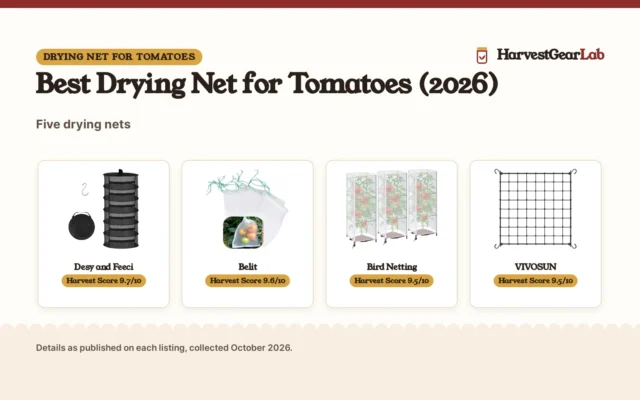
 Desy and Feeci Drying Net9.7/10View on Amazon
- 2
 RnneLeen 6 Layer Hanging Drying Net9.6/10View on Amazon
- 3Hwayslon 6 Layer Hanging Drying Net9.6/10View on Amazon
- 4
 Cosori Food DehydratorView on Amazon
- 5
 Hamilton Beach Digital Food Dehydrator for FruitView on Amazon
- 6
 NESCO FD‑80A Square Food Dehydrator for SnacksView on Amazon
- 7
 Food-Dehydrator Machine Adjustable Temperature 12 Trays 800WView on Amazon
- 8
 CROWNFUL Food Dehydrator MachineView on Amazon
- 9
 Small Food Dehydrator DryerView on Amazon
A counter full of tomatoes at the end of August forces the question: for drying net vs food dehydrator, which one should you buy? The short answer: a drying net wins for small herb and garden batches that dry well in moving air, while a food dehydrator wins for bigger batches, wetter produce and steady results, because it does not depend on the weather. This guide walks through both, then ranks the four hanging nets in this guide’s listings.
Runners-up to consider
 Cosori Food DehydratorCheck price on Amazon
 Hamilton Beach Digital Food Dehydrator for FruitCheck price on Amazon
 NESCO FD‑80A Square Food Dehydrator for SnacksCheck price on Amazon
 Food-Dehydrator Machine Adjustable Temperature 12 Trays 800WCheck price on Amazon
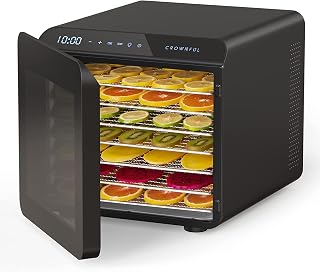 CROWNFUL Food Dehydrator MachineCheck price on Amazon
 Small Food Dehydrator DryerCheck price on Amazon
HarvestGearLab earns a commission when you buy through links on this page, at no extra cost to you. As an Amazon Associate I earn from qualifying purchases. Affiliate disclosure.
Drying net vs food dehydrator: the short answer
Both remove water from food, and they differ in how. A drying net is a stack of mesh layers that hangs in moving air; the food dries on its own time with no power cord. A food dehydrator is an electric box with a fan and heat that dries on a schedule you set. If your harvest is a few handfuls of herbs, a net is the simpler tool. If it is trays of sliced tomatoes or apples, the dehydrator finishes the job without watching the sky.
| Drying net | Food dehydrator | |
|---|---|---|
| Power | None needed | Electric |
| Layers in this guide | 4 or 7 hanging layers | Not covered here |
| Weather | Needs moving air | Works indoors year-round |
| Pest protection | Zippered mesh on all four | Enclosed box |
| Storage | Folds flat or into a pouch | A box on the shelf |
The four listings in this guide are all drying nets; no dehydrator listing is in the set, so the dehydrator side is described in general terms.
When a drying net wins
Choose the net when the batch is small and the air is moving. Herbs, seeds, flowers and thin-sliced garden extras dry fine in a hanging net, and the zippered enclosure keeps out dust, pests and curious birds. All four nets here fold or collapse for storage, so they disappear into a pouch between seasons. See our best drying net for tomatoes picks for tomato-sized batches.
When a food dehydrator wins
Choose the dehydrator when the batch is big, the produce is wet, or the weather will not cooperate. A fan and heat dry tray after tray on a predictable schedule, indoors, in any season. If you dry fruit leather, jerky or large apple harvests every fall, a dedicated machine earns its shelf space. See our best food dehydrator for home use comparison for electric options.
The four nets, ranked
Ranked by stated capacity, build detail and value, best first.
| Net | Layers | Size | Capacity | Zipper |
|---|---|---|---|---|
| SPONDWILD 7-Layer | 7 | 23.62D x 23.62W x 52.17H in | 10.5 kg | C-shaped #5 zipper |
| VIVOSUN 4-Layer | 4 | 23.62 in diameter, 30 in tall | 2.2 lbs per layer, 8.8 lb total | Green zippers |
| Coloch 4-Layer | 4 | 23.7 x 15.7 x 49.5 in | Not stated | Zipper closure |
| WEISGJA 4-Layer | 4 | 25.59 x 13.78 x 13.78 in | Not stated | Front-opening zipper |
The SPONDWILD leads on stated capacity: 7 layers at 10.5 kg with sturdier #5 zippers, a built-in storage bag and no assembly, though the maker warns the net springs open forcefully from its sack, so keep your face away. The VIVOSUN follows with the most specific layer figures, 2.2 lbs per layer across 4 layers, plus pruning shears in the box and a storage pouch. The Coloch is the tallest 4-layer at 49.5 inches with 8.7 inch tiers and a collapsible build, and the WEISGJA is the compact 4-layer with steel wire loops in each layer.
Drying mistakes to avoid
- Overloading the layers: the VIVOSUN states about 2.2 lbs per layer; spread the harvest so air moves around it.
- Drying in still, damp air: a net needs moving air; in a closed room the harvest stalls.
- Leaving the zipper open: every net here has a zipper; keep it shut against dust and pests.
- Forgetting the spring: the SPONDWILD maker warns the net springs open forcefully from its sack; keep your face away while opening.
FAQ: preserving at home
How many layers do the nets have?
Three state 4 layers: the VIVOSUN, the WEISGJA and the Coloch. The SPONDWILD states 7 layers.
How much can each layer hold?
The VIVOSUN states about 2.2 lbs per layer and 8.8 pounds total. The SPONDWILD states a 10.5 kg capacity.
Do drying nets need electricity?
No. They hang in moving air with no power cord, which is the whole point of the net side of this comparison.
How do the nets keep pests out?
Zippered mesh: the VIVOSUN is fully enclosed, the WEISGJA has a front-opening zipper, the Coloch has a zipper closure, and the SPONDWILD uses a C-shaped #5 zipper.
How do I store a drying net?
The VIVOSUN folds into a pouch, the Coloch is collapsible, and the SPONDWILD has a built-in storage bag. Open the SPONDWILD sack with care; it springs open forcefully.
More preserving guides
See every herb drying rack guide and all drying guides. Also see our best drying net for tomatoes. Also see our best food dehydrator for home use.
More picks: food dehydrators, alternative drying methods, food dehydrator guides.