
On this page
A bumper harvest of beans, peppers and onions turns into a pile of work fast, so drying vegetables for storage is the low-energy way to keep them for months: remove the water, and the food keeps without a freezer. The short version: dry thin, dry even, check for snap-dryness, then store airtight away from light. This guide covers the methods, the mesh racks and bags that hold the vegetables, conditioning, and storage.
HarvestGearLab earns a commission when you buy through links on this page, at no extra cost to you. As an Amazon Associate I earn from qualifying purchases. Affiliate disclosure.
Drying vegetables for storage: the short answer
Dry vegetables until they are brittle, not leathery: a snap-dry bean breaks cleanly instead of bending. Spread pieces in a single layer with air on all sides, keep the temperature steady, and check the thickest pieces, because those decide when the batch is done. Then condition the batch for a few days, watching for any moisture, before it goes into airtight storage. Rush any step and the storage step fails.
Start with the method, not the tool
Vegetables dry three ways: warm moving air, a food dehydrator, or hanging. Warm moving air suits herbs, peppers and beans. A dehydrator suits thick vegetables like sliced carrots and potatoes, where steady heat matters more than speed. Hanging suits whole heads, braided onions and garlic. Pick the method that matches the vegetable, then pick the tool; a rack meant for herbs will not carry a batch of potato slices.
The drying vs freezing question comes up every harvest: dehydrating shrinks the food and needs no freezer space, freezing keeps texture closer to fresh but needs power forever. Our dehydrating vs freezing comparison walks through the trade-offs.
Drying on mesh racks
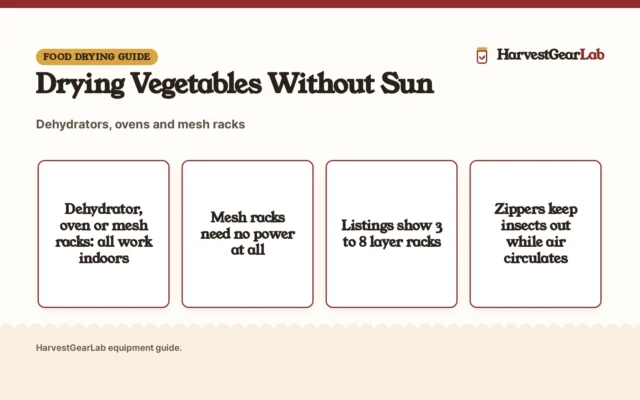
Mesh racks are the default for air drying: air reaches the food from above and below, so pieces dry evenly without turning. A four-layer folding mesh drying net in our listings measures 25.59 by 13.78 by 13.78 inches with a zipper opening, which shows what to look for: multiple layers for batch size, a zipper so pieces stay in, and mesh fine enough that small pieces cannot fall through.
Stack the layers by vegetable: herbs and flowers on the top layers where air is warmest, heavier vegetables below. Do not crowd the layers; air has to move between the pieces, and a packed rack dries slower than two half-full racks. If the bottom layer stays damp while the top crisps, swap the layers halfway through.
Hanging and air drying
Some vegetables never touch a rack. Braided onions, garlic heads and hot pepper strings hang from hooks and dry in moving air over weeks. An iron drying rack in our listings carries 81 holes with 20 S-hooks, which is the right shape for hanging: many hooks, spaced so the air reaches every head.
Hang in a dry, shaded place with moving air, never in direct sun. Sun bleaches color and cooks flavor out of peppers; shade with a breeze does the work slowly and keeps the color. Check the strings weekly: a head that slips off and sits on a damp shelf will spoil and take its neighbors with it.
Mesh bags for curing and storage
Mesh bags do double duty: they finish drying onions and potatoes in the barn, then hold them in the pantry. A 21 by 32 inch mesh bag in our listings holds 60 pounds, and an 11 by 18 inch bag holds 10 pounds, which shows the range: big sacks for the curing shed, small bags for the pantry shelf. The drawstring top keeps the bag closed without trapping moisture the way plastic does.
Finish drying before you store. Onions and garlic need their skins papery and their necks tight before they go into a bag; potatoes need their skins set. A cotton mesh bag, like the 12 by 10 inch reusable produce sacks in our listings, breathes well enough for dried-down vegetables in a cool pantry. Never store half-dried vegetables in a closed bag: the moisture has nowhere to go.
Conditioning and the storage step
Conditioning is the step everyone skips. Put the dried batch in a jar or container for several days, shake it daily and watch for condensation. If drops form, the batch is not dry: return it to the rack. Only after the batch passes the condensation check does it go into long-term storage.
Store dried vegetables airtight, cool and dark. Mason jars work for pantry storage, and mylar bags work for the long term; our mylar bag guide compares the options. Label every container with the vegetable and the date, because dried peppers and dried tomatoes look alike six months later. Check stored jars monthly for the first season: a jar that clouds is a jar to use first.
What to skip or double-check
Skip drying thick pieces whole: a whole tomato takes days and risks spoiling from the inside. Slice thick vegetables and halve cherry tomatoes so every piece is the same thickness. Double-check the thickest piece in every batch, because one under-dried piece can spoil a whole jar.
Skip the oven as a default: it is the least even drying method and the easiest way to cook the vegetables instead of drying them. If a dehydrator is not in the plan, the mesh rack and hanging methods above carry the whole harvest; our herb rack vs dehydrator comparison helps decide which suits the kitchen.
What this guide does not cover
This guide does not cover canning, fermenting or freeze drying; those are their own methods with their own safety rules. It also does not cover drying fruit, which wants different temperatures and has different spoilage signs. See our drying category for the full set of guides.
FAQ: preserving at home
How dry is dry enough for storage?
Brittle, not leathery. A snap-dry bean or pepper breaks cleanly instead of bending. If it bends, it still holds water; dry it longer.
Do I need to condition dried vegetables?
Yes. Jar the batch for several days, shake daily and watch for condensation. Drops mean the batch is not dry; return it to the rack before long-term storage.
What is the best container for dried vegetables?
Airtight, cool and dark. Mason jars for the pantry, mylar bags for the long term. Label with the vegetable and the date.
More preserving guides
See every herb drying rack guide and all drying guides.
More guides: dehydrating vs freezing and herb rack vs dehydrator.