
On this page
Top picks at a glance
As an Amazon Associate I earn from qualifying purchases.
- 1
 LEBENLANG Orange Juicer Electric with 2 Cones9.5/10View on Amazon
- 2
 Vineyard Stainless Steel Steam Juicer and Roaster Set9.6/10View on Amazon
- 3
 BLACK+DECKER 32oz Electric Citrus Juicer9.3/10View on Amazon
- 4
 VIVOHOME 11 Qt Stainless Steel Steam Juicer for Canning FruitView on Amazon
- 5
 VIVOHOME Stainless Steel Steam Juicer for Canning Fruit andView on Amazon
- 6
 Cooks Standard Steam Juicer Pot 11 Quart Stainless SteelView on Amazon
- 7
 Fruit Steam Juicer Stainless Steel SteamerView on Amazon
Electric tomato juicer vs steam juicer comes down to what you want in the jar. An electric tomato strainer presses tomatoes through a screen to make thick sauce, with the skins and seeds coming out separately. A steam juicer uses rising steam to draw clear juice out of fruit, which then drips into a collection pan. For tomato sauce, salsa and puree, the electric strainer is the right tool; for clear juice from grapes, berries or apples, the steam juicer wins. This guide walks through how each one works, what each one makes, and how to match the tool to your harvest.
Runners-up to consider
 VIVOHOME 11 Qt Stainless Steel Steam Juicer for Canning FruitCheck price on Amazon
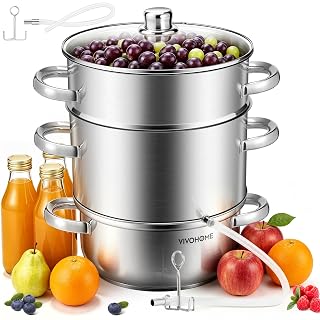 VIVOHOME Stainless Steel Steam Juicer for Canning Fruit andCheck price on Amazon
 Cooks Standard Steam Juicer Pot 11 Quart Stainless SteelCheck price on Amazon
 Fruit Steam Juicer Stainless Steel SteamerCheck price on Amazon
HarvestGearLab earns a commission when you buy through links on this page, at no extra cost to you. As an Amazon Associate I earn from qualifying purchases. Affiliate disclosure.
Electric tomato juicer vs steam juicer: the short answer
The two machines do different jobs, and the table shows the split at a glance.
| Method | What it does | Best for | Power source | What comes out |
|---|---|---|---|---|
| Electric tomato strainer | Motor-driven auger presses produce through a screen; skins and seeds exit separately | Tomato sauce, salsa, puree | Electric, e.g. 450W | Thick sauce |
| Steam juicer | Rising steam bursts fruit cells; juice drips into a collection pan | Grapes, berries, apples | Stovetop heat | Clear juice |
If your harvest is mostly tomatoes, buy the electric strainer. If it is mostly grapes or berries for jelly, the steam juicer earns its shelf space. Many preserving kitchens end up with both, since neither one does the other’s job well.
How an electric tomato strainer works
An electric tomato strainer feeds tomatoes into a hopper, where an auger crushes them and presses the pulp through a perforated screen. Skins and seeds travel out a separate chute, so there is no peeling or seeding by hand. The Kitchen Crop VKP250 ships with an apple and tomato screen with 1.3mm holes and a clamp that mounts to countertops from 3/4 inch to 2-1/8 inches thick, with 10 square inches of clamping surface; it runs on a hand crank, with an electric motor available as an add-on.
Motor size sets the pace for big harvests. The Reber N.3 lists a 450W induction motor and a rate of up to 309 pounds of tomatoes per hour, in a 21 pound unit measuring 12.5 by 19.75 by 9 inches. The larger Reber N.5 lists a 650W motor and up to 772 pounds per hour. If you already own a KitchenAid stand mixer, the KSMFVSP strainer attachment purees and strains fruit and vegetables, but it requires the KSMFGA food grinder attachment, sold separately, and its parts are dishwasher safe. Compare strainer options in our best tomato strainer for sauce and best electric tomato juicer for canning guides.
How a steam juicer works
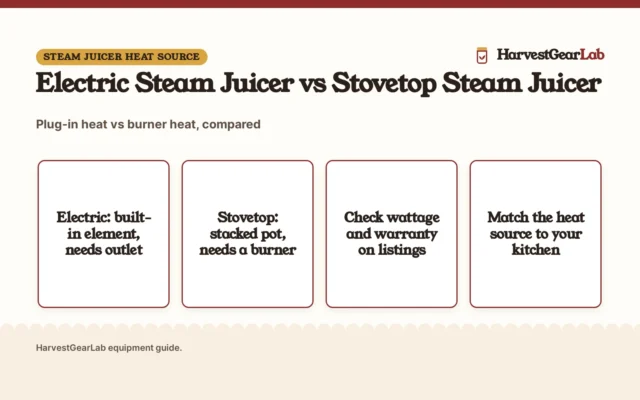
A steam juicer is a stack of three pans on the stove. The bottom pan holds boiling water, the middle pan collects juice, and the top basket holds the fruit. Steam rises through the fruit, bursts the cells, and the juice runs down into the middle pan, where a spout lets you draw it off into jars. There is no motor, no screen to choose, and no skins to separate by hand.
The trade-off is texture. Steam extraction makes clear, thin juice, which is exactly what you want for grape or berry juice and for jelly making. It is a poor way to make tomato sauce: tomatoes give up a thin juice and leave the pulp you actually want for sauce behind in the basket. A steam juicer also ties up a burner for the whole batch, while an electric strainer works on the counter wherever there is an outlet. See our steam juicers section for the category.
Which one suits your harvest
Count what comes off the vines. A household that cans twenty jars of tomato sauce a year will use an electric strainer every August and never miss a steam juicer. A household with grapevines or a berry patch will get more use from the steam juicer, drawing off clear juice for drinking and jelly. If you grow both, the strainer handles the tomatoes in August and the steam juicer handles the grapes in September, and neither machine sits idle.
Batch size matters too. A hand-crank strainer suits a few jars at a time, while a 450W or 650W electric unit suits a full harvest weekend. The Reber N.5’s stated 772 pounds per hour is built for very large batches; a smaller garden will never ask that much of it. Our food mill vs tomato strainer guide covers the manual alternative for small batches.
What to check before you buy
For an electric strainer, check the screen: a 1.3mm tomato screen gives a smooth sauce, and some makers sell separate screens for salsa, pumpkin and berries. Check the mount: a clamp model needs a counter edge between 3/4 inch and 2-1/8 inches thick, while a freestanding motor unit like the 21 pound Reber needs a permanent counter spot. Check cleanup: the KitchenAid attachment’s parts are dishwasher safe, while the Reber units are hand wash only. And check the electrics: the Elite Gourmet citrus juicer is ETL listed with BPA-free materials, a useful reminder to look for stated safety listings on any electric model.
For a steam juicer, check the construction: stainless steel pans last, and a spout with a clamp or shutoff keeps the juice where you want it. Since it runs on the stove, confirm you can spare a burner for the afternoon. Either way, keep the paperwork: current USDA and National Center for Home Food Preservation guidance sets the rules for acid, processing and storage, not the appliance maker.
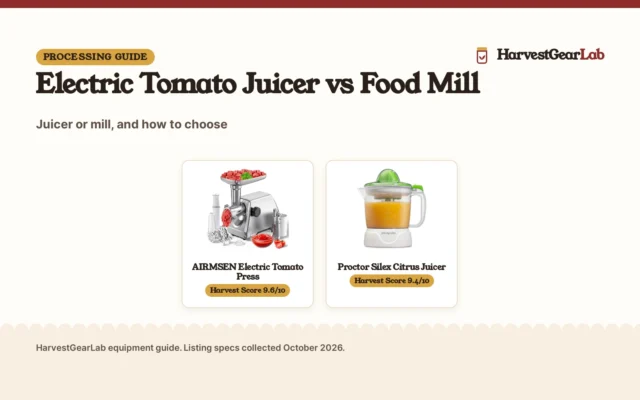
One more note: a citrus juicer is neither of these. The Elite Gourmet ETS623 is a 40W, 24 ounce citrus reamer for oranges, lemons, limes and grapefruits, and the Proctor Silex 66340 is a 30W model with a 34 ounce pitcher and two reamers. Neither one processes tomatoes, so do not buy a citrus reamer for sauce season.
FAQ: preserving at home
Can I make tomato sauce in a steam juicer?
Not well. A steam juicer draws off thin, clear juice and leaves the pulp behind, while sauce needs that pulp. Use an electric tomato strainer, which presses the pulp through a screen and ejects the skins and seeds separately.
Do I have to peel tomatoes before using an electric strainer?
No. The strainer separates skins and seeds as it works; the Kitchen Crop listing names skin and seed separation as the machine’s job. Wash the tomatoes and feed them in whole or halved.
Is a hand-crank strainer enough for a home garden?
For a few jars at a time, yes. The Kitchen Crop VKP250 runs on a hand crank with an optional electric motor for bigger days. For a full harvest weekend, a motor unit such as the 450W Reber N.3 keeps pace.
Can I water bath can tomato juice?
Follow current USDA and National Center for Home Food Preservation guidance for tomatoes. Their guidance calls for added acid when tomatoes go through a water bath canner, and it sets the processing rules the appliance maker does not.
What is the difference between a tomato strainer and a food mill?
A tomato strainer is usually motor driven and built for volume, while a food mill is a hand tool for smaller batches. Our food mill vs tomato strainer guide compares the two side by side.
More preserving guides
See every steam juicer guide and all canning guides.
More picks: tomato strainers for canning, electric tomato juicers, tools for canning tomatoes and food mills.