
On this page
Top picks at a glance
As an Amazon Associate I earn from qualifying purchases.
- 1
 Electric Butter ChurnerView on Amazon
- 2
 Electric Butter Churn One-Touch Butter Maker Ready in 5-15View on Amazon
- 3
 IFOLO Electric Butter ChurnView on Amazon
- 4
 Butter ChurnView on Amazon
- 5
 IFOLO One-Touch Electric Butter Churner with Borosilicate JarView on Amazon
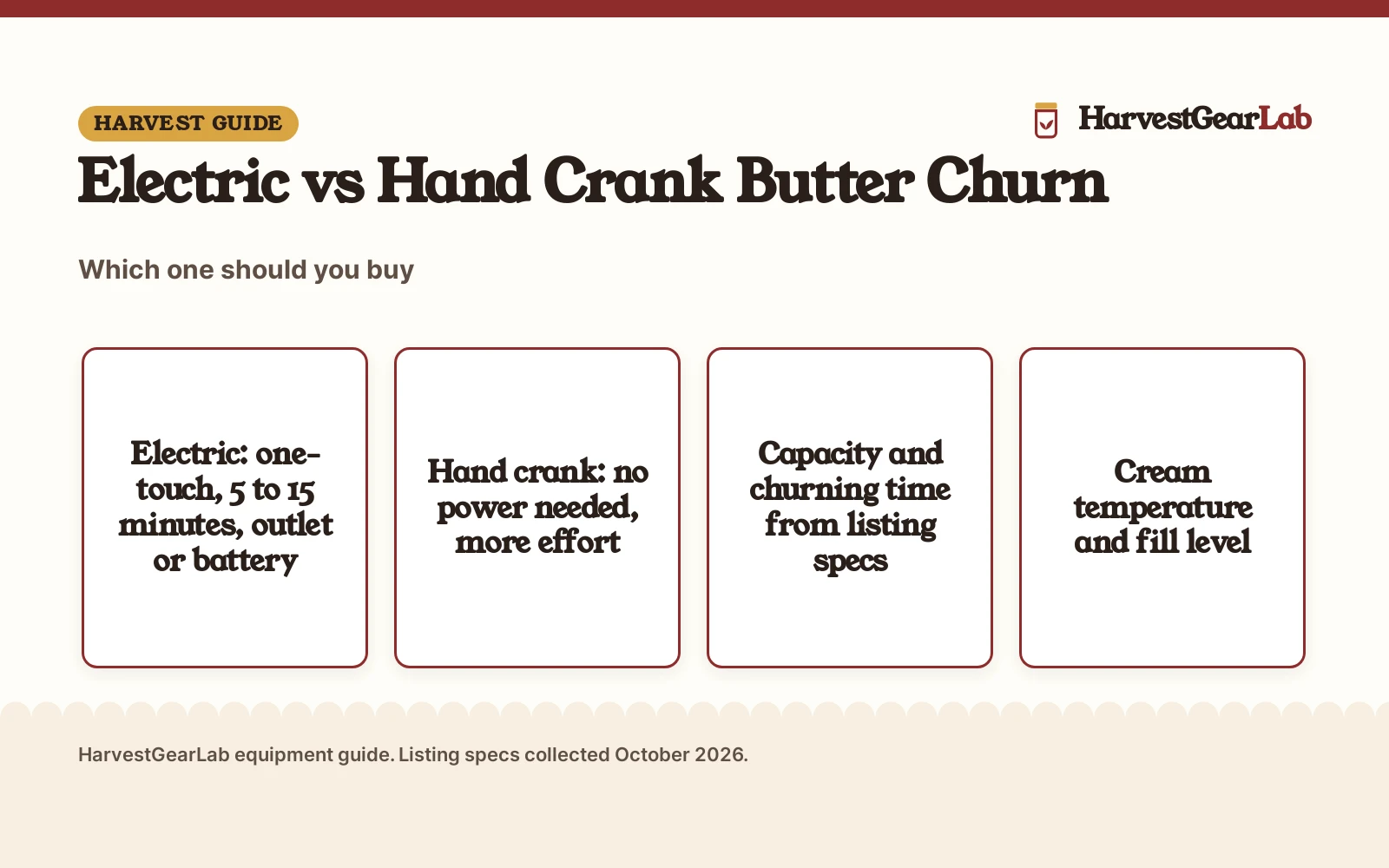
The cream is at the right temperature and the jar is ready, so the electric vs hand crank butter churn question comes down to whose arm does the work. The short answer: an electric churn makes butter in about 5 to 15 minutes at the press of a button but needs an outlet or a charged battery, while a hand crank churn needs no power at all and costs you elbow grease instead. Every number below comes from an Amazon listing for an electric butter churn we compared, and we point out where those listings contradict themselves.
Runners-up to consider
 Electric Butter ChurnerCheck price on Amazon
 Electric Butter Churn One-Touch Butter Maker Ready in 5-15Check price on Amazon
 IFOLO Electric Butter ChurnCheck price on Amazon
 Butter ChurnCheck price on Amazon
 IFOLO One-Touch Electric Butter Churner with Borosilicate JarCheck price on Amazon
HarvestGearLab earns a commission when you buy through links on this page, at no extra cost to you. As an Amazon Associate I earn from qualifying purchases. Affiliate disclosure.
Electric vs hand crank butter churn: the short answer
Start with where you churn, then pick the power source. An electric churn suits a kitchen with an outlet: the Kigmmro lists 34 ounces and 5 to 10 minutes, the Palvo lists 34 ounces and 5 to 10 minutes, and the Tormiv lists 61 ounces and 3 to 10 minutes. A hand crank churn suits off-grid kitchens, camping or anyone who wants no motor to maintain. Once the style is settled, compare the stated capacity, churning time and power source, and read the listing twice for conflicting numbers.
If you would rather go straight to the products, our best butter churn for homesteading roundup scores five churns on these points.
Two churn styles compared
| Style | Example listing | Stated capacity | Stated churning time |
|---|---|---|---|
| Electric, corded | Kigmmro 34 oz | 34 oz | 5-10 min |
| Electric, corded | Hokuvory 34 oz | 34 oz | 5-15 min |
| Electric, corded | Palvo 34 oz | 34 oz | 5-10 min |
| Electric, cordless | Chicdaze 50 oz | 50 oz | 15 min |
| Electric, cordless | ZEosonor 50 oz | 50 oz | 15 min |
| Electric, corded | Tormiv 61 oz | 61 oz | 3-10 min |
| Electric, corded | Wisemen Buttermeister Pro | 1 gallon | Not stated |
| Electric, cordless | VigorMach 34 oz | 34 oz | 5-7 min |
Corded electric churns
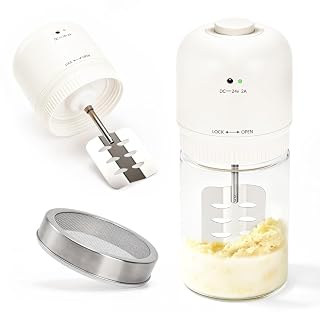
Corded churns plug in and run one-touch cycles. The Kigmmro lists a 34 oz glass jar, a powerful motor and 5 to 10 minutes, at 2.1 pounds. The Hokuvory lists 34 oz, a high-speed brushless motor, 5 to 15 minutes and a 2-year warranty, at 3.5 pounds. The Palvo lists 34 oz, a high-torque motor, 5 to 10 minutes and a 2-year warranty, at 3 pounds. The Tormiv lists 61 oz, a 10,000 RPM brushless motor and 3 to 10 minutes, at 2.7 pounds. The Wisemen Buttermeister Pro lists 1 gallon, 100 watts, 110 volts and stainless steel at 4.01 kg, with overheat protection. Corded suits a kitchen where the churn lives on the counter.
Cordless electric churns
Cordless churns trade the cord for a battery. The Chicdaze lists a 50 oz glass jar, an 8000 RPM motor, 15 minutes and a 3000 mAh battery for 7 to 10 cycles per charge. The ZEosonor lists a 50 oz jar, an 8000 RPM brushless motor, 15 minutes and a 6000 mAh battery for 7 to 10 uses per charge, taking up to 40 oz of cream per batch. The VigorMach lists 34 oz, 8000 RPM, 5 to 7 minutes and a 6000 mAh battery for 8 to 15 batches per charge, at 16 ounces. The SPASTACISE lists a 32 oz jar, 8000 RPM, 5 to 10 minutes and a 6000 mAh battery for 8 to 15 batches. Cordless suits a kitchen without a free outlet or a churn that travels.
Hand crank churns
No hand crank listings appear in the data we compared, so there are no figures to quote for them. In general terms, a hand crank churn needs no outlet and no battery, which suits off-grid kitchens and travel. The trade is effort and time: your arm replaces the motor, and a batch takes longer than the 5 to 15 minutes the electric listings state. Hand cranks also have fewer parts to fail, which suits a churn used far from replacement parts.
Reading capacity against your kitchen
Capacity on these listings runs from 32 ounces to 1 gallon. The 34 oz size is the most common: Kigmmro, Hokuvory, Palvo and VigorMach all list 34 oz jars. The Chicdaze and ZEosonor list 50 oz, the SPASTACISE lists 32 oz, the Tormiv lists 61 oz and the Wisemen lists 1 gallon. Several listings cap the fill at 3/4 full for proper cream movement: the Kigmmro and Palvo both state the 3/4 maximum, and the ZEosonor takes up to 40 oz of cream in a 50 oz jar. A 34 oz churn suits a family batch; the 1 gallon Wisemen suits a dairy-heavy household.
Cream temperature and fat
Several listings agree on the cream conditions. The Kigmmro, Palvo, Chicdaze, ZEosonor and VigorMach listings all call for heavy cream with at least 35% milk fat. The Kigmmro says to warm refrigerated cream to 15 to 20 degrees C, while the Chicdaze and ZEosonor say 18 to 21 degrees C, with the ZEosonor giving 65 to 70 degrees F. Cream that is too cold separates slowly; cream that is too warm makes soft butter, per the Palvo listing. These are maker instructions, so follow the listing of the churn you buy.
Read the listing twice
Butter churn listings often contradict themselves, and the numbers that conflict are usually the ones you need to plan the batch:
- Hokuvory: the care instructions field holds the 2-year warranty, not care instructions.
- Chicdaze white: the motor is listed as 8000RMP, a typo for RPM.
- Tormiv: the capacity field says 3.8 pounds while the jar is 61 oz; the two measure different things.
- VigorMach: the item weight is 16 ounces while the capacity is 34 fluid ounces; weight and volume are different figures.
Check the fill level and cream temperature on the listing before the first batch, and allow for the longer churning time when the two disagree. Some listings also carry marketing claims in the extracted data; we report the stated figures as the maker’s claims, not as our own findings.
What this guide does not cover
This guide covers churn hardware only. It does not cover recipes, culturing or any health question. For the stand mixer alternative, our butter churn vs stand mixer guide compares the two approaches.
FAQ: preserving at home
How long does an electric churn take?
The listings state 3 to 15 minutes: 5 to 10 on the Kigmmro and Palvo, 5 to 15 on the Hokuvory, 15 on the Chicdaze and ZEosonor, 3 to 10 on the Tormiv and 5 to 7 on the VigorMach. Time depends on cream temperature and fill level, per the listings.
Do electric churns need an outlet?
Corded ones do: the Kigmmro, Hokuvory, Palvo, Tormiv and Wisemen plug in. The Chicdaze, ZEosonor, VigorMach and SPASTACISE are cordless with rechargeable batteries, from 3000 to 6000 mAh.
How much cream can I churn at once?
The listings state 34 oz on four models, 50 oz on the Chicdaze and ZEosonor, 61 oz on the Tormiv, 32 oz on the SPASTACISE and 1 gallon on the Wisemen. Several listings cap the fill at 3/4 full.
What cream should I use?
The listings agree on heavy cream with at least 35% milk fat, warmed to 15 to 21 degrees C depending on the listing. Follow the temperature range on your churn’s listing.
Is a hand crank churn worth it?
A hand crank needs no outlet and no battery, which suits off-grid kitchens. The trade is effort and time against the 5 to 15 minutes the electric listings state.
More preserving guides
See every butter churn guide and all harvest and processing guides.
More picks: butter churns for homesteading, butter churn vs stand mixer and butter churns for mason jars.