
On this page
Top picks at a glance
As an Amazon Associate I earn from qualifying purchases.
- 1
 Ball Electric Canner by Jarden9.5/10View on Amazon
- 2
 Ball freshTECH Electric Water Bath Canner and Multi-CookerView on Amazon
- 3
 24.5QT Electric Water Bath CannerView on Amazon
- 4
 15 quart Jar Stove Top Water Bath CannerView on Amazon
- 5
 25 Quart Pressure Canner Cooker & pressure canners forView on Amazon
- 6
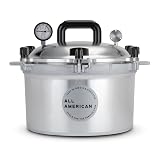 All American 1930 Pressure Cooker/CannerView on Amazon
- 7
 Barton 6-Quart Aluminum Pressure Canner & CookerView on Amazon
When the tomato harvest hits its peak and every pot in the kitchen is already full, electric water bath canner vs stovetop canner is the question that decides where the next batch gets processed. The short answer: an electric water bath canner heats itself with a built-in element and plugs into the wall, while a stovetop canner is a deep pot with a rack that sits on your burner. Both do the same job, boiling-water processing for high-acid foods, and this guide explains each type step by step, using concrete figures only where listings state them.
Runners-up to consider
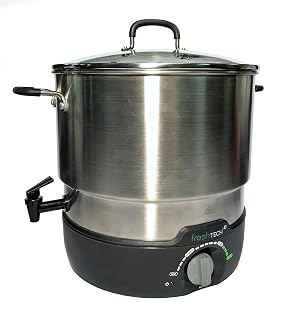 Ball freshTECH Electric Water Bath Canner and Multi-CookerCheck price on Amazon
 24.5QT Electric Water Bath CannerCheck price on Amazon
 15 quart Jar Stove Top Water Bath CannerCheck price on Amazon
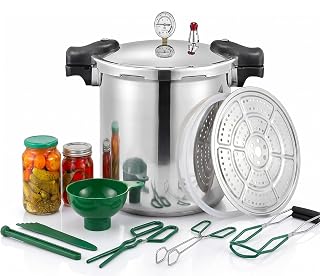 25 Quart Pressure Canner Cooker & pressure canners forCheck price on Amazon
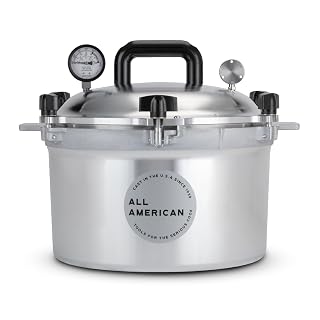 All American 1930 Pressure Cooker/CannerCheck price on Amazon
 Barton 6-Quart Aluminum Pressure Canner & CookerCheck price on Amazon
HarvestGearLab earns a commission when you buy through links on this site, at no extra cost to you. As an Amazon Associate I earn from qualifying purchases. Affiliate disclosure.
Electric water bath canner vs stovetop canner: the heat source in plain terms
The difference is what boils the water. An electric water bath canner carries its own heating element in the base, so the wall outlet is the heat source. A stovetop canner has no element at all: it is a deep pot with a rack that borrows heat from your burner. The table sums up the split; the sections below ground each point in what listings actually state.
| Type | Heat source | What the listing states | Needs |
|---|---|---|---|
| Electric water bath canner | Built-in element, plugs in | Capacity, controls, timer, warranty | An outlet; no burner |
| Stovetop water bath canner | Your stove burner | Capacity, rack, lid, burner compatibility | A burner that fits the pot |
How an electric water bath canner works
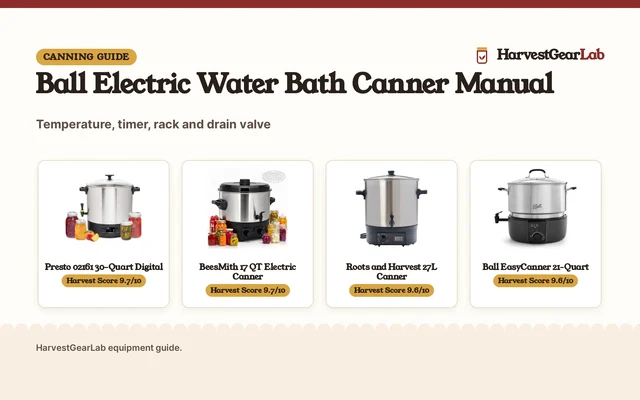
An electric water bath canner is a self-contained unit: the heating element is built into the base, so you fill it, load jars in the rack, plug it in and set the controls. No burner is tied up, which matters on a heavy canning day. The listings show the format. The Ball freshTECH is an electric water bath canner and multi-cooker with a 21-quart capacity, a rack and a recipe book, backed by a 1 Year Manufacture Limited warranty. The Topfurn 24.5QT model lists a temperature knob control and a timer with automatic insulation. The NeuronDeals 24.5QT model lists a digital LCD with an adjustable 86-212°F range and a timer. Compare an electric canner’s own stated capacity, controls and warranty; the figures above describe those listings only.
The tradeoff is dependence on the outlet and the element, plus counter space: a 24.5QT electric unit is a large appliance to store. Check the listing for the cord length and the warranty term.
How a stovetop water bath canner works
A stovetop water bath canner is the classic deep pot with a rack and a lid: it borrows heat from your burner, so there is no wattage and no element to fail. The HOMKULA listings show the format: a 20 QT and a 27.5 QT stainless steel pot with rack and lid, stated as suitable for induction cooktops. The Supa Ant 23 Qt listing adds a starter kit of canning tools. Any burner that fits the pot works, provided the maker says the pot suits that burner type.
The tradeoff is burner time: the pot occupies a large burner for the whole batch, and you manage the heat yourself. There are no electric figures to check; instead confirm the capacity in quarts, that a rack and lid are included, and whether the listing mentions your cooktop type.
Electric water bath canner vs stovetop canner: how to choose
Choose by your kitchen, not by the food: both types process high-acid foods the same way. If your stove is crowded on canning day or you want to run the batch on a counter away from the range, electric fits: look for stated capacity, controls and warranty, like the Ball freshTECH’s 21-quart capacity and 1 Year warranty or the 24.5QT models’ timers. If you want the simplest tool with no element to fail, or you can spare a big burner, stovetop fits: compare quart capacity and check for rack, lid and cooktop compatibility, like the HOMKULA 20 QT and 27.5 QT listings.
One boundary never moves: a water bath canner, electric or stovetop, is for high-acid foods such as jams, jellies, pickles and acidified tomatoes, following a current USDA recipe. Low-acid foods such as plain vegetables, meat and stock need a pressure canner; see our water bath canner vs pressure canner comparison. For complete units, see the best water bath canner roundup.
FAQ: preserving at home
Can I can green beans in a water bath canner?
No. A water bath canner, electric or stovetop, is for high-acid foods such as jams, jellies, pickles and acidified tomatoes. Plain vegetables, meat, poultry, seafood and stock need a pressure canner.
What size water bath canner do I need?
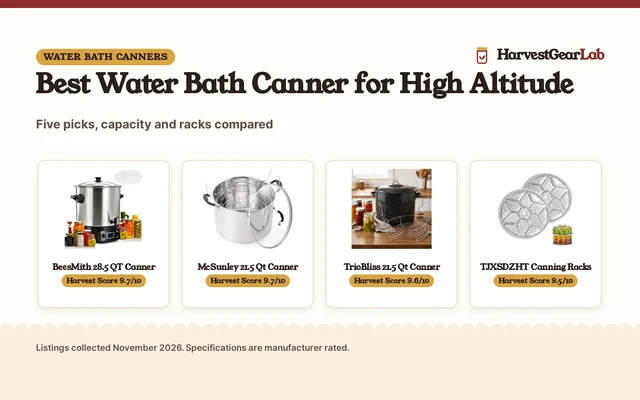
Match the quart capacity to your batch: the listings show 20 QT and 27.5 QT stovetop pots, a 23 Qt kit, a 21-quart electric Ball, and 24.5QT electric models. Bigger batches need fewer refills but more storage space.
Do electric water bath canners need a stove?
No. The heating element is built in; the Ball freshTECH, Topfurn and NeuronDeals listings describe plug-in units with their own controls.
Will a stovetop canner work on induction?
Only if the listing says so. The HOMKULA 20 QT and 27.5 QT listings state suitability for induction cooktops; check any other pot’s own listing.
More preserving guides
See every water bath canners guide and all canning guides.
More picks: water bath canner vs pressure canner, best water bath canners, enamel vs stainless steel water bath canners and water bath canners for quart jars.