
On this page
Top picks at a glance
As an Amazon Associate I earn from qualifying purchases.
- 1
 HOPERAN 16-Tray Stainless Steel Food Dehydrator9.7/10View on Amazon
- 2
 Cosori Food DehydratorView on Amazon
- 3
 Hamilton Beach Digital Food Dehydrator for FruitView on Amazon
- 4
 NESCO FD‑80A Square Food Dehydrator for SnacksView on Amazon
- 5
 Food-Dehydrator Machine Adjustable Temperature 12 Trays 800WView on Amazon
- 6
 CROWNFUL Food Dehydrator MachineView on Amazon
- 7
 Small Food Dehydrator DryerView on Amazon
A food dehydrator dries with low, steady heat and constant airflow; an oven dries with higher heat and still air. That is the core of food dehydrator vs oven drying: the dehydrator is built for the job, the oven is a workaround. For regular harvest drying, the dehydrator wins on control and capacity; for an occasional small batch, the oven works fine.
Runners-up to consider
 Cosori Food DehydratorCheck price on Amazon
 Hamilton Beach Digital Food Dehydrator for FruitCheck price on Amazon
 NESCO FD‑80A Square Food Dehydrator for SnacksCheck price on Amazon
 Food-Dehydrator Machine Adjustable Temperature 12 Trays 800WCheck price on Amazon
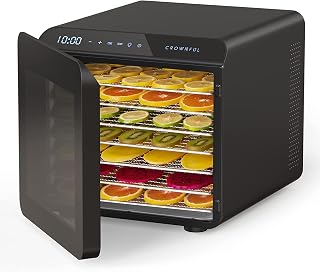 CROWNFUL Food Dehydrator MachineCheck price on Amazon
 Small Food Dehydrator DryerCheck price on Amazon
HarvestGearLab earns a commission when you buy through links on this page, at no extra cost to you. As an Amazon Associate I earn from qualifying purchases. Affiliate disclosure.
Food dehydrator vs oven drying: the short answer
Buy a food dehydrator if you dry harvest produce regularly. The listings here show 95 to 167°F ranges with 1°F adjustments, 5 to 10 trays, and drying areas up to 7.4 ft² that fit up to 5.5 lbs of beef at 5 mm thick. Use the oven if you dry rarely and in small batches: spread food on a rack like the 15 x 10 inch stainless cooling racks listed here, set the lowest heat, and prop the door open. The dehydrator gives better texture and uses less energy per batch; the oven costs nothing extra.
What a food dehydrator does
A food dehydrator moves warm air across stacked trays for hours, holding a low temperature the whole time. The Cosori 10-tray lists a 95 to 167°F range with 1°F adjustments, horizontal airflow, 10 stainless steel trays and 7.4 ft² of drying space, enough for up to 5.5 lbs of beef sliced to 5 mm. The Elite Gourmet lists 5 BPA-free 11.4-inch trays, 350W of power, and a 95 to 158°F dial, with trays that stack from 8.5 to 10.75 inches tall for thicker cuts. The steady airflow is the point: it carries moisture away evenly so every tray dries at the same rate.
What oven drying does
Oven drying uses the oven you already own. Spread sliced produce on wire racks, such as the 15 x 10 inch stainless steel cooling racks in the listings, set the oven to its lowest heat, and leave the door propped open so moisture escapes. It works, and it costs nothing beyond the electricity. The drawbacks are control and capacity: most ovens do not hold temperatures as low as 95°F, the heat is still rather than moving, and a single oven rack holds far less than 7.4 ft² of dehydrator trays. No oven figures for food drying appear in the reference listings, so we give none here.
Temperature and control
Low and steady wins for drying. The dehydrator listings hold 95 to 167°F with fine adjustments, which suits herbs at the low end and jerky at the top. An oven’s lowest setting is usually hotter, which risks cooking the outside before the inside dries, especially with thick slices. If you oven-dry, slice thin, watch closely, and expect less even results than the horizontal airflow of a dehydrator gives.
Batch size
This is where the dehydrator pulls away. The Cosori’s 7.4 ft² across 10 trays handles a real harvest day; the Elite Gourmet’s 5 trays suit smaller households. An oven gives you one or two racks of about 15 x 10 inches each. For a bushel of apples or a big tomato harvest, the dehydrator finishes in fewer batches; for a handful of herbs, the oven is perfectly adequate.
Which one should you buy
Buy the dehydrator if you dry every harvest season: the temperature control, airflow and tray capacity pay off quickly. Keep using the oven if you dry a tray or two a year and do not want another appliance. Either way, slice evenly, do not overload, and follow current food safety guidance for the temperatures each food needs.
| Method | Heat | Airflow | Listed capacity | Best for |
|---|---|---|---|---|
| Food dehydrator | 95-167°F, adjustable | Constant fan | Up to 7.4 ft², 10 trays | Regular harvest drying |
| Oven | Lowest setting, less precise | Still; prop door open | 1-2 racks, 15 x 10 in | Occasional small batches |
FAQ: preserving at home
Can I dry food in a regular oven?
Yes. Use wire racks like the 15 x 10 inch stainless racks listed here, the lowest heat, and a propped-open door. It suits small, occasional batches.
What temperature do food dehydrators use?
The listings here show 95 to 167°F on the Cosori and 95 to 158°F on the Elite Gourmet, with 1°F adjustments on the Cosori.
How much can a dehydrator hold?
The Cosori lists 7.4 ft² across 10 trays, fitting up to 5.5 lbs of beef at 5 mm thick. The Elite Gourmet has 5 trays at 11.4 inches.
Is oven drying as good as a dehydrator?
For texture and evenness, no: the dehydrator’s steady low heat and airflow beat still oven heat. For convenience on a small batch, the oven is fine.
More preserving guides
See every food dehydrator guide and all drying guides.
More picks: food dehydrators and drying guides.