
On this page
Top picks at a glance
As an Amazon Associate I earn from qualifying purchases.
- 1
 Cuisipro Deluxe Stainless Steel Food Mill9.7/10View on Amazon
- 2
 Küchenprofi Stainless Steel Food MillView on Amazon
- 3
 Louis TellierView on Amazon
- 4
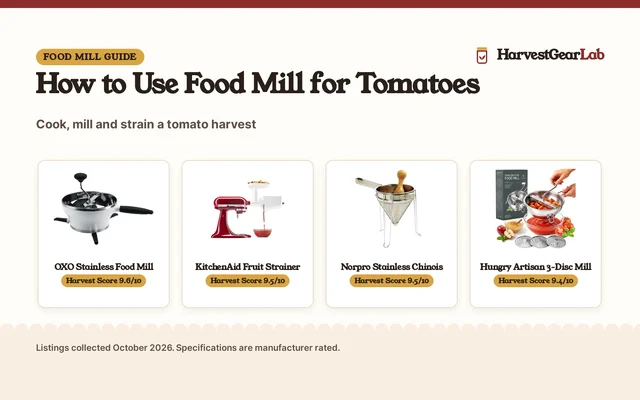
 Hungry Artisan 3-Disc Food Mill for ApplesauceView on Amazon
- 5
 Mirro 50024 Foley Stainless Steel Healthy Food Mill CookwareView on Amazon
- 6Mirro 50025 Foley Stainless Steel Healthy Food Mill CookwareView on Amazon
- 7
 Rosle 16252 Stainless Steel Food Mill with HandleView on Amazon
A food mill separates skins and seeds while it purees; an immersion blender purees everything, skins and seeds included. That is the core of food mill vs immersion blender: the mill strains as it works, the blender just blends. For tomato sauce and applesauce where you want skins and seeds out, the food mill wins; for soups and smoothies where everything stays in, the immersion blender wins.
Runners-up to consider
 Küchenprofi Stainless Steel Food MillCheck price on Amazon
 Louis TellierCheck price on Amazon
 Hungry Artisan 3-Disc Food Mill for ApplesauceCheck price on Amazon
 Mirro 50024 Foley Stainless Steel Healthy Food Mill CookwareCheck price on Amazon
- Mirro 50025 Foley Stainless Steel Healthy Food Mill CookwareCheck price on Amazon
 Rosle 16252 Stainless Steel Food Mill with HandleCheck price on Amazon
HarvestGearLab earns a commission when you buy through links on this page, at no extra cost to you. As an Amazon Associate I earn from qualifying purchases. Affiliate disclosure.
Food mill vs immersion blender: the short answer
Buy a food mill if you turn harvest produce into sauces and purees and want skins and seeds removed in one pass. The listings here show mills with interchangeable discs from 1.3 mm to 8 mm, capacities from 2 to 8 quarts, and throughputs up to 11 lbs per minute. Buy an immersion blender if you blend soups, smoothies and small batches right in the pot and do not need straining. Many preserving kitchens end up with both.
What a food mill does
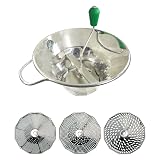
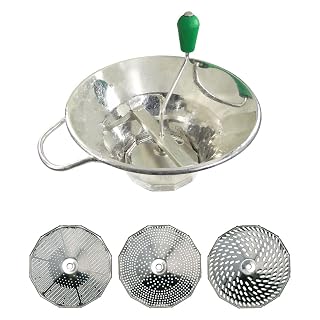
A food mill is a hand-crank or electric strainer: you put cooked produce in the bowl, turn the crank or switch on the motor, and a blade presses the pulp through a perforated disc while skins and seeds stay behind. The Kuchenprofi mill comes with 4 discs at 1.3, 2.5, 3 and 5 mm for coarse to extra fine textures, in an 8.75-inch diameter stainless body. The Louis Tellier N.3 includes 1.5, 2.5 and 4 mm discs with a 5-quart capacity and processes up to 3.3 lbs per minute; the larger N.5 has an 8-quart capacity, a 3 mm disc, and processes up to 11 lbs per minute with double milling action. The Chencheerio offers 3, 5 and 8 mm discs, and the VEVOR electric strainer includes 1, 1.5, 3 and 6 mm screens rated at 88 lbs per hour.
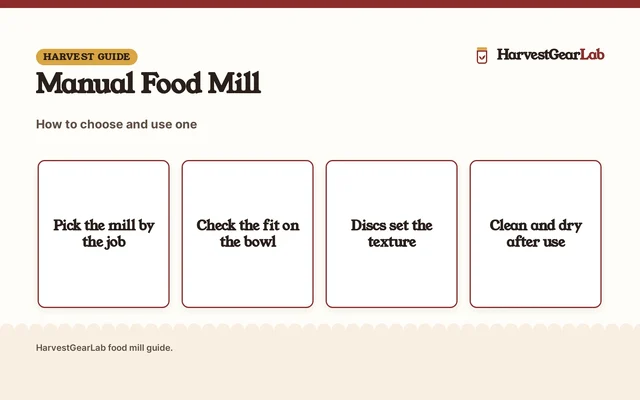
The Johnny Apple Sauce Maker works the same way as a clamp-on strainer with a 1.3 mm screen, mounting to countertops from 3/4 inch to 2-1/8 inches thick, and the Norpro mill holds 2 quarts. Disc size sets texture: small holes for silky sauces, large holes for rustic mashes. The Kuchenprofi listing states a 5 year warranty against manufacturing defects.
What an immersion blender does
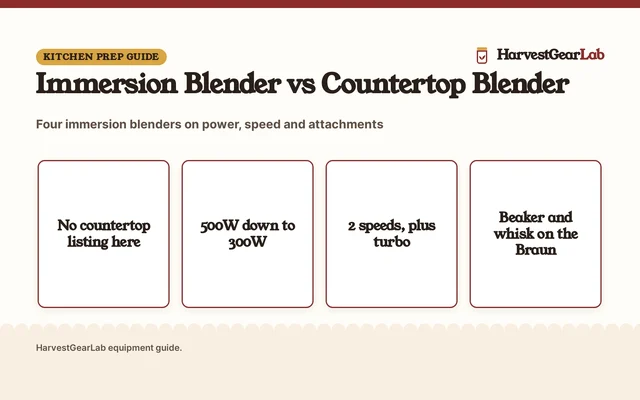
An immersion blender is a motorized blade on a stick that you lower directly into a pot, bowl or jar. It purees whatever is in there, skins, seeds and all, with no straining step. It is fast for soups, smoothies and small batches, and it rinses clean in seconds. What it cannot do is separate: tomato skins and apple seeds go through the blade and stay in the mix. No immersion blender figures appear in the reference listings, so we give none here; judge blenders on their own listings.
Skins and seeds: the real difference
This is the decision point. If your sauce needs skins and seeds out, only the mill does it in one step; with a blender you would have to strain separately through a sieve. If skins and seeds do not matter, the blender is faster and easier to clean. For apple butter, tomato sauce and seedless jams, the mill; for blended soups and baby food from peeled produce, the blender. The OXO Tot mash maker sits between them: a small hand mill for turning grown-up food into baby purees.
Batch size and power
Food mills scale with the harvest: 2 quarts on the Norpro for small batches, 5 quarts on the Tellier N.3, 8 quarts on the N.5, and the VEVOR electric at 88 lbs per hour for big canning days. The VEVOR runs on an 800W max, 300W rated motor for continuous work. An immersion blender handles whatever fits in your pot, one pot at a time, which suits everyday cooking better than harvest-scale batches. If your preserving day means bushels, the mill’s throughput matters more than the blender’s convenience.
Which one should you buy
For preserving a harvest into sauces, buy the food mill: it removes skins and seeds while it purees, and the disc sizes let you set the texture from silky to rustic. For daily cooking, soups and quick purees, buy the immersion blender. If you do both, buy the mill first for harvest season; the blender is the everyday tool you will reach for the rest of the year.
| Tool | Strains skins and seeds | Listed disc sizes | Best for |
|---|---|---|---|
| Food mill | Yes | 1.3 to 8 mm across listings | Sauces, harvest batches |
| Immersion blender | No | Not stated | Soups, quick purees |
FAQ: preserving at home
Can an immersion blender replace a food mill?
Only if you do not need straining. A blender purees skins and seeds along with everything else; a mill holds them back. For seedless sauces, there is no substitute for the mill.
What disc size should I use for tomato sauce?
Fine discs for silky sauce: the listings show 1.3 mm, 1.5 mm and 1 mm screens. Medium discs at 2.5 to 3 mm suit a more rustic texture.
Are food mills dishwasher safe?
The Kuchenprofi listing states dishwasher safe. The Louis Tellier tinned steel mills say to hand wash and dry right away to protect the tin coating.
How fast does a food mill work?
Listed throughputs run from 3.3 lbs per minute on the Tellier N.3 to 11 lbs per minute on the N.5, with the VEVOR electric rated at 88 lbs per hour.
Do food mills come with a warranty?
The Kuchenprofi lists 5 years against manufacturing defects. The Johnny strainer lists both a 5 year and a 1-year warranty in different fields, so confirm the term before buying.
More preserving guides
See every food mill guide and all harvest and processing guides.
More picks: food mills and harvest and processing.