
On this page
Top picks at a glance
As an Amazon Associate I earn from qualifying purchases.
- 1
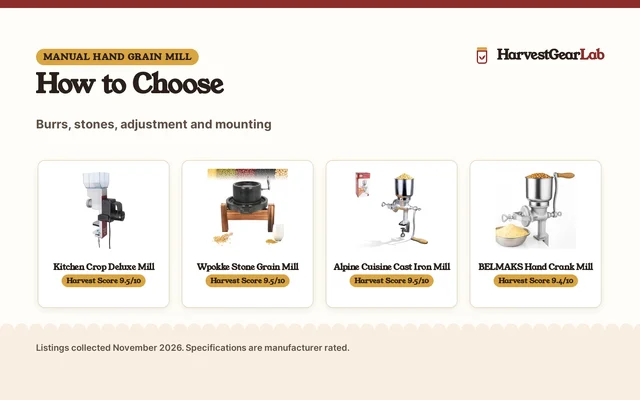
 Marcato Marga Mulino Grain Mill and Flaker9.5/10View on Amazon
- 2
 Kitchen Crop Grain Mill with Stainless Steel Burrs9.5/10View on Amazon
- 3
 Wpokke Stone Grain Mill9.5/10View on Amazon
- 4
 Country Living Hand Grain MillView on Amazon
- 5
 Grain Mill Grinder 750g High Speed Electric Stainless SteelView on Amazon
A grain mill for beginners turns a pantry shelf of whole grain into flour you bake with the same day. A mill grinds wheat, corn, rye and other whole grain into flour at home, and the grind setting decides whether the flour suits bread, muffins or a coarse meal. This guide walks through the types of mill, the grind settings and what to check before you buy.
Runners-up to consider
 Country Living Hand Grain MillCheck price on Amazon
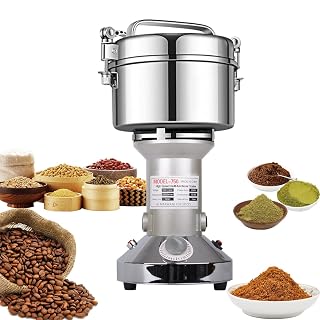 Grain Mill Grinder 750g High Speed Electric Stainless SteelCheck price on Amazon
HarvestGearLab earns a commission when you buy through links on this site, at no extra cost to you. As an Amazon Associate I earn from qualifying purchases. Affiliate disclosure.
Grain mill for beginners: the short list
A grain mill has a small set of parts, and each part shapes the flour it makes. The table shows what each part does and what to check.
| Part | What it does | What to check |
|---|---|---|
| Mill body | Holds the burrs and the hopper | Cast metal or steel, solid build |
| Burrs | Grind the grain | Stone or steel, and what the maker states |
| Hopper | Feeds grain into the burrs | Sized to the batch you mill |
| Grind adjustment | Sets coarse or fine flour | From cracked grain to cake flour |
| Drive | Turns the burrs | Hand crank or electric motor |
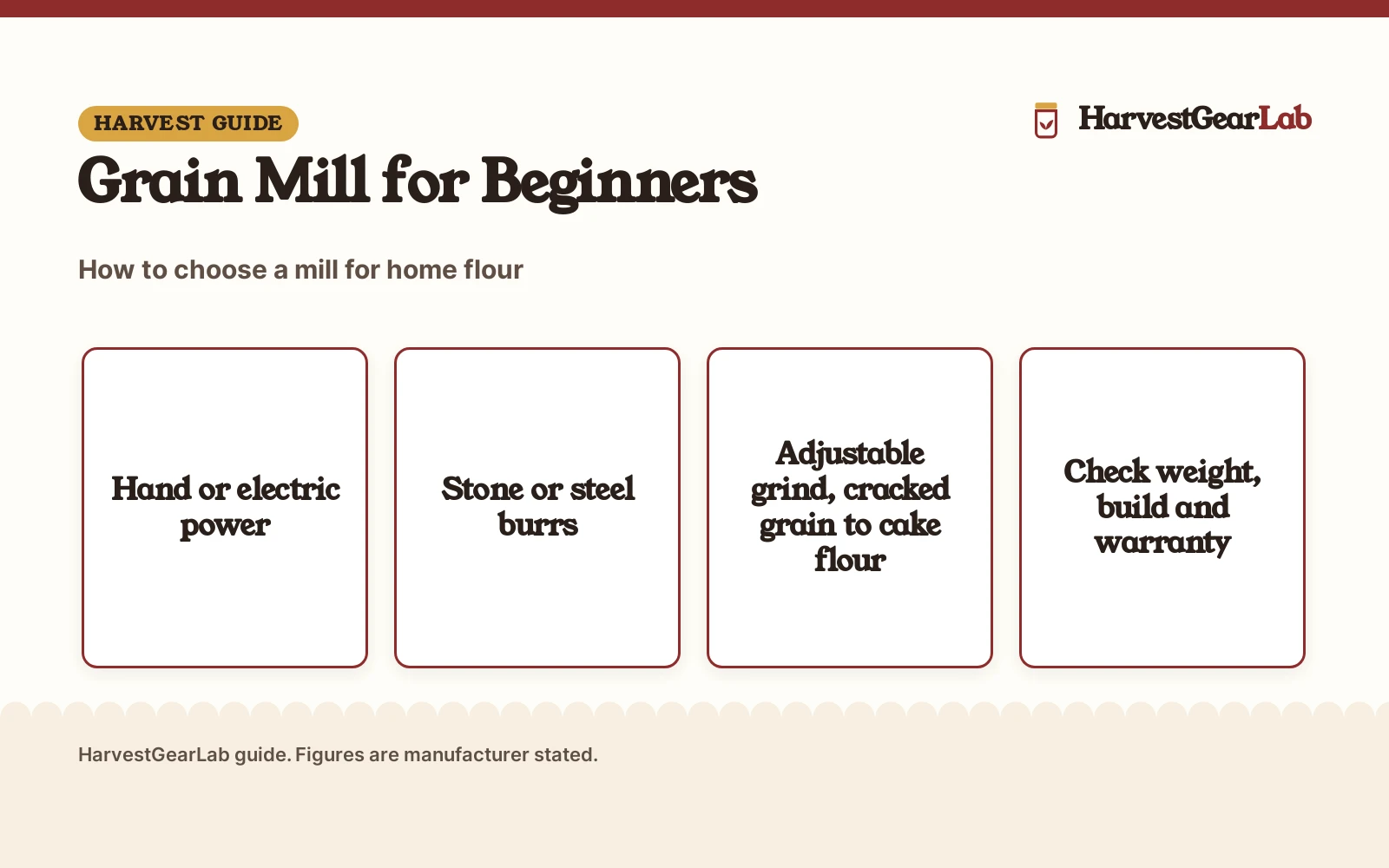
Hand or electric power
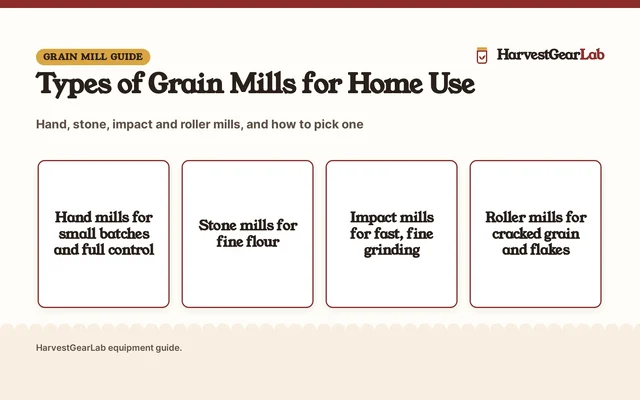
A hand mill turns by crank and needs no power outlet, so it works anywhere you can clamp it to a counter or table. The work is steady and slow, which suits a household that mills a small batch for a loaf or a pan of muffins. A hand mill also stays simple: fewer parts, nothing to plug in, and a body you can wipe clean after use.
An electric mill runs on a motor and grinds a batch with far less effort, which suits a household that bakes often and mills in larger amounts. The trade-off is counter space, noise and a power cord. As a reference point for weight, the Country Living hand mill listed in our data weighs 16.0 pounds, with a solid cast aircraft aluminum body and double sealed industrial grade ball bearings, so a hand mill can be a heavy piece of gear even without a motor.
Stone or steel burrs
The burrs do the grinding, and the common materials are stone and steel. Stone burrs crush grain between rough plates and are the classic choice for whole grain flour. Steel burrs cut grain between metal plates and are common on mills that also handle corn and other hard grain. Either material can make good flour when the mill is built well; the listing should state which material the burrs use, and a listing that does not state it leaves you guessing.
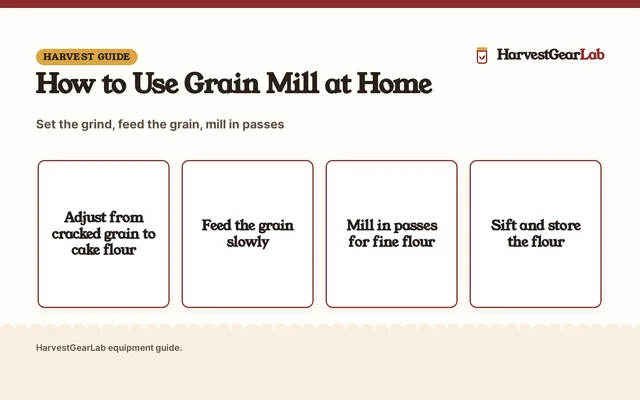
The grind adjustment matters more than the burr material for a beginner. A mill that adjusts from cracked grain to cake flour covers coarse meal for porridge and fine flour for bread in the same mill: the Country Living listing states exactly that range, from cracked grain to cake flour. Look for an adjustment you can turn in small steps, and check that the listing states the range instead of promising a fine grind in general words.
What grain can a mill grind
Most home mills grind wheat, rye, corn and rice, which covers the flour most home bakers use. Whole wheat flour comes from hard red or hard white wheat, while a softer wheat gives a lighter flour for cakes and pastries. Corn grinds into cornmeal, and rye grinds into a darker flour for rye bread. Oats grind into oat flour, though some mills handle oats better than others, so check the listing before you mill a grain the maker does not name.
Skip grain the maker does not name in the listing, and skip oily seed and very hard grain unless the listing states the mill handles it. A mill built for dry grain can jam or wear when it meets seed with high oil content, and a cracked burr is a costly repair. When in doubt, mill the grain the listing names and keep the rest for a mill that states it.
How much flour to mill at a time
Mill flour as you need it. Freshly milled flour bakes best soon after milling, so mill the amount your next baking session calls for and store any extra in a sealed jar in a cool pantry. A large hopper helps when you mill for a big baking day, but a small hopper is fine when you mill a batch at a time and refill as you go.
The hopper size is worth checking before you buy, because the listing we compared does not state a hopper size for the Country Living mill. Ask the listing for the hopper capacity, the grind range and the weight, and weigh those against the space on your counter. A mill that lives on the counter gets used; a mill that lives in a cupboard gets forgotten.
What to skip or double-check
- Mill size and weight: the Country Living mill weighs 16.0 pounds. A heavy mill stays put on the counter, but it is a chore to lift in and out of a cupboard.
- Warranty: the Country Living listing carries a lifetime warranty. Check the warranty term on any listing before you buy, and look for a term stated in years or as a lifetime term.
- Grind range: the Country Living listing adjusts from cracked grain to cake flour. A listing that does not state its range may not reach the fine flour bread needs.
- Hopper size: the listing we compared does not state a hopper size. Check the listing before you buy when hopper size matters for your batch.
- Mounting: the listing we compared does not state a clamp or base. Check how the mill mounts to a counter or table before you buy.
- Food contact coating: the Country Living listing states a food grade powder coating on a solid cast aircraft aluminum body. Check what coating the listing states when the coating matters to you.
What this guide does not cover
This guide does not give recipes, milling quantities or storage times. Take those from current USDA and National Center for Home Food Preservation guidance where they apply, and follow the mill maker’s instructions for the grain and the settings. Every grain mill guide on the site is collected in our grain mills section.
FAQ: preserving at home
What is the difference between a hand mill and an electric mill?
A hand mill turns by crank and needs no power, while an electric mill runs on a motor. A hand mill suits occasional milling, and an electric mill suits a household that bakes often and mills in larger amounts.
What grind settings does a beginner need?
An adjustable mill that runs from cracked grain to cake flour covers coarse meal and fine flour. The Country Living listing states exactly that range.
How heavy is a hand grain mill?
It varies by build. The Country Living hand mill weighs 16.0 pounds, and the listing describes a solid cast aircraft aluminum body with double sealed industrial grade ball bearings.
Do grain mills come with a warranty?
Some do. The Country Living listing carries a lifetime warranty, so check the warranty term on any listing before you buy.
Can a grain mill grind flour fine enough for bread?
An adjustable mill that reaches a fine setting can. The Country Living listing adjusts down to cake flour, which is a fine grind.
More preserving guides
See every grain mills guide and all harvest and processing guides.
More picks: grain mills for bread, grain mills for flour, grain mills for fine flour and food mills for grains.