
On this page
Top picks at a glance
As an Amazon Associate I earn from qualifying purchases.
- 1
 Tioncy 13-Piece Pasta Set9.6/10View on Amazon
- 2
 Nodaaiie 7-Piece Pasta Set9.5/10View on Amazon
- 3
 KitchenAid Pasta Roller Set9.2/10View on Amazon
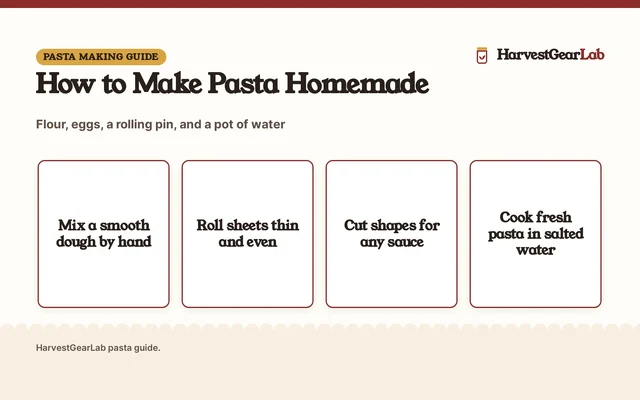
A quiet kitchen, flour on the board and a batch of fresh pasta on the way: that is the scene when learning how to make pasta no machine. The answer is simple: mix a firm dough, roll it thin with a pin, cut it into the shapes wanted, and dry the strands before cooking. No machine is needed, only a rolling pin, a board, a cutter and a rack.
HarvestGearLab earns a commission when you buy through links on this site, at no extra cost to you. As an Amazon Associate I earn from qualifying purchases. Affiliate disclosure.
| # | Product | Harvest Score | Buy |
|---|---|---|---|
| 1 | Tioncy 13-Piece Pasta Set | 9.6/10 | Buy on Amazon |
| 2 | Nodaaiie 7-Piece Pasta Set | 9.5/10 | Buy on Amazon |
| 3 |  Mastering Pasta Cookbook | 9.5/10 | Buy on Amazon |
| 4 | KitchenAid Pasta Roller Set | 9.2/10 | Buy on Amazon |
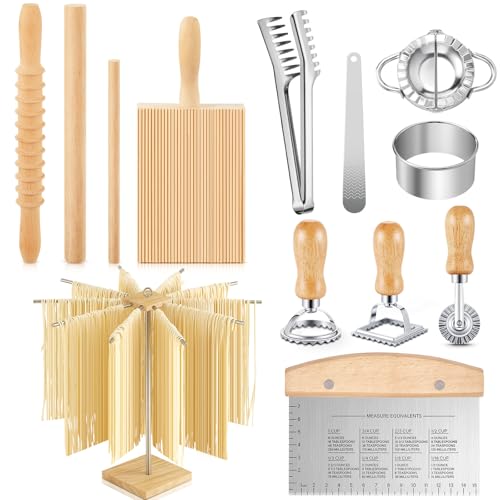
Tioncy 13-Piece Pasta Set
A 13-piece set that covers drying, shaping and cutting, with a drying rack on 10 arms for fresh strands and a gnocchi board for ridged shapes.
Pros
- 13 pieces cover the drying rack, gnocchi board, rolling pins, stamps, molds, scraper and tong in a set
- Drying rack has 10 hanging arms and a height of 15.75 inches, with a round wooden base
- Gnocchi board has a deep grooved side and a flat side for more shapes
Cons
- At 16.93 by 12.2 by 2.17 inches, the set needs a full shelf or drawer for storage
- No warranty term is stated
- 13 pieces mean more parts to wash and put away after pasta night

Nodaaiie 7-Piece Pasta Set
A compact 7-piece wooden set for gnocchi, ravioli and noodles, with a gnocchi board, ravioli stamps and a rolling pin for hand shaping.
Pros
- 7 pieces cover a cutter, rolling pin, gnocchi board, roller and 3 ravioli stamp cutters
- Solid wood build with smooth, polished edges and a comfortable grip
- Compact tools tuck into a drawer and take little counter space
Cons
- No warranty term is stated
- No drying rack is included, so fresh strands need a rail or tray at home
- Only 7 pieces, so cooks who want empanada molds or a pasta tong need a larger set

Mastering Pasta Cookbook
A cookbook on handmade pasta, gnocchi and risotto for cooks learning the shapes the tools in this guide make, kept beside the tools on a dry shelf.
Pros
- Covers handmade pasta, gnocchi and risotto in one book
- Gives context for the gnocchi boards and cutters in this guide
- A shelf reference that needs no power and only dry storage
Cons
- A book, not a tool: it does not roll, cut or shape dough
- Published in 2015, so newer tools are not covered
- No tool is included: boards, pins and cutters are bought separately

KitchenAid Pasta Roller Set
A 3-piece stainless pasta roller and cutter set for household KitchenAid stand mixers.
Pros
- Stainless rollers and cutters for clean cutting
- 8 thickness settings for 6-inch pasta sheets
- Spaghetti and fettuccine cutters, cleaning brush included
Cons
- An attachment, not a mixer; needs a KitchenAid mixer
- Hand wipe only for cleaning
- Pasta only, no dough hook or whisk
As an Amazon Associate I earn from qualifying purchases.
How to make pasta no machine: the stages
Handmade pasta moves through clear stages. The table below matches each stage with its job and the tool that does it.
| Stage | What happens | Tool that handles it | Amazon |
|---|---|---|---|
| Mix and knead | Flour and eggs come together into a firm, smooth dough | Hands, a board and a dough scraper | |
| Rest and roll | The dough rests, then rolls into a thin, even sheet | Rolling pin and a flat board | |
| Cut and shape | The sheet becomes strands, squares or filled shapes | Cutter wheel, ravioli stamps and gnocchi board | |
| Dry | Fresh strands hang until they hold their shape | Drying rack with hanging arms |
Mix the dough
Start with flour and eggs worked into a dough that feels firm and smooth, not sticky and not dry. Knead it on a clean board until it holds together, then let it rest under a cover so it relaxes before rolling.
Roll the sheet
Rolling is the stage that decides the pasta. Work from the center outward with a rolling pin, turning the sheet so it stays even, and roll until it is thin enough to see the board through it in places. A gnocchi board gives ridged shapes their grip on sauce. The Tioncy set includes a gnocchi board with a roller, and the Nodaaiie set pairs its board with a rolling pin. See the pasta maker vs rolling pin comparison for the machine choice.
Cut the shapes
Cutting turns the sheet into dinner. A cutter wheel makes clean strands, and stamps seal filled pasta in rounds, squares or fluted edges. The Tioncy set adds ravioli stamps and empanada press molds for filled shapes, while the Nodaaiie set includes stamp cutters in round, square and fluted roller forms. Keep the filled edges sealed so the filling stays inside during cooking.
Dry the strands
Fresh strands dry well hung up, not piled in a heap. Drape them over the arms of a drying rack so air reaches each strand, and let them rest until they hold their shape before cooking. The Tioncy drying rack (on Amazon) has 10 hanging arms and a height of 15.75 inches, with a round wooden base and a detachable stand for spaghetti, tagliatelle and fettuccine. Without a rack, strands can drape over a clean rail, but a rack keeps them apart.
The gear for hand-rolled pasta
Each stage above needs a tool, and the picks below cover rolling, shaping, cutting and drying with the sets that handle those stages.
What to skip or double-check
- Machine-only habits: a machine is not required. A pin, board and cutter cover the same stages by hand.
- Set contents: check what the set includes before ordering, so it covers the shapes planned for pasta night.
- Wet dough on wood: check that boards and racks are dry before storage, so the wood stays in good shape.
- Filled pasta edges: double-check that stamps and molds seal the edges, or the filling leaks during cooking.
- Crowded racks: hang strands with space between them, so they dry evenly instead of sticking together.
What this guide does not cover
This is a method guide. It does not give recipes, quantities or cooking times. Take those from a current cookbook or a trusted recipe source, and follow the recipe for the shape and filling chosen. Every bread and pasta guide on the site is collected in the bread and pasta section.
FAQ: preserving at home
Is a pasta machine needed to make fresh pasta at home?
No. A rolling pin, a board and a cutter cover the rolling and cutting stages, and a drying rack handles the strands.
Which tools make pasta without a machine?
A rolling pin for the sheet, a gnocchi board for ridged shapes, a cutter or stamps for the shapes, and a rack for drying the strands. The 13-piece Tioncy set and the 7-piece Nodaaiie set each bundle those tools.
How is fresh pasta dried without a machine?
Hang the strands over the arms of a drying rack so air reaches each strand. The Tioncy rack has 10 hanging arms for fresh spaghetti, tagliatelle and fettuccine.
Can gnocchi and ravioli be made with the same set?
Yes. The Tioncy set includes a gnocchi board with a roller, ravioli stamps and empanada press molds, and the Nodaaiie set includes a gnocchi board and stamp cutters for ravioli.
What is the difference between the 13-piece set and the 7-piece set?
The Tioncy set has 13 pieces with a drying rack, a pasta tong and a dough scraper, while the Nodaaiie set has 7 wooden pieces built for a small kitchen.
More preserving guides
See every pasta makers guide and all bread and pasta guides.
More picks: pasta making sets, pasta making tools, pasta drying racks and do you need a drying rack.