
On this page
Top picks at a glance
As an Amazon Associate I earn from qualifying purchases.
- 1
 Arrow 2pk Canning Funnel9.7/10View on Amazon
- 2
 Gejoy 12pc Stainless Canning Funnels9.7/10View on Amazon
- 3
 serinar Wide Mouth Canning Funnel9.7/10View on Amazon
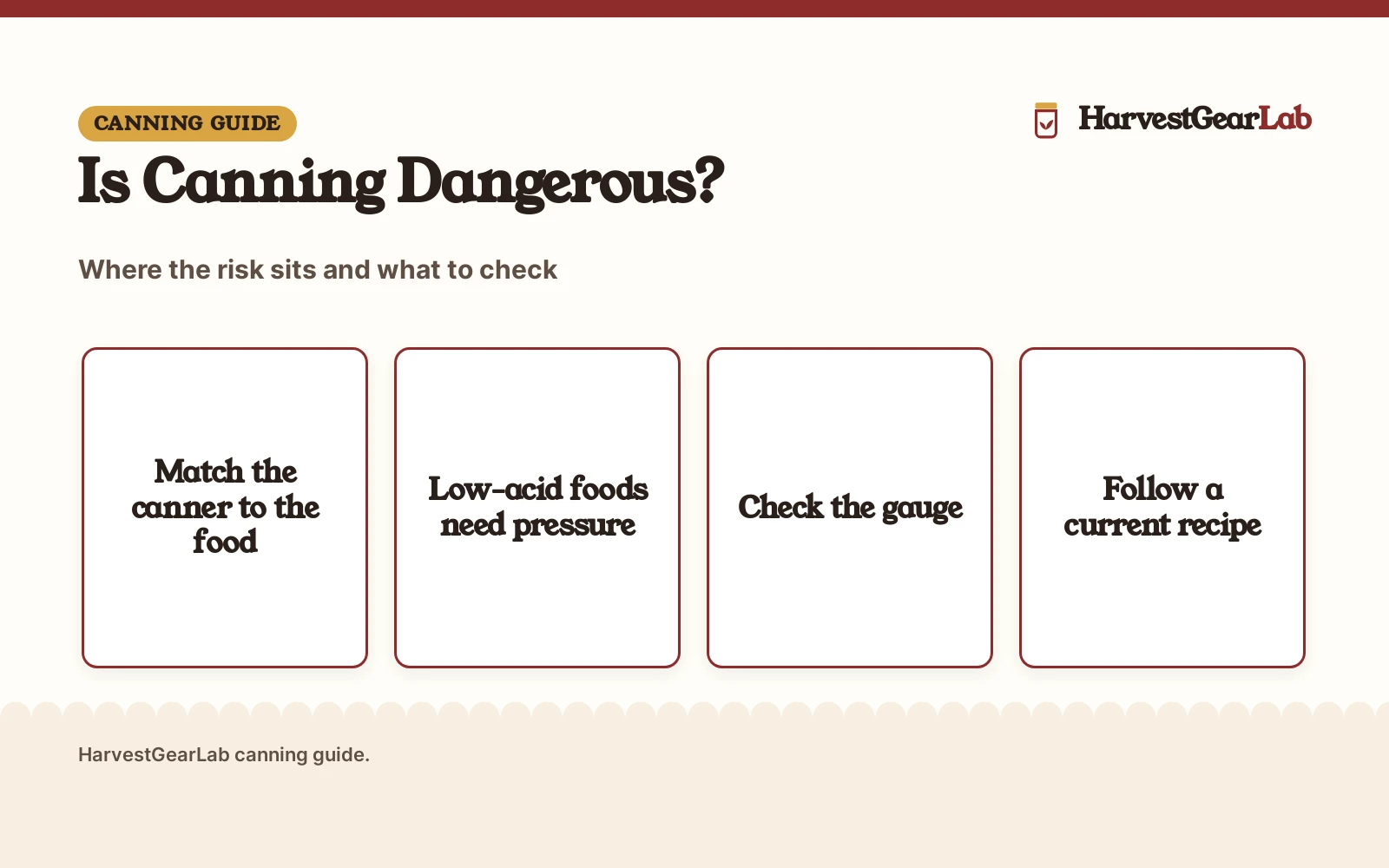
Is canning dangerous? Done with a current USDA recipe and the right canner for the food, home canning is a routine way to put up the harvest. The danger sits with low-acid foods sealed without enough heat, which can carry spores that survive boiling water. This guide explains where the risk sits, which canner suits which food, and what to check before each batch.
HarvestGearLab earns a commission when you buy through links on this site, at no extra cost to you. As an Amazon Associate I earn from qualifying purchases. Affiliate disclosure.
Is canning dangerous: the short answer
For most home canners, the short answer is no, as long as the recipe is current and the canner matches the food. High-acid foods go in a water bath canner, and low-acid foods need a pressure canner. The table below lines up each group with its canner.
| Food | Canner | Why |
|---|---|---|
| High-acid foods: fruits, jams, jellies, pickles, acidified tomatoes | Water bath canner | Boiling water is hot enough for high-acid foods |
| Low-acid foods: plain vegetables, meat, poultry, seafood, stock | Pressure canner | Sealed steam runs hotter than boiling water |
Where the danger sits
The risk in home canning is botulism. Spores in low-acid food can form a toxin when jars are sealed without enough heat. Boiling water alone does not get hot enough for low-acid foods, and no amount of extra time in a water bath changes that. A pressure canner locks shut and traps steam, so it runs hotter than boiling water and reaches the heat low-acid foods need. That is why the canner must match the food, and why a current recipe matters more than any shortcut.
Water bath or pressure canner
Sort the foods you want to put up by acidity before you buy or borrow a canner. High-acid foods, such as most fruits, jams, jellies, pickles and tomatoes with added acid, can go in a boiling water bath when you follow a current USDA recipe. Low-acid foods, such as green beans, corn, potatoes, meat and stock, need a pressure canner. Never water bath low-acid foods, and never use an electric pressure cooker for canning unless the maker states it is made for pressure canning.
Processing jars in the oven is not a safe way to process canning jars. Dry oven heat does not reach jars evenly, so skip it and use a water bath canner or a pressure canner with a current recipe. Our water bath canner vs pressure canner comparison walks through the difference, and the best pressure canner guide lines up current models.
The gauge: a small part with a big job
A pressure canner is only as good as its gauge. The gauge shows the pressure inside the canner, and a dial gauge that reads low can leave food under-processed. Replacement gauges for Presto canners (on Amazon) fit models such as 175001 and 178001 and list a measurement range of 0-20 PSI, while the MEASUREMAN gauge (on Amazon) lists a 0-30 PSI range with a 2-inch dial. All American 1930 canners run from the 910 at 10.5 quarts to the 941 at 41.5 quarts, and each size needs a gauge that reads true. Watch the dial during a run, and ask your local extension office whether they can check a dial gauge.
What to check before each batch
- Gauge: the dial reads clearly and the needle moves freely; if it sticks or reads off, swap the gauge before you can.
- Gasket and vent: the sealing ring is clean and flexible, and the vent is clear.
- Lid and seal: the lid locks shut and the seal has no cracks.
- Jars and lids: jars are free of chips and cracks, and bands are free of rust. Flat lids with sealing compound are for a fresh seal, so buy new lids for each batch.
- Recipe: the recipe is current and matches the food and the jar size.
What this guide does not cover
This guide explains the risk and the gear. It does not give recipes, processing times, pressures, headspace figures or altitude changes. Take those from current USDA and National Center for Home Food Preservation guidance, or from a current edition of a trusted canning guide, and follow them exactly for each food. Every canner and tool guide on the site is collected in our canning section.
FAQ: preserving at home
Is home canning dangerous?
Canning is a routine way to put up food when you follow a current USDA recipe and match the canner to the food. The risk sits with low-acid foods sealed without enough heat, so use a pressure canner for those and a water bath canner for high-acid foods.
Can I water bath can green beans?
No. Green beans are a low-acid food, so they need a pressure canner. Boiling water alone does not get hot enough for them.
How do I know my pressure canner gauge is accurate?
Watch the dial during a run and ask your local extension office whether they can check a dial gauge. Replacement gauges for Presto canners list a 0-20 PSI range, and a gauge that reads off is worth swapping before the season.
Can I process jars in the oven?
No. Dry oven heat is not a safe way to process canning jars. Use a water bath canner or a pressure canner with a current recipe.
Do I need a pressure canner to start canning?
Only if you plan to can low-acid foods such as plain vegetables, meat, poultry, seafood or stock. If you start with jams, jellies, pickles and acidified tomatoes, a water bath canner is enough, and you can add a pressure canner later.
More preserving guides
See every pressure canners guide and all canning guides.
More picks: pressure canners, water bath canners, water bath vs pressure canner and pressure canner gauges.