
On this page
Top picks at a glance
As an Amazon Associate I earn from qualifying purchases.
- 1
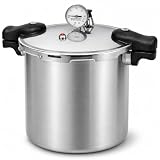 Siftary 24 Quart Pressure Canner for Induction and Gas9.7/10View on Amazon
- 2
 MENTENSIL 23-25 Quart Pressure Canner9.6/10View on Amazon
- 3
 Supa Ant Regular Mouth Canning Lids9.6/10View on Amazon
Is canning meat safe? Yes, when meat is canned in a pressure canner and you follow a current USDA recipe from start to finish. Meat is a low-acid food, and a pressure canner is the tool that makes it safe to put up at home. This guide explains why meat needs pressure, what to look for in a canner, and what to check before each batch.
HarvestGearLab earns a commission when you buy through links on this site, at no extra cost to you. As an Amazon Associate I earn from qualifying purchases. Affiliate disclosure.
Is canning meat safe: the short answer
The short answer is yes, with the right method. Meat, poultry, seafood and stock are low-acid foods, and low-acid foods need a pressure canner. A water bath canner cannot make meat safe, no matter how long the jars stay in the water. The table sums up the methods.
| Method | Works for meat? | Why |
|---|---|---|
| Pressure canner | Yes | Locks shut and traps steam to run hotter than boiling |
| Water bath canner | No | Boiling water alone does not get hot enough for low-acid foods |
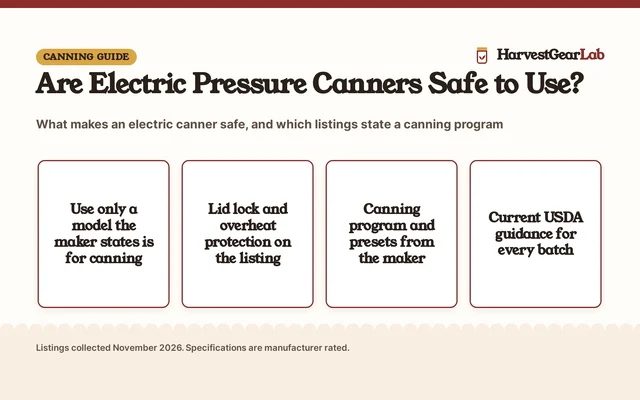
| Electric pressure cooker | Only if the maker states it is made for pressure canning | Most cookers are not sold as canners |
The rest of this guide walks through each row in turn, then covers the checks that keep every batch on track.
Why meat needs a pressure canner
Meat sits on the low-acid side of the pantry. High-acid foods, such as most fruits, jams, jellies, pickles and tomatoes with added acid, can go in a boiling water bath when you follow a current USDA recipe. Low-acid foods, such as plain vegetables, meat, poultry, seafood and stock, need a pressure canner. Boiling water alone does not get hot enough for them, and no amount of extra time in a water bath changes that.
A pressure canner locks shut and traps steam, so it runs hotter than boiling water. That extra heat is what makes low-acid foods safe to store on the shelf. The canner, the recipe and the jar seal work together: the recipe sets the method, the canner supplies the heat, and the seal keeps the jar shut after it cools. Skip any one of them and the batch is not safe to store.
What to look for in a pressure canner
Look for a canner sold as a pressure canner, not only as a pressure cooker. It should have a pressure gauge you can read, a regulator weight, and an overpressure plug or similar safety feature. Check that the base suits your stove, and confirm the jar capacity before you buy: the All American 925 (on Amazon) lists a 25 quart capacity and holds 18 pint jars or 7 one-quart jars, with a metal-to-metal seal and a pressure gauge and regulator weight. Pick the size that matches the batch you will realistically fill in one afternoon.
Cast aluminum is the common build for a home pressure canner, and the All American 925 is cast aluminum made in the USA, for gas, electric or flat-top stoves. Compare current options in our best pressure canner guide.
What to check before each batch
Check the gauge before the season starts. Ask your local extension office whether they can check a dial gauge, and replace a gauge that reads off. Check the seal and the safety plug at the same time, and make sure the regulator weight moves freely.
Use jars made for home canning, in the sizes your recipe calls for. Pints suit most meats and sauces, and quarts suit whole cuts and stock. Jars and bands can be reused if they are free of chips and rust, but the flat lids with sealing compound are made for one use. Buy more lids than you think you need, since a nicked rim or a lid that does not seal sends you back to the box.
Follow the recipe exactly for each food: the pack, the headspace, the venting step and the cooling step. Fill jars as the recipe says, wipe the rims clean, and set the lids and bands as the recipe directs. When the batch is done, let the canner cool on its own and check that every lid has sealed before you move the jars to the shelf.
What to skip or double-check
- Processing jars in the oven: skip it. Dry oven heat is not a safe way to process canning jars.
- Electric pressure cookers: do not use one for canning unless the maker states it is made for pressure canning.
- Water bath canning meat: skip it. Boiling water does not get hot enough for low-acid foods.
- Old or secondhand canners: check the gauge, seal and safety plug before use, and ask your local extension office whether they can check a dial gauge.
- Reused single-use lids: buy new flat lids each season.
- Old recipes: use a current USDA recipe or a current edition of a trusted canning guide, and follow it exactly for each food.
What this guide does not cover
This guide explains the method. It does not give recipes, processing times, pressures, headspace figures or altitude changes. Take those from current USDA and National Center for Home Food Preservation guidance, or from a current edition of a trusted canning guide, and follow them exactly for each food. Every canner guide on the site is collected in our canning section.
FAQ: preserving at home
Can I can meat in a water bath canner?
No. Meat is a low-acid food, and a water bath canner does not get hot enough for low-acid foods. Use a pressure canner and a current USDA recipe.
Can I use an electric pressure cooker to can meat?
Only if the maker states it is made for pressure canning. Most electric pressure cookers are sold as cookers, not canners, so check the listing before you treat one as a canner.
How do I know my pressure canner gauge is right?
Ask your local extension office whether they can check a dial gauge, and have it checked before the season starts. A gauge that reads off can leave jars under-processed, so replace it when it does not read true.
Can I reuse canning lids for meat?
No. The flat lids with sealing compound are made for one use, so buy new flat lids for each batch. Jars and bands can be reused as long as they have no chips, cracks or rust.
More preserving guides
See every pressure canners guide and all canning guides.
More picks: pressure canners, water bath canners, water bath vs pressure canner and canning tool kits.