
On this page
Top picks at a glance
As an Amazon Associate I earn from qualifying purchases.
- 1
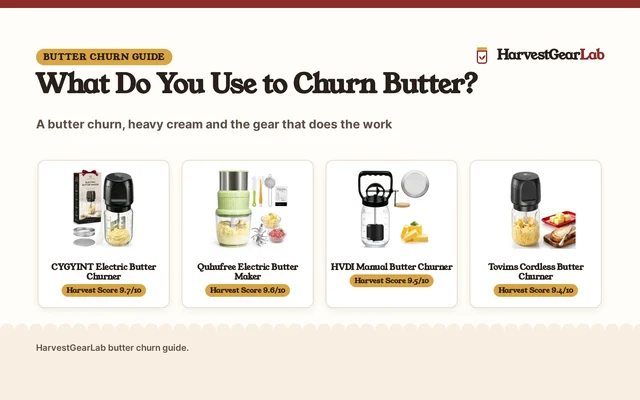
 Roman Ventures Turn N Churn Manual Butter Maker with Crock9.4/10View on Amazon
- 2
 RDGDFONG Butter Churn9.4/10View on Amazon
- 3
 aeaker Manual Butter Churner9.6/10View on Amazon
- 4
 KILNER Butter ChurnView on Amazon
- 5
 IFOLO Electric Butter ChurnView on Amazon
- 6
 Hokuvory Electric Butter Churn One-Touch Butter Maker ReadyView on Amazon
- 7
 VigorMach Cordless Electric Butter ChurnView on Amazon
When cream from the morning milking stands in the pantry and the kitchen is quiet, a manual butter churn turns that cream into butter with nothing but steady motion. A manual butter churn is a hand-powered vessel that agitates cream until the fat gathers into butter and the liquid left behind becomes buttermilk. This guide walks through the parts, the cream, the churning steps, and the cleaning that keeps a churn ready for the next batch.
Runners-up to consider
 Dazey Butter ChurnCheck price on Amazon
 Butter ChurnCheck price on Amazon
 KILNER Butter ChurnCheck price on Amazon
 IFOLO Electric Butter ChurnCheck price on Amazon
 Hokuvory Electric Butter Churn One-Touch Butter Maker ReadyCheck price on Amazon
 VigorMach Cordless Electric Butter ChurnCheck price on Amazon
HarvestGearLab earns a commission when you buy through links on this site, at no extra cost to you. As an Amazon Associate I earn from qualifying purchases. Affiliate disclosure.
Manual butter churn: the parts to know
A churn has a vessel to hold the cream, a lid to keep it in, and a moving part that stirs the cream. In a dasher churn the moving part is a plunger on a rod, with a crosspiece at the foot that pushes through the cream. In a jar churn a paddle turns inside a glass jar, with a hand crank on the lid on the lid. In a crank churn a handle turns paddles inside a closed vessel. The shape differs, but the work is the same: keep the cream moving until the butter gathers.
| Churn type | How it works | What to look for |
|---|---|---|
| Dasher churn | A plunger with a crosspiece moves up and down through cream in a tall vessel | A lid that fits the dasher rod, a vessel that sits steady on the counter |
| Jar churn | A paddle or dasher turns inside a glass jar, with a hand crank on the lid | A jar that lets you watch the cream change, a crank that turns smoothly |
| Crank churn | A handle turns paddles inside a closed vessel | Paddles that reach the cream, a handle that stays firm in the hand |
Pick the churn that fits your kitchen and the amount of cream you plan to churn. A dasher churn suits a large vessel of cream and a steady arm, a jar churn suits a small batch and a clear view of the cream as it changes, and a crank churn suits hands that tire of lifting a dasher. Our how does a butter churn work guide compares the types in more depth.
Cream ready for the churn
Use cream that has been skimmed from milk and left to lose the chill of cold storage, so it pours easily and churns evenly. Cream that is too cold takes longer to gather, and cream that is too warm turns soft before the butter firms. Cream that has been cultured or left to ripen churns readily and gives butter with a tangy note.
Pour the cream into the churn and leave room at the top for the cream to move. A churn filled to the brim splashes cream out with each stroke, while a churn with room to move lets the cream fold and gather. Set the lid in place and check that the dasher rod moves freely before you start.
Sweet cream gives butter with a mild flavor, while cultured cream gives butter with a tangy note. The choice is a matter of taste and of what the dairy has on hand, and the churning steps stay the same for each kind.
Churn step by step
Work the dasher with slow, steady strokes, lifting it clear of the cream and pressing it down again in a steady rhythm. Keep the motion even and let the cream do the work: rushing the strokes splashes cream and tires the arm without gathering the butter. Watch for the change in the cream as you work.
The cream thickens, then breaks into grains of butter swimming in buttermilk. When the grains gather into a mass, stop churning and lift out the butter with a slotted spoon or a strainer. Pour off the buttermilk and save it for baking. If you want a sense of how long the work takes, our how long to churn butter guide covers timing and equipment.
Wash, shape and store the butter
Rinse the butter in cool water and knead it with butter paddles to press out the buttermilk that stays inside, changing the water until it runs clear. Butter that keeps buttermilk inside spoils earlier than butter that has been washed well, so wash it with care. Shape the butter with paddles, or press it into a mold for a neat block. Our how to use butter paddles guide shows the shaping step, and our how to use a butter mold guide covers molding.
Keep the finished butter cool and covered, in a butter bell or a covered dish, and use it before it picks up flavors from the pantry. A butter bell keeps the butter at hand on the counter while keeping air away from it. See our how to use a butter bell crock guide for the setup.
Clean the churn after each batch
Wash the vessel, lid and dasher in hot soapy water, rinse well, and let the parts dry fully before you put the churn away, so no milk residue stays behind to sour. Store the churn with the lid off so air moves through it. If the dasher is wood, let it dry fully before storage, and keep it away from damp corners of the pantry.
FAQ: preserving at home
How does a manual butter churn work?
Agitation breaks the thin skin around fat globules in cream, so the fat clumps together into butter while the liquid left behind becomes buttermilk. A dasher, paddle or crank keeps the cream moving until the butter gathers.
What cream should I use in a manual butter churn?
Use fresh cream skimmed from milk, or cultured cream that has been left to ripen. Cream that is cool to the touch and pours easily churns evenly, while cream straight from cold storage takes longer to gather.
Do I need to wash butter after churning?
Yes. Rinse the butter in cool water and knead it with paddles to press out the buttermilk, changing the water until it runs clear. Butter that keeps buttermilk inside spoils earlier than butter that has been washed well.
How do I clean a manual butter churn?
Wash the vessel, lid and dasher in hot soapy water, rinse well, and let the parts dry fully before storage. Store the churn with the lid off so air moves through it, and keep wooden parts dry.
What can I do with leftover buttermilk?
Save it for baking, where it adds a tangy note to breads and cakes. Buttermilk also works in dressings and marinades, so keep it cool and covered until you use it.
More preserving guides
See every butter churns guide and all harvest and processing guides.
More picks: how to churn butter at home, butter paddles, butter mold and how long to churn butter.