
On this page
Top picks at a glance
As an Amazon Associate I earn from qualifying purchases.
- 1
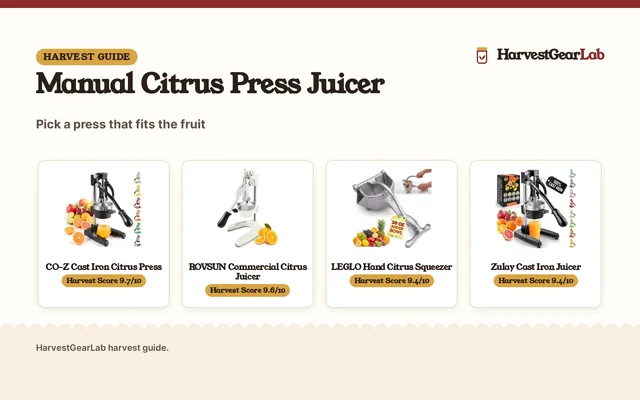
 ROVSUN Commercial Grade Citrus Juicer Hand Press9.6/10View on Amazon
- 2
 Zulay Kitchen Cast Iron Juicer9.4/10View on Amazon
A bowl of citrus waits on the counter after a market run, and a manual fruit press turns those halves into juice without a motor or a plug. A manual fruit press is a lever hand press: you set the fruit in the bowl, hold the base, and lower the handle to squeeze the juice out. This guide covers how the press works, which fruits it suits, and how to wash and store it after pressing.
HarvestGearLab earns a commission when you buy through links on this site, at no extra cost to you. As an Amazon Associate I earn from qualifying purchases. Affiliate disclosure.
Manual fruit press: how it works
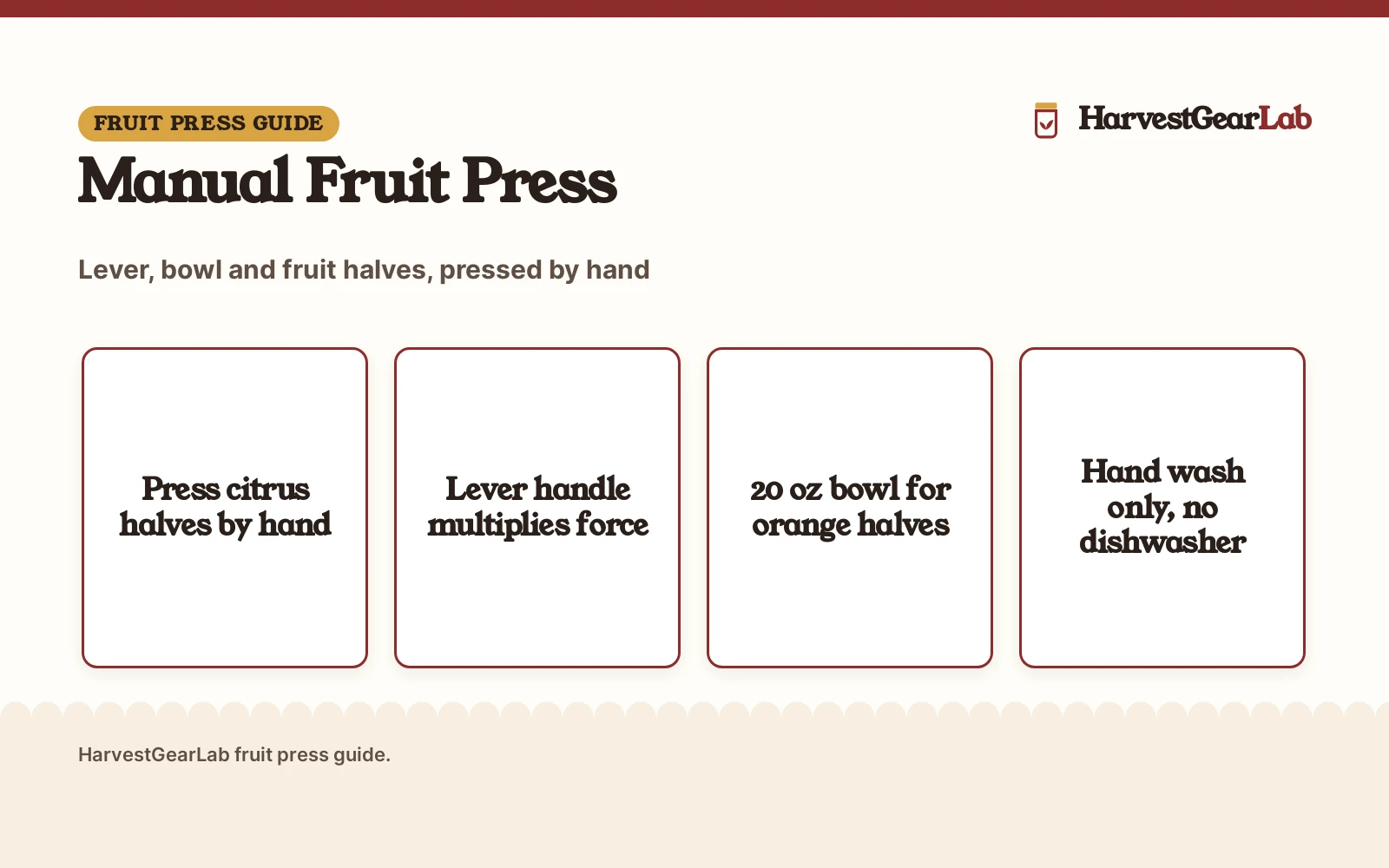
A manual fruit press works by leverage. The fruit half sits in the bowl, the base holds the press steady on the table, and the long handle multiplies the force of your hand as you lower it. The listing states the long handle multiplies your force, so the lever does the hard work while your hand guides it.
The NADOBA press (on Amazon) in the listing is cast aluminum alloy, 9.3 inches long with a 20 oz bowl, and the bowl takes orange and grapefruit halves. The press weighs 1.12 pounds. Hold the base with one hand and lower the handle with the other, and pour the juice out of the bowl as it fills. Cast iron presses are another option: see the cast iron fruit press picks.
| Part | Detail |
|---|---|
| Bowl | 20 oz bowl that takes orange and grapefruit halves |
| Length | 9.3 inches long |
| Weight | 1.12 pounds |
| Material | Cast aluminum alloy |
| Wash | Hand wash only, warm soapy water |
| Fruits | Lemon, lime, orange, grapefruit, pomegranate |
| Not for | Garlic, ginger, hard vegetables |
Which fruits suit a manual fruit press
A manual fruit press suits soft citrus halves: lemon, lime, orange and grapefruit, plus pomegranate. The listing names those fruits, and the 20 oz bowl takes orange and grapefruit halves. Load one fruit half at a time, lower the handle slowly, then turn the half and press again to get the rest of the juice.
Do not use the press for garlic, ginger or hard vegetables. The listing states the press is a citrus and pomegranate juicer, not for garlic, ginger or hard vegetables, so those foods belong in another tool. If the harvest runs to bushels of apples rather than citrus halves, a cider press does that job instead: see the cider press for home use guide, and the apple crusher vs cider press comparison covers the orchard route.
How to use a manual fruit press
Set the press on a table or counter and wash it with warm soapy water before first use. Hold the base with one hand, load one fruit half at a time, and lower the handle slowly with the other hand. Turn the half and press again, then pour the juice out of the bowl.
For juice from garden produce in volume rather than one half at a time, see the centrifugal juicer for garden produce guide. A hand press suits small batches at the counter, while a juicer suits a counter full of produce waiting to be juiced.
Washing, drying and storage
Wash the press by hand with warm soapy water, rinse it, and towel-dry it after every use. The listing states hand wash only, with no dishwasher. Wash it before first use as well, so the bowl and handle start clean.
The press is 9.3 inches long, and the listing notes it is bigger than a wedge squeezer, so plan shelf space for it. The press is cast aluminum alloy, so store it dry between uses and keep it where the handle will not catch on other tools.
What this guide does not cover
This guide does not give recipes or juice yields. It does not cover electric juicers or cider presses in depth; for sauces and purees, a food mill strains out skins and seeds, so see the best food mill guide. Take any canning or preserving steps from current USDA and National Center for Home Food Preservation guidance.
FAQ: preserving at home
What fruits can I press in a manual fruit press?
Lemon, lime, orange, grapefruit and pomegranate halves. The listing states the press is a citrus and pomegranate juicer, so load one fruit half at a time and lower the handle slowly.
Can I put a manual fruit press in the dishwasher?
No. The listing states hand wash only, with no dishwasher. Wash it with warm soapy water before first use, rinse it, and towel-dry it after every use.
How big is the bowl on a manual fruit press?
The NADOBA press in the listing has a 20 oz bowl, which the listing also gives as 0.6 L, and the bowl takes orange and grapefruit halves.
Can a manual fruit press press garlic or ginger?
No. The listing states the press is a citrus and pomegranate juicer, not for garlic, ginger or hard vegetables.
How much does a manual fruit press weigh?
The NADOBA press in the listing weighs 1.12 pounds, and it is 9.3 inches long. The listing notes it is bigger than a wedge squeezer, so plan shelf space for it.
More preserving guides
See every cider and fruit presses guide and all harvest and processing guides.
More picks: cast iron fruit presses, cider presses for home use, food mills and apple crusher vs cider press.