
On this page
Top picks at a glance
As an Amazon Associate I earn from qualifying purchases.
- 1
 All American 1930 Pressure Cooker/Canner9.7/10View on Amazon
- 2
 Siftary 24 QT Pressure Canner with 14.5 PSI Gauge and 7-Piece9.7/10View on Amazon
- 3
 Presto 01781 23-Quart Pressure Canner and Cooker9.6/10View on Amazon
Pressure canner uses cover the low-acid foods that a boiling water bath cannot make safe to put up: plain vegetables, meat, poultry, seafood and stock. A pressure canner locks shut and traps steam, so it runs hotter than boiling water, and that extra heat is what low-acid foods need. This guide walks through what a pressure canner is for, what it is not for, and how to match each food to the right method.
HarvestGearLab earns a commission when you buy through links on this site, at no extra cost to you. As an Amazon Associate I earn from qualifying purchases. Affiliate disclosure.
Pressure canner uses: the short list
The table below lines up the foods by method, so you can see at a glance which foods belong in a pressure canner and which belong in a boiling water bath.
| Food | Method | Why |
|---|---|---|
| Plain vegetables | Pressure canner | Low-acid food; needs heat above boiling |
| Meat and poultry | Pressure canner | Low-acid food; needs heat above boiling |
| Seafood | Pressure canner | Low-acid food; needs heat above boiling |
| Stock and broth | Pressure canner | Low-acid food; needs heat above boiling |
| Jams, jellies and pickles | Boiling water bath | High-acid food; boiling water is enough |
| Acidified tomatoes | Boiling water bath | High-acid food; boiling water is enough |
What a pressure canner is for
A pressure canner is for low-acid foods. Plain vegetables such as green beans, corn and potatoes, meat and poultry, seafood, and stock all fall in this group, and none of them is safe to put up in a boiling water bath. Boiling water alone does not get hot enough for them, and no amount of extra time in a water bath changes that. A pressure canner locks shut, traps steam and runs hotter than boiling water, which is why it is the tool for this group.
That makes a pressure canner the workhorse of the fall harvest, when the garden gives up beans, corn and potatoes in bulk and the freezer is already full. It is also the tool for meat and stock, which turn a harvest of game or a bulk buy of meat into jars for the pantry. If your list includes plain vegetables or meat, you need a pressure canner, and many people end up owning both a pressure canner and a water bath canner. Compare current options in our best pressure canner guide.
What a pressure canner is not for
A pressure canner is not the tool for high-acid foods. Jams, jellies, pickles and acidified tomatoes belong in a boiling water bath, and using a pressure canner for them adds nothing. A pressure canner is also not a substitute for a recipe: every food needs its own recipe from current USDA and National Center for Home Food Preservation guidance.
Dry oven heat is not a safe way to process canning jars, so never process jars in the oven. Do not use an electric pressure cooker for canning unless the maker states it is made for pressure canning. A cooker sold as a cooker and canner still needs that statement before you treat it as a pressure canner. Our water bath canner vs pressure canner comparison walks through the difference between the methods.
How to match the food to the method
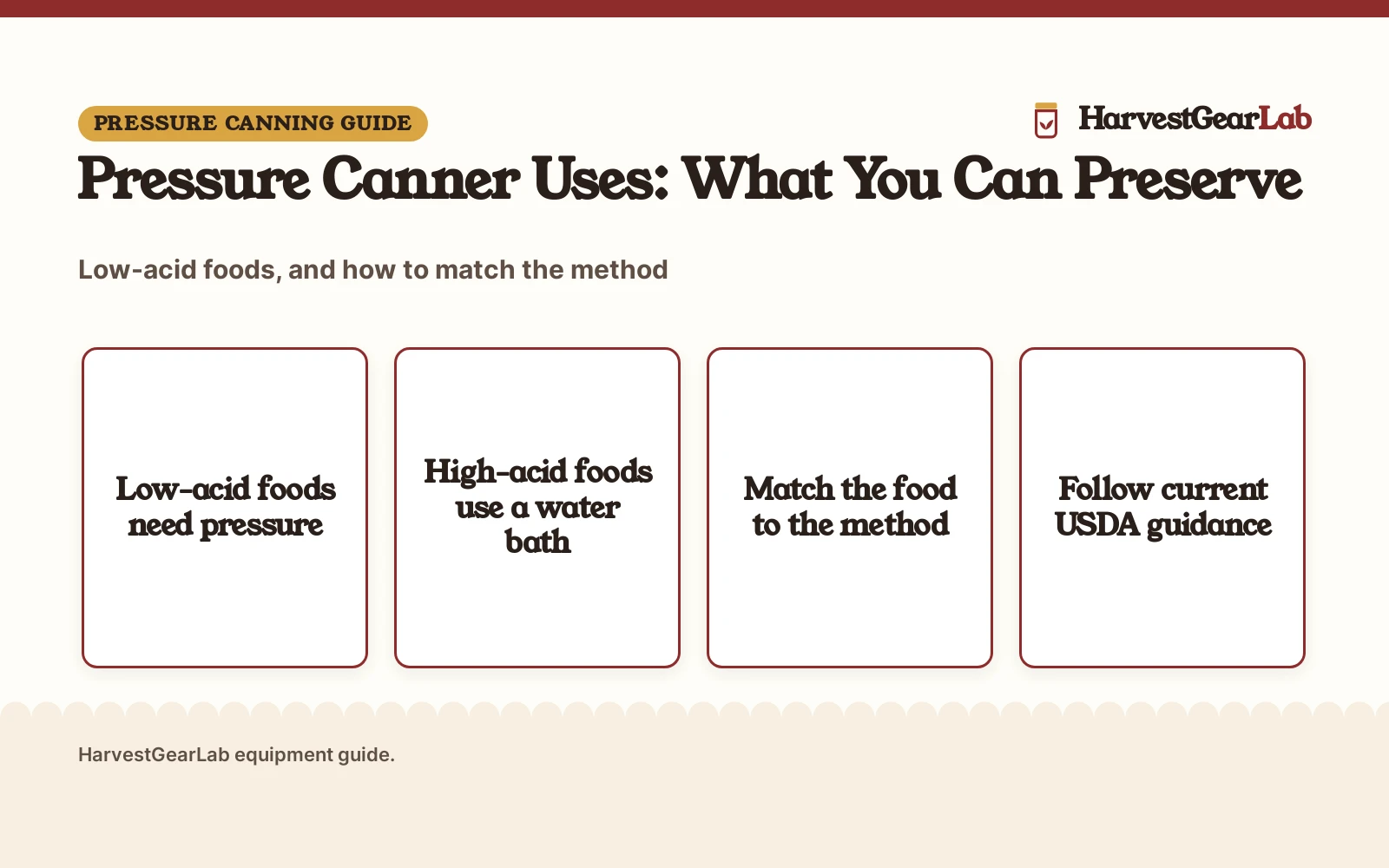
Before you buy anything, sort the foods you want to put up into groups by acid level. High-acid foods, such as most fruits, jams, jellies, pickles and tomatoes with added acid, can go in a boiling water bath when you follow a current USDA recipe. Low-acid foods, such as green beans, corn, potatoes, meat and stock, need a pressure canner.
If your list is all jam and pickles, a water bath canner is enough for now. If it includes plain vegetables or meat, you need a pressure canner. When you are unsure where a food falls, check current USDA and National Center for Home Food Preservation guidance before you choose a method, and follow the recipe exactly for each food. Compare the methods in our best water bath canner guide, or line up tool sets in our best canning tool kit comparison.
Uses through the year
A pressure canner earns its place through the year, not just at harvest time. In spring and summer it handles green beans and corn as they come in from the garden, so the glut never piles up on the counter. In fall it handles potatoes and the last of the garden, plus meat and stock when the hunting season or a bulk buy fills the freezer. In winter it stays ready for stock from bones and trimmings, which turns leftovers into jars for the pantry.
Check the canner before you start
Before you start a batch, check the canner itself: the gauge, the seal and the safety plug should all be in good order, and a dial gauge can be checked by your local extension office. A canner that has sat unused needs the same check as a canner you use every week, so make the check part of the routine before you fill jars for a batch.
What this guide does not cover
This is a guide to uses, not a recipe book. It does not give recipes, processing times, pressures, headspace figures or altitude changes. Take those from current USDA and National Center for Home Food Preservation guidance, or from a current edition of a trusted canning guide, and follow them exactly for each food. Every canner and tool guide on the site is collected in our canning section.
FAQ: preserving at home
What foods need a pressure canner?
Low-acid foods need a pressure canner: plain vegetables such as green beans, corn and potatoes, meat, poultry, seafood and stock. A boiling water bath does not get hot enough for them.
Can I use a pressure canner for jam?
Jam is a high-acid food, so a boiling water bath is the method for it. Save the pressure canner for low-acid foods such as plain vegetables, meat and stock.
Can I use an electric pressure cooker as a pressure canner?
Only if the maker states it is made for pressure canning. Do not use an electric pressure cooker for canning on the strength of its pressure cooking mode alone.
Can I process canning jars in the oven?
No. Dry oven heat is not a safe way to process canning jars. Use a boiling water bath for high-acid foods and a pressure canner for low-acid foods, and follow a current USDA recipe for each food.
Do I need a pressure canner if I only can tomatoes?
Tomatoes with added acid can go in a boiling water bath, so a water bath canner is enough if acidified tomatoes, jam and pickles are your whole list. Add a pressure canner when you put up plain vegetables, meat or stock.
More preserving guides
See every canning guide.
More picks: pressure canners, water bath canners, water bath vs pressure canner and canning tool kits.