
On this page
Top picks at a glance
As an Amazon Associate I earn from qualifying purchases.
- 1
 OSTBA 6-Tray Stainless Steel Dehydrator with ETL Listing9.8/10View on Amazon
- 2
 HOPERAN 16 Tray Dehydrator9.8/10View on Amazon
- 3
 HOPERAN 16-Tray Stainless Steel Food Dehydrator9.7/10View on Amazon
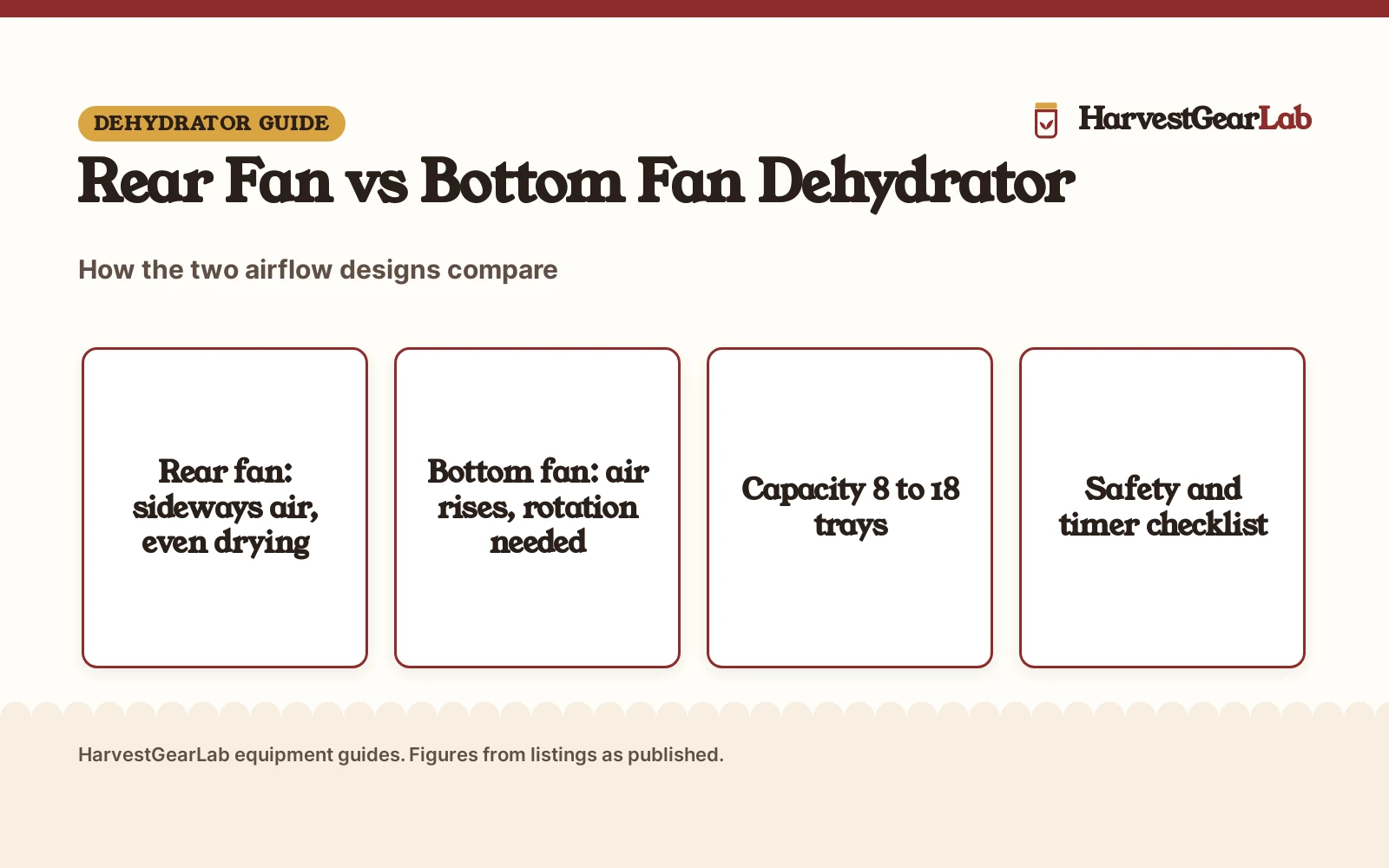
Rear fan vs bottom fan dehydrator is usually the first design question before you buy. The short answer: a rear fan blows air sideways across every tray, while a bottom fan pushes air up from the base. Rear-fan dehydrators dry more evenly and rarely need tray rotation, so they suit most home drying; a bottom fan can work for small, infrequent batches if you rotate trays. This guide compares the two designs with figures from current listings.
HarvestGearLab earns a commission when you buy through links on this page, at no extra cost to you. As an Amazon Associate I earn from qualifying purchases. Affiliate disclosure.
rear fan vs bottom fan dehydrator: the short list
Three design traits decide which fan layout suits you. The table shows how the two layouts differ.
| Design | Airflow direction | Evenness | Tray rotation |
|---|---|---|---|
| Rear fan | Horizontal, from back to front across the trays | Even across all trays | Usually not needed |
| Bottom fan | Vertical, rising from the base | Bottom trays dry faster | Often needed for even results |
How a rear fan works
In a rear-fan dehydrator the fan and heating element sit at the back of the cabinet and blow warm air sideways across each tray. Every tray sees similar airflow, which is why listings for rear-fan models advertise even drying. The Rosewill RHFD-25002 runs a 400-watt rear-fan even-drying system with 8 full-size stainless steel trays, a 95 to 195 degree Fahrenheit temperature range, and a 48-hour timer with auto shutoff. The Weston 75-1501-W pairs a 900-watt heater with a quiet rear-mounted fan and states that its 15 stackable trays need no rotation for consistent drying from top to bottom.
Osluken’s 1100-watt model uses a rear fan with thick heating tubes for 360-degree hot air circulation on all 12 trays, stating temperature fluctuation of 10 percent or less and no need for tray rotation. The Yinglom 800-watt model uses rear dual fans to push a 360-degree horizontal airflow and likewise states that trays do not need rotation. These four listings all describe the same core idea: air moves sideways across the stack instead of rising through it.
How a bottom fan works
In a bottom-fan dehydrator the fan sits in the base and pushes warm air upward through the tray stack. The trays closest to the heat dry fastest, so bottom-fan models generally dry less evenly unless you rotate trays during the session. None of the listings used for this guide states a bottom-only fan layout, so no concrete figure from them applies to bottom fans. Treat bottom-fan evenness as a weakness of the layout rather than of any single listing.
Even drying decides most buyers
The biggest practical gap is how much attention the batch needs. Rear-fan listings state no tray rotation: the Weston 75-1501-W, the Osluken 1100-watt model and the Yinglom 800-watt model all say trays need no rotation for even results. The Osluken listing goes further, stating temperature fluctuation of 10 percent or less, which it compares to an industry 15 percent average. If you plan to dry overnight or while at work, a rear fan lets you set the timer and walk away.
For jerky and other foods where thorough drying matters, even airflow also matters for safety margins. The Osluken listing notes beef jerky should reach at least 185 degrees Fahrenheit and fruits should stay under 145 degrees Fahrenheit, figures that only help if every tray holds the target temperature.
Capacity: trays and square footage
Fan layout does not limit capacity by itself, but rear-fan listings in this guide show a wide spread. Tray counts run from 8 on the Rosewill RHFD-25002, to 12 on the Osluken and Yinglom models, to 15 on the Weston 75-1501-W, to 18 on the Ayovoch model, which combines top and bottom dual fans with a rear 800-watt heating element. The Weston states 15.5 square feet of drying space across its 15 trays.
One note: more trays only help if air reaches them. A rear fan’s sideways airflow keeps working as the stack grows, while a bottom fan’s vertical path gets weaker toward the top of a tall stack. Compare current options in our best dehydrator for large family guide.
Noise and running time
Listed noise levels run from 45 decibels on the Ayovoch model and 45 decibels or less on the Yinglom model, to under 55 decibels on the Osluken model. The Weston 75-1501-W describes its rear-mounted fan as quiet. These are single-listing figures, not a property of either fan layout, but they show that rear-fan models can run overnight in a kitchen without much disturbance.
Timer ranges matter for long recipes. The Rosewill, Weston and Osluken listings state 48-hour timers, while the Ayovoch and Yinglom listings state 24-hour timers. Temperature ranges run from 90 to 160 degrees Fahrenheit on the Weston, 95 to 195 on the Rosewill, and 86 to 194 on the Osluken and Ayovoch models, with the Yinglom listing stating 85 to 194.
Safety features to check
Look for auto shutoff and overheat protection regardless of fan layout. The Rosewill RHFD-25002 lists automatic shutoff, and the Yinglom model lists both automatic shutoff and a built-in overheat protection mechanism. The Osluken listing states overheat protection that powers the machine off automatically. Warranty terms run from 1 year on the Rosewill, Weston and Ayovoch listings to a 3-year factory warranty on the Osluken model.
Who should pick which
Pick a rear fan if you want even drying across the full stack without rotating trays. The listings here support that choice: no tray rotation stated on three rear-fan models, even circulation claims on four, and capacities up to 18 trays. Pick a bottom fan only if you find a deal on a small unit and do not mind rotating trays. For anything else on the sheets question, see our silicone vs Teflon dehydrator sheets guide, or compare listings in our budget food dehydrators guide.
What to skip or double-check
- No tray rotation claim: if a listing does not state it, expect to rotate trays on a bottom-fan model.
- Timer range: long jerky and fruit recipes need up to 48 hours; some listings state only 24.
- Wattage comparisons: the listings here run from 400 to 1100 watts, but wattage is not drying power alone; check the temperature range too.
- Noise claims: stated decibel levels come from single listings, so compare them within the same listing set, not against reviews.
FAQ: preserving at home
Do I need to rotate trays in a rear-fan dehydrator?
Usually not. The Weston 75-1501-W, the Osluken 1100-watt model and the Yinglom 800-watt model all state that no tray rotation is needed.
Which fan layout dries faster?
The listings here do not give drying times for either layout. The Yinglom listing states its dual-fan setup increases drying speed by 30 percent compared to traditional single-fan models, but no listing compares rear fan against bottom fan directly.
Can a rear-fan dehydrator dry meat jerky?
The listings describe jerky use for several rear-fan models. The Osluken listing notes beef jerky should reach at least 185 degrees Fahrenheit; check the temperature range of the listing you buy.
How many trays do I need?
The listings here run from 8 to 18 trays. Pick by batch size: 8 to 12 trays suit most families, while 15 to 18 trays suit garden harvests.
More preserving guides
See every food dehydrator guide and all food drying guides.
More guides: dehydrators for large families, silicone vs Teflon sheets and affordable food dehydrators.