
On this page
Top picks at a glance
As an Amazon Associate I earn from qualifying purchases.
- 1
 Vineyard Stainless Steel Steam Juicer and Roaster Set9.6/10View on Amazon
- 2
 Cooks Standard Steam Juicer Pot 11 Quart Stainless SteelView on Amazon
- 3
 VIVOHOME 11 Qt Stainless Steel Steam Juicer for Canning FruitView on Amazon
- 4
 VIVOHOME Stainless Steel Steam Juicer for Canning Fruit andView on Amazon
The first apples are in and the grapes are heavy on the vine, and the question is how to turn them into clear juice, because steam juicer vs jelly bag is the juice-straining question every harvest asks. This guide compares the two methods by how each one works, what the steam juicer listings state about sizes, and when each one makes sense. Every number below comes from an Amazon listing we read for this guide.
Runners-up to consider
 Cooks Standard Steam Juicer Pot 11 Quart Stainless SteelCheck price on Amazon
 VIVOHOME 11 Qt Stainless Steel Steam Juicer for Canning FruitCheck price on Amazon
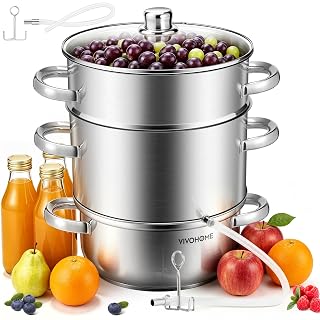 VIVOHOME Stainless Steel Steam Juicer for Canning Fruit andCheck price on Amazon
HarvestGearLab earns a commission when you buy through links on this site, at no extra cost to you. As an Amazon Associate I earn from qualifying purchases. Affiliate disclosure.
Steam juicer vs jelly bag: the short answer
Use a steam juicer for large batches with hands-off extraction, and a jelly bag for small batches of clear juice with no special equipment. A steam juicer is a stovetop stack of pots: water boils below, fruit steams above, and juice collects in a middle kettle that drains through a hose. A jelly bag is a cloth bag on a stand: cooked fruit goes in, and the juice drips through by gravity while the pulp stays behind. Pick the steamer when the harvest is big; pick the bag when it is small.
If you would rather go straight to the products, our best steam juicer for canning roundup scores the steamer options on these points.
What the steam juicer listings state
The WATERJOY listing describes an 11 quart, 3-tier stainless steel steam juicer measuring 12 by 12 by 14 in. Fruit goes in the top colander, water boils in the bottom pot, and juice collects in the center kettle, which drains through a hose with a clamp. A glass lid and an instruction manual are included, and the bottom pot doubles as a soup pot. The listing names a 90-day money-back term and lifetime customer service.
| Listing | Stated capacity | Stated size | Extras |
|---|---|---|---|
| WATERJOY steamer juicer | 11 quarts | 12 x 12 x 14 in | Hose with clamp, glass lid |
| EJWOX fruit press | 1.6 gallons | 7.48 x 7.48 x 12.99 in | Pour spout, screw-hole feet |
| EJWOX fruit press | 3.2 gallons | 14.4 x 20.5 x 22.4 in | Pour spout, screw-hole feet |
The presses are a different method, pressing rather than steaming, but their capacities show the batch range these listings cover. Our steam juicer vs fruit press comparison walks through that choice.
How a jelly bag works
A jelly bag needs no listing figures to explain. It is a cloth bag, usually on a frame or stand, that holds cooked fruit while the juice drips out by gravity into a bowl or pot below. The pulp and skins stay in the bag, which is what gives jelly its clarity. It handles one pot of fruit at a time, it washes out for the next batch, and it costs far less than a three-tier steamer. No jelly bag listing was in this guide’s data, so no bag figures are stated here.
Batch size and effort
Batch size is the real divider. An 11 quart steam juicer processes a full load of fruit in one steaming, with the hose draining juice straight into jars or a kettle. A jelly bag processes one bag at a time and drips slowly, so a big harvest means many bags. The steamer needs a stovetop and ventilation for the steam; the bag needs only a bowl and a place to hang. If the harvest fills more than a couple of pots, the steamer saves the day; if it is a single picking for a few jars of jelly, the bag is simpler.
What this guide does not cover
This is an equipment guide. It does not give recipes, processing times, canning pressures, altitude changes or sugar ratios. Take those from current USDA and National Center for Home Food Preservation guidance, and follow them exactly for each food. For the jars the juice goes into, see our best canning jars for jelly guide.
FAQ: preserving at home
Do I need a steam juicer to make jelly?
No. A jelly bag and a pot handle small batches with no special equipment. A steam juicer suits large harvests where one 11 quart load beats many slow-dripping bags.
Can I use an electric juicer instead?
Electric juicers such as the listed centrifugal models are built for fresh drinking juice, not for the clear strained juice that jelly needs. For jelly, strain through a jelly bag or a steamer, not a spinning basket.
What size steam juicer do I need?
The WATERJOY listing states 11 quarts in a 12 by 12 by 14 in footprint. Match the capacity to the batch you will realistically fill in one session.
More preserving guides
See every steam juicers guide and all canning guides.
More picks: steam juicers for apples, stainless vs aluminum steam juicers, electric vs stovetop steam juicers and canning jars for jelly.