
On this page
Top picks at a glance
As an Amazon Associate I earn from qualifying purchases.
- 1
 Vineyard Stainless Steel Steam Juicer and Roaster Set9.6/10View on Amazon
- 2
 VIVOHOME 11 Qt Stainless Steel Steam Juicer for Canning FruitView on Amazon
- 3
 VIVOHOME Stainless Steel Steam Juicer for Canning Fruit andView on Amazon
- 4
 Fruit Steam Juicer Stainless Steel SteamerView on Amazon
The steam juicer vs steam canner question comes up every fall when the counter fills with fruit and the pantry shelves start to empty. The short answer: a steam juicer extracts juice from fruit with steam, while a steam canner processes filled jars in steam instead of a boiling water bath. One makes juice; the other heat-processes jars of high-acid food. This guide explains how each one works, what each cannot do, and how to tell which one you actually need.
Runners-up to consider
 VIVOHOME 11 Qt Stainless Steel Steam Juicer for Canning FruitCheck price on Amazon
 VIVOHOME Stainless Steel Steam Juicer for Canning Fruit andCheck price on Amazon
 Fruit Steam Juicer Stainless Steel SteamerCheck price on Amazon
HarvestGearLab earns a commission when you buy through links on this page, at no extra cost to you. As an Amazon Associate I earn from qualifying purchases. Affiliate disclosure.
Steam juicer vs steam canner: the short answer
The two share steam and little else. The table below shows what each one is for.
| Equipment | What it does | Made for | Not for |
|---|---|---|---|
| Steam juicer | Steams fruit so juice drips into a center kettle, drawn off through a hose | Extracting juice from apples, grapes and berries | Processing jars, low-acid foods |
| Steam canner | Processes filled jars in a shallow pan of steam under a lid | High-acid foods in jars, like a water bath canner | Low-acid foods, which need a pressure canner |
How a steam juicer works
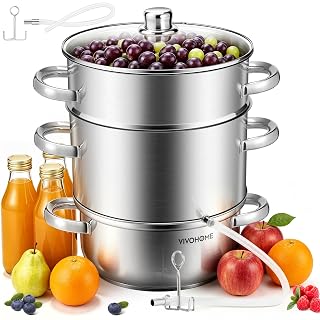
A steam juicer is a stack of pots. Fruit goes in the top colander, water boils in the bottom pot, and steam rises through the fruit so the juice releases and drips into a center juice kettle, which you draw off through a hose. The WATERJOY listing describes an 11-quart, 3-tier stainless steel steamer juicer, 12 by 12 by 14 inches, with a glass lid and a hose with clamp, built for stovetop and induction use. Its bottom pot can double as a soup pot, per the listing. Fruit presses take a different route: the EJWOX listings describe manual presses with beech wood baskets in 1.6 and 3.2 gallon sizes, which squeeze crushed fruit rather than steaming it. A steam juicer is the gentler choice for clear juice with little effort on your part; you load the fruit and the steam does the extracting.
What comes out is fresh juice, not a sealed jar. If you want that juice to keep on the pantry shelf, it has to be processed in jars separately, following current USDA and National Center for Home Food Preservation guidance for the food in question. The steam juicer itself does no jar processing at all. See our steam juicers guides for the models we compare.
How a steam canner works
A steam canner is a shallow pot with a tight lid and a rack, sized to hold jars in a few inches of water that boil into steam around them. It processes filled jars the way a boiling water bath canner does, but with less water to heat. That makes it quicker to get going on canning day and lighter to lift when the jars come out.
The key limit is the same as for a water bath canner: it suits high-acid foods only, the foods a current USDA recipe allows in a water bath. A steam canner is not a pressure canner and cannot make low-acid foods safe. If your harvest includes plain vegetables, meat, poultry or stock, you need a pressure canner instead. Compare the two methods in our water bath canner vs pressure canner guide, and see current models in our best water bath canner picks.
What each one cannot do
- A steam juicer cannot process jars. It extracts juice; sealing that juice in jars takes a separate step with a canner, following USDA guidance.
- A steam canner cannot handle low-acid foods. It is a water bath alternative for high-acid foods. Plain vegetables, meat, poultry, seafood and stock need a pressure canner; see our best pressure canner picks.
- Neither replaces a pressure canner. Steam is useful for juice extraction and for high-acid jar processing, but only a pressure canner runs hot enough for low-acid foods.
- Neither gives processing times or pressures. This guide does not either. Take times, pressures and altitude changes from current USDA and National Center for Home Food Preservation guidance, and follow them exactly for each food.
What to skip or double-check
- Buying a steam juicer to can jars: it makes juice, not sealed jars. Plan the canning step separately.
- Buying a steam canner for vegetables: skip it unless your recipes are all high-acid. Low-acid foods need a pressure canner.
- Oven processing: skip it. Dry oven heat is not a safe way to process canning jars.
- Secondhand steam gear: check the lid fit, the hose and clamp on a steamer juicer, and the rack on a steam canner before the first use.
What this guide does not cover
This is an equipment explainer. It does not give recipes, processing times, pressures, headspace figures or altitude changes. Take those from current USDA and National Center for Home Food Preservation guidance, or from a current edition of a trusted canning guide, and follow them exactly for each food. Every canner guide on the site is collected in our canning section.
FAQ: preserving at home
Can a steam juicer process canning jars?
No. A steam juicer extracts juice from fruit; the juice then needs separate jar processing. Follow current USDA guidance for the food you are putting up.
Can I use a steam canner for vegetables?
Only for high-acid foods that a current USDA recipe allows in a water bath. Plain vegetables are low-acid and need a pressure canner.
Does a steam juicer need electricity?
The WATERJOY listing describes a stovetop steamer juicer for stovetop and induction use, with water boiled in the bottom pot. No electric model is listed here.
How big is a typical steam juicer?
The WATERJOY listing states 11 quarts across 3 tiers, at 12 by 12 by 14 inches. Check the listing of any model you consider, since sizes vary.
More preserving guides
See every steam juicers guide and all canning guides.
More picks: water bath canners, best water bath canner, best pressure canner and water bath vs pressure canner.