
On this page
Top picks at a glance
As an Amazon Associate I earn from qualifying purchases.
- 1
 Granite Ware 9-Piece Enamelware Water Bath Canning Pot with9.7/10View on Amazon
- 2
 Ball freshTECH Electric Water Bath Canner and Multi-Cooker9.6/10View on Amazon
- 3
 HOMKULA 20QT Water Bath Canning Pot with Rack and Lid9.6/10View on Amazon
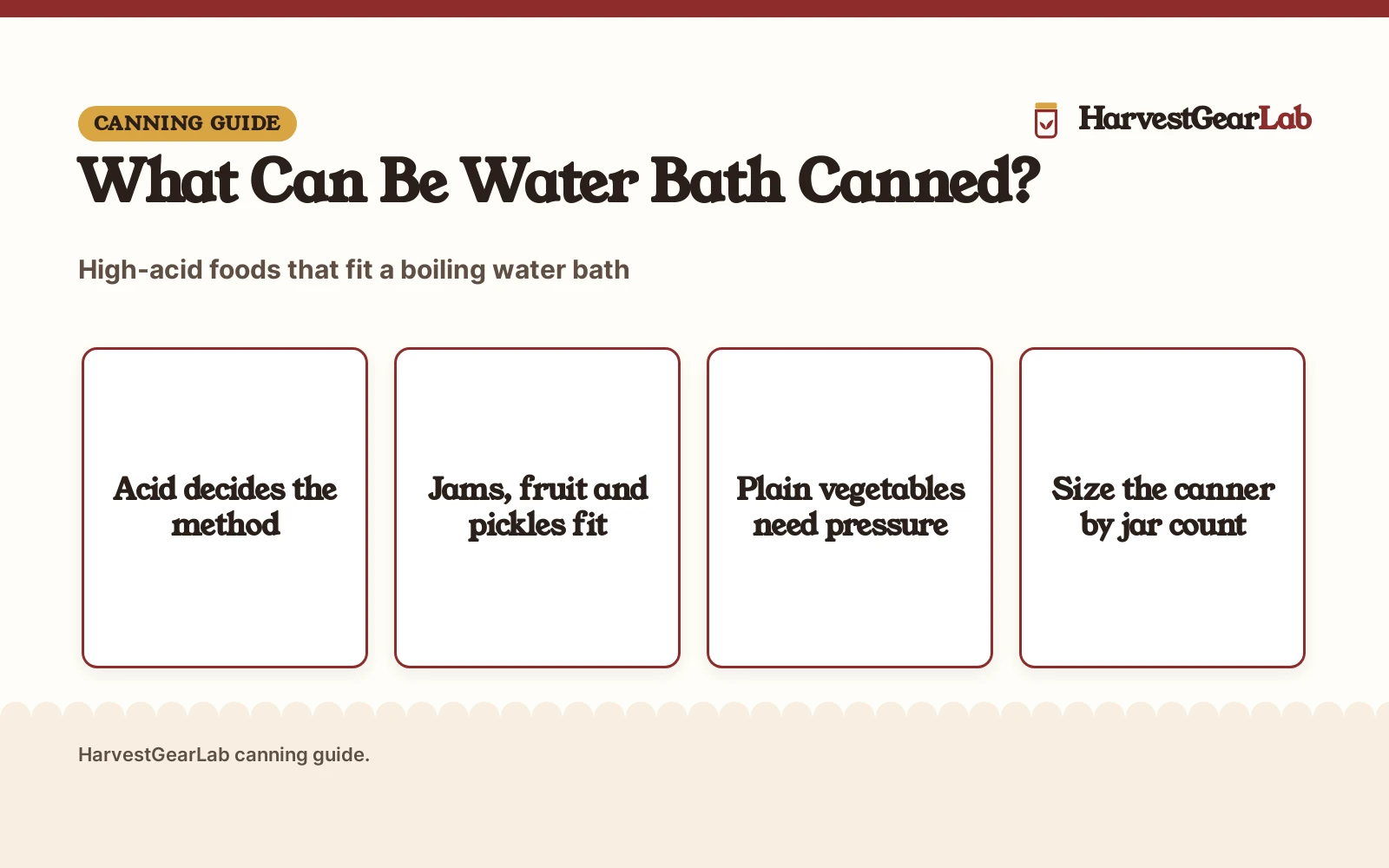
What can be water bath canned comes down to acid. Jams, jellies, most fruits, pickles, relishes, chutneys, salsas and tomatoes with added acid all belong in a boiling water bath, while plain vegetables, meat, poultry, seafood and stock do not. A water bath canner is a deep pot with a rack that holds jars under boiling water, and the acid in the food is what makes that heat enough. This guide lists the foods that fit, the ones that need a pressure canner instead, and how to size a canner for your jars.
HarvestGearLab earns a commission when you buy through links on this site, at no extra cost to you. As an Amazon Associate I earn from qualifying purchases. Affiliate disclosure.
What can be water bath canned: the short list
The table shows what each group covers and where its acid comes from.
| Food group | Examples | Where the acid comes from |
|---|---|---|
| Jams and jellies | Strawberry jam, grape jelly, marmalade | Fruit acid plus sugar |
| Fruit in syrup or juice | Peaches, pears, cherries, applesauce | Fruit acid |
| Pickles and relishes | Cucumber pickles, pickled beets, corn relish | Vinegar brine |
| Salsa, chutney and sauces | Tomato salsa, fruit chutney, barbecue sauce | Acidified recipes |
| Tomatoes with added acid | Whole tomatoes, crushed tomatoes, tomato juice | Acid added per recipe |
| Fruit juice | Apple juice, grape juice, berry juice | Fruit acid |
Acid is the dividing line
Water bath canning works when the food is acid enough that boiling water heat plus the acid keeps it safe in the jar. That is why fruit, pickles and jam lead every water bath list, and why plain vegetables and meat never appear on one. The acid may come from the fruit itself, from vinegar in a brine, or from acid added to tomatoes under a current recipe. When the acid level is in doubt, the food belongs in a pressure canner or the freezer, not in a water bath.
A recipe from a current USDA or National Center for Home Food Preservation source states the acid, the jar size and the method for each food. Older family recipes and general cookbooks may not, so check the source before filling jars. The water bath canner vs pressure canner comparison walks through the difference with one listing of each type.
Fruit, jams and jellies
Fruit is the easiest place to start. Jams, jellies, marmalades and fruit butters use the acid already in the fruit, and whole, halved or sliced fruit in syrup or juice follows the same rule. Applesauce, pie filling made with an acidified recipe, and fruit juice also fit. Small jars suit jams and jellies, while larger jars suit whole fruit and juice.
Size the canner by the jars you plan to fill. One 27.5 quart canner lists room for 8 32 oz jars or 10 16 oz jars, and a 24 quart pot is the smaller stovetop option in the listings. An electric canner lists room for 11 one-quart jars. Look for a listing that states the jar count rather than leaving you to guess, and check that a rack is included to keep jars off the bottom of the pot.
Pickles, relishes, salsa and chutney
Vinegar does the work in this group. Cucumber pickles, pickled beets, pickled green beans, corn relish and dilly beans all sit in a vinegar brine that makes them high-acid, so a boiling water bath is the right method when a current recipe is followed. Salsa, chutney and barbecue sauce belong here too, as long as the recipe is an acidified one from a current source.
The line to watch is the plain version of the same vegetable. Pickled green beans are fine because the vinegar brine makes them high-acid; plain green beans packed in water are not, and they need a pressure canner. The same split applies to corn: corn relish belongs in a water bath, while plain corn kernels need pressure.
Tomatoes and tomato sauce
Tomatoes sit near the line, so they need added acid to qualify for a water bath. Whole tomatoes, crushed tomatoes, tomato juice and tomato sauce are all listed for water bath canning when the recipe adds acid and comes from a current USDA source. Measure the acid as the recipe states and do not swap in a lower-acid variety or skip it.
Sauce from a current USDA recipe follows the same rule. If the recipe is a family favorite with no acid added, freeze it or run it through a pressure canner instead. Compare current options in the best pressure canner guide.
What cannot go in a water bath
- Plain vegetables: green beans, corn, potatoes, peas, carrots and squash packed in water.
- Meat, poultry and seafood, including soups and stews built on them.
- Stock, broth and plain vegetable soup with no added acid.
- Dried beans, grains and rice packed without acid.
None of these is acid enough for boiling water heat alone, and extra time in the bath does not change that. They need a pressure canner, which runs hotter than boiling water. Many households end up owning both pots.
Pick a canner that fits your jars
A water bath canner is a deep pot, a rack and a lid. The rack keeps jars off the bottom, the lid traps heat, and the pot must cover the jars with boiling water. Kits bundle the rack with a jar lifter, funnel, lid lifter and bubble remover, and the best canning tool kit comparison lines up the sets by pieces and materials.
Check the base before buying. One 27.5 quart stainless steel pot lists a flat bottom that suits gas, electric, ceramic and induction cooktops, and the same listing states the pot and rack are dishwasher safe. An electric canner adds a drain valve so the pot empties without heavy lifting, and the maker lists a 1-year warranty with technical support. Match the pot to the stove you own and to the jar sizes in your recipes.
What to skip or double-check
- Processing jars in the oven: skip it. Dry oven heat is not a safe way to process canning jars.
- Electric pressure cookers: do not use one for canning unless the maker states it is made for pressure canning.
- Small stovetop cookers sold as cooker and canner: check that the listing states a quart jar capacity before treating it as a pressure canner.
- Old or secondhand canners: check the rack and lid for rust and warping before use.
- Reused single-use lids: buy new flat lids each season.
What this guide does not cover
This is a foods guide. It does not give recipes, processing times, pressures, headspace figures or altitude changes. Take those from current USDA and National Center for Home Food Preservation guidance and follow them exactly for each food. Every canner and tool guide on the site is collected in the canning section.
FAQ: preserving at home
Can you water bath can green beans?
No. Plain green beans packed in water are low-acid, so they need a pressure canner. Pickled green beans in a vinegar brine are a different food and fit a water bath under a current USDA recipe.
Can you water bath can tomatoes?
Yes, with added acid and a current USDA recipe. Tomatoes, tomato juice and crushed tomatoes are listed for water bath canning only when the recipe adds acid.
What vegetables can be water bath canned?
Only acidified ones, such as pickles, relishes and pickled beets. Plain vegetables such as corn, potatoes, peas and carrots need a pressure canner.
Can you water bath can meat?
No. Meat, poultry, seafood and stock are low-acid foods and need a pressure canner. A water bath never gets hot enough for them.
Is a special pot needed for water bath canning?
A pot deep enough to cover jars with boiling water plus a rack works, and canning kits bundle the rack, jar lifter, funnel and lid lifter. Compare options in the best water bath canner guide before buying.
More preserving guides
See every water bath canners guide and all canning guides.
More picks: water bath canners, pressure canners, water bath vs pressure canner and canning tool kits.