
On this page
Top picks at a glance
As an Amazon Associate I earn from qualifying purchases.
- 1
 Kenley Fermentation Crock9.6/10View on Amazon
- 2
 HomeBuddy Fermentation Crock with Weights9.7/10View on Amazon
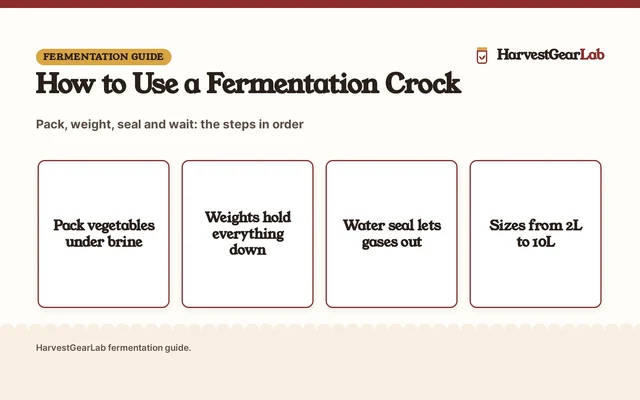
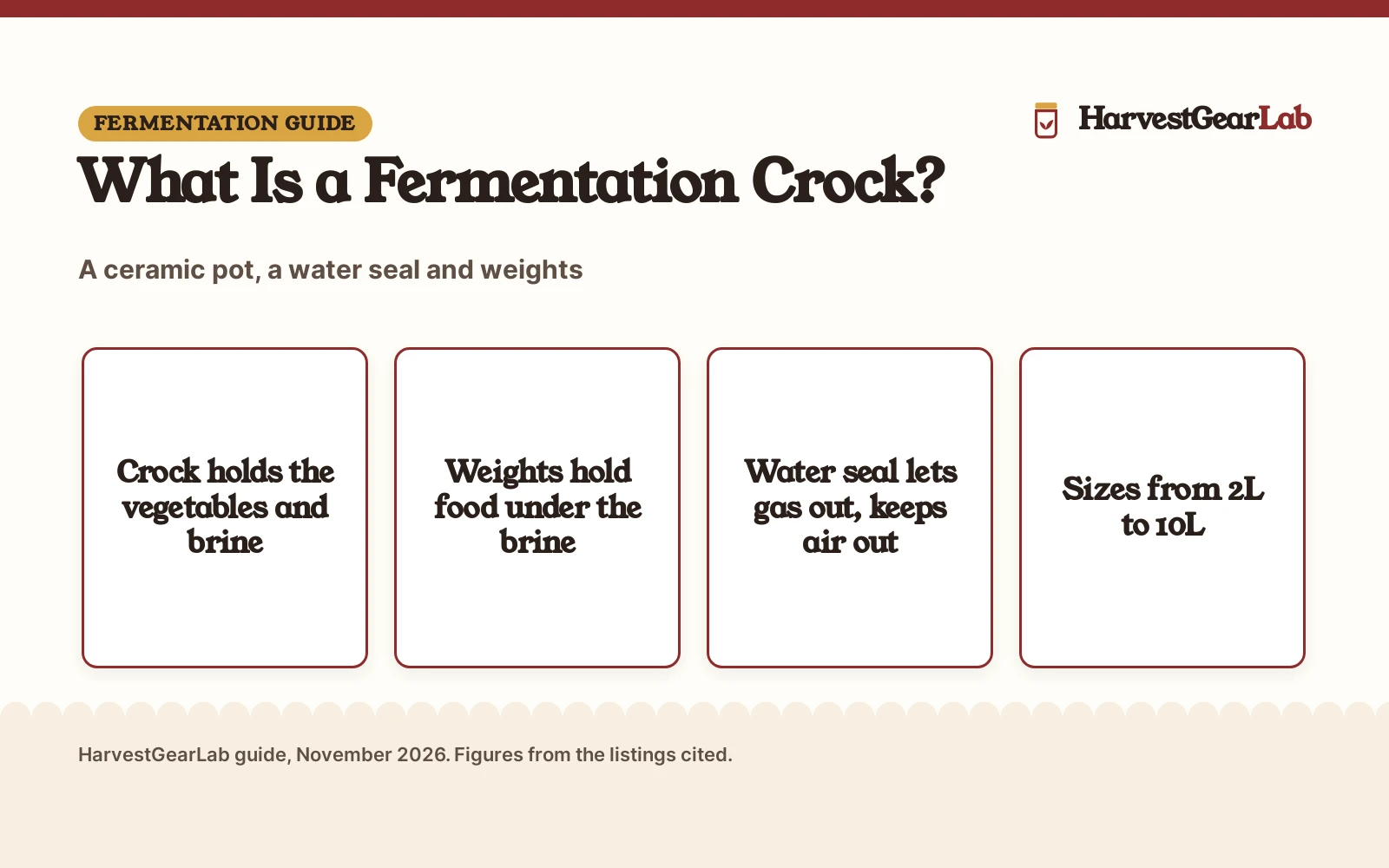
What is a fermentation crock? It is a heavy ceramic pot with a water-seal lid and weights, made for keeping vegetables under brine while gas escapes. The crock holds the ferment, the weights hold the food down, and the water seal lets gas out without letting air in. This guide walks through the parts, the sizes and how to use one.
Runners-up to consider
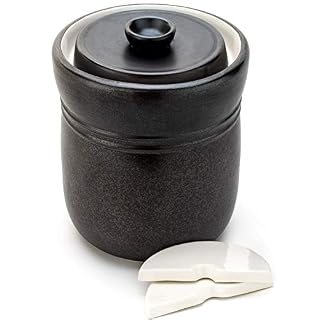 TOMO Fermentation Crock with WeightsCheck price on Amazon
 HomeBuddy Fermentation Crock with WeightsCheck price on Amazon
 Jucoan Fermentation Crock 1/2 Gallon Sauerkraut Crock withCheck price on Amazon
 Mojoberry 7LCheck price on Amazon
 Fermentation Crock Jar 2 Liter/0.5 GallonCheck price on Amazon
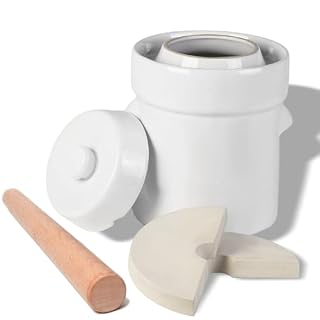 Fermentation Crock Jar 10 Liter/2.6 GallonCheck price on Amazon
HarvestGearLab earns a commission when you buy through links on this site, at no extra cost to you. As an Amazon Associate I earn from qualifying purchases. Affiliate disclosure.
What is a fermentation crock: the short list
Most fermenters get started with the parts below. The table shows what each one does and why it matters.
| Part | What it does | Why it matters |
|---|---|---|
| Crock | Holds the vegetables and brine | Ceramic walls block light and hold steady warmth |
| Weights | Hold the food under the brine | Food above the brine meets air |
| Water-seal lid | Lets gas out, keeps air out | No daily burping, the seal does the work |
| Pounder | Packs the vegetables down | Releases juices so the brine covers the food |
How the water seal works
The lid of a fermentation crock sits in a channel of water around the rim, and that water is the seal. Gas from the ferment bubbles out through the water, while outside air cannot get back in through it. TOMO calls its seal an extra-wide waterlock and notes it needs refilling less often, and Jucoan notes the same idea in plainer words: fill the channel with water, set the lid, and let it work, with no daily burping. HomeBuddy describes its water seal the same way, as an airtight seal that lets gases escape while keeping outside air out. Keep the channel topped up, since a dry channel is no seal at all.
Crock sizes by cabbage count
Crocks are sold by volume, and the listings state the size in liters, gallons, cabbages and mason jars, so pick by the batch you plan to make. The table lines up the sizes the listings state.
| Size | Cabbages | Mason jars of sauerkraut |
|---|---|---|
| 2L (0.5 gallon) | 2 cabbages | 4 mason jars |
| 3L (1 gallon) | 2 to 3 cabbages | 5 mason jars |
| 7L (2 gallon) | 5 to 7 cabbages | About 12 mason jars |
| 10L (2.6 gallon) | 6 to 9 cabbages | 13 mason jars |
Small batches suit the 2L crocks: the Jucoan 2L crock holds up to 3.2 lbs of vegetables and suits 1 to 2 cabbages, and the Kenley 1/2-gallon crock (on Amazon) holds up to 3.2 lb of vegetables for small batches. The HomeBuddy crock (on Amazon) is a 1 gallon crock at 12.2 by 11.4 by 7.68 in, so measure the shelf before you buy a crock that lives on the counter. A 7L crock suits a household that ferments often, and a 10L crock suits a large harvest.
Step 1: Pack the vegetables
Shred or chop the vegetables, salt them, and pack them into the crock with the pounder until the juices rise and cover the food. The TOMO kit includes 2 weights and a wooden tamper, and the Jucoan kit includes 2 unglazed ceramic weighting stones and 1 wooden cabbage pounder, so the packing tools come with the crock. Pack in layers and press each layer down before adding the next, so no air pockets sit under the brine.
Step 2: Set the weights
Set the weights on top of the packed vegetables so the food stays fully under the brine. Jucoan states its 2 stones keep vegetables fully submerged under brine, and Kenley states the same for its unglazed weighting stones. The weights are the part that does the holding: the lid keeps air out, but only the weights keep the food down. If a piece of food floats up past the brine, push it back down and reset the weights.
Step 3: Fill the water seal and set the lid
Pour water into the channel around the rim, then set the lid into the channel so the water seals the edge. The water lets gas escape while keeping outside air out, and the wide channel on the TOMO crock (on Amazon) needs refilling less often than a narrow one. Check the water level when you check the ferment, and top it up when it runs low, since a dry channel lets air in.
Step 4: Wait, then check the ferment
Leave the crock alone while the ferment works, and check the water seal rather than opening the lid. Mojoberry notes its water seal needs less monitoring, and the thick ceramic walls shield the ferment from sunlight and buffer temperature swings, so the crock does the steady work on its own. When the ferment tastes ready, lift the weights out, scoop the food into jars, and keep the jars cold.
What the crock is made of
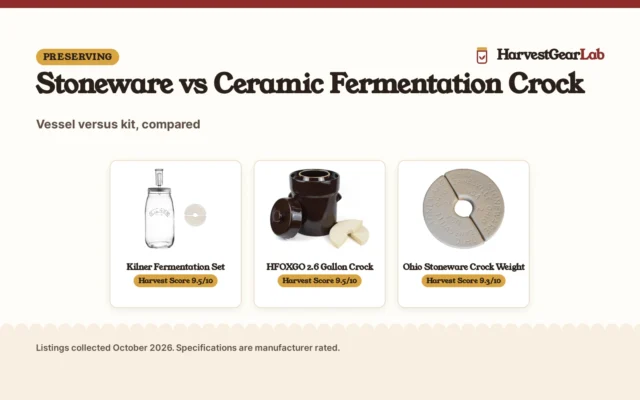
Most fermentation crocks are stoneware or ceramic, glazed inside so the surface stays non-porous and easy to clean. Jucoan states a fully glazed interior with a food-safe, lead-free glaze, and HFOXGO states a lead and cadmium-free glaze on its crocks. Mojoberry lists its crock as A-grade porcelain fired at 1260°C from kaolin clay, with thick walls that resist cracking and steady temperature swings. HomeBuddy lists food-grade double-glazed ceramic, and Kenley lists high-grade ceramic with a food-safe coating. Earthen ceramic blocks UV light, per the TOMO listing, so the nutrients in the ferment stay out of the light.
Crock or mason jar: which fits
A mason jar with a weight and lid suits a small batch, and the best size jar for fermenting guide compares jar sizes. A crock suits a larger batch and a kitchen where the ferment lives on the counter for weeks: the 7L crocks hold 5 to 7 cabbages and make about 12 mason jars of sauerkraut, while the 10L crock holds 6 to 9 cabbages and makes 13 mason jars. A crock is also heavier and harder to move once full, so pick the size by the batch and the shelf, not by the largest size on the page.
FAQ: preserving at home
What is a fermentation crock used for?
Making sauerkraut, kimchi, pickles and kombucha at home. The listings name german sauerkraut, pickled vegetables, kombucha and kimchi, and the crock, weights and water seal handle the whole batch in one pot.
How big a crock do I need?
Pick by the batch. A 2L crock fits 2 cabbages and makes 4 mason jars of sauerkraut, a 7L crock fits 5 to 7 cabbages and makes about 12 mason jars, and a 10L crock fits 6 to 9 cabbages and makes 13 mason jars.
Do I need weights with a crock?
Yes. The weights hold the vegetables fully under the brine, and the lid alone cannot do that job. The TOMO kit includes 2 weights, and the Jucoan kit includes 2 unglazed ceramic weighting stones.
How does the water seal work?
The lid sits in a channel of water around the rim. Gas escapes through the water, while outside air cannot get back in. Fill the channel with water, set the lid, and top the channel up when it runs low.
Can I use a fermentation crock for kombucha?
Yes. The TOMO listing states its crock makes full 3L or 7L of kombucha, and the HFOXGO listings name kombucha among the uses for their 2L and 10L crocks.
More preserving guides
See every fermentation kits guide and all harvest and processing guides.
More picks: airlock lids for mason jars, fermentation lids for beginners, how to use airlock for fermentation and best size jar for fermenting.