
On this page
Top picks at a glance
As an Amazon Associate I earn from qualifying purchases.
- 1
 All American 1930 Pressure Cooker/Canner9.6/10View on Amazon
- 2
 All American 1930 Pressure Cooker/Canner9.5/10View on Amazon
- 3
 All American 1930 Pressure Cooker/CannerView on Amazon
- 4
 All American pressure cooker regulator weight.View on Amazon
- 5
 All American 1930 Steam GaugeView on Amazon
- 6
 All American 1930View on Amazon
A counter full of tomatoes in August, a freezer that needs filling, and a pantry shelf waiting for jars is the moment gardeners start comparing canners. The question all american 925 vs 941 asks is simple: the 925 is the mid-size model and the 941 is the large model, so pick the 925 for modest batches and the 941 when your harvest days run big. Both are All American pressure canners, so the choice turns on batch size, stove fit and storage space rather than on method.
Runners-up to consider
 All American 1930 Pressure Cooker/CannerCheck price on Amazon
 All American pressure cooker regulator weight.Check price on Amazon
 All American 1930 Steam GaugeCheck price on Amazon
 All American 1930Check price on Amazon
HarvestGearLab earns a commission when you buy through links on this page, at no extra cost to you. As an Amazon Associate I earn from qualifying purchases. Affiliate disclosure.
all american 925 vs 941: the short answer
The split between the two models is size. A mid-size canner suits a gardener who puts up a steady run of jars across the season, while a large canner suits a gardener who faces a glut all at once and wants to clear it in fewer loads. Neither model changes what you can preserve: both handle the low-acid foods that call for a pressure canner, and both leave high-acid foods to the water bath method where a current recipe calls for it.
| Model | Batch fit | Suits | Check on the listing |
|---|---|---|---|
| All American 925 | Mid-size batches | Gardeners putting up modest harvests | Stated jar count and stove fit |
| All American 941 | Large batches | Gardeners putting up big harvests | Stated jar count and stove fit |
Start from the batch you will fill on a normal canning day, not from the biggest harvest you can imagine. Read the listing for the jar count the maker states, since that figure tells you more about a load than volume alone.
Start with the method, not the pot
Before comparing sizes, sort the foods you want to put up into two groups. High-acid foods, such as most fruits, jams, jellies, pickles and tomatoes with added acid, can go in a boiling water bath when you follow a current recipe from USDA or National Center for Home Food Preservation guidance. Low-acid foods, such as plain vegetables, meat, poultry, seafood and stock, need a pressure canner, because boiling water alone does not get hot enough for them.
If your list is all jam and pickles, a water bath canner is enough for now. If it includes plain vegetables or meat, you need a pressure canner, and many gardeners end up owning both. Our water bath canner vs pressure canner comparison walks through the difference, and our best pressure canner for home canning guide lines up current options.
How to choose between all american 925 vs 941
Batch size is the deciding factor, and it shows up in three places: how many jars you fill at once, how much stove space the canner takes, and where the canner lives between uses. A mid-size model fits a smaller stove and a tighter shelf, and it comes up to pressure with a smaller load behind it. A large model clears a glut in fewer loads, which matters when beans, corn or tomatoes all ripen in the same week and the garden will not wait.
Think about the shape of your season as well as the size of your garden. A gardener with a steady trickle of produce across months may prefer the mid-size model, since every load stays close to full. A gardener with a short, heavy harvest window may prefer the large model, since fewer loads mean fewer evenings at the stove during the busiest weeks.
Stove fit deserves a careful look before you buy. Check that the listing states the base suits your stove type, and measure the space you have, including room to lift jars in and out. A large canner that crowds the burners will slow every load, however well it suits your batch size. Storage matters too: a tall, wide canner needs a shelf of its own.
What to check on each listing
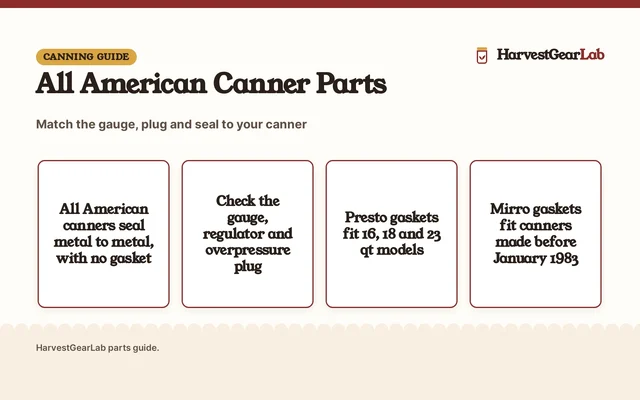
Listings vary in how much they state, so compare them on the same points. Look for a stated gauge, a regulator weight and an overpressure plug or similar safety feature, and confirm the listing sells the pot as a canner, not only as a pressure cooker. Check whether a rack is included, and whether the listing mentions glass tops or induction if either applies to your stove.
Read the jar count the maker states for each jar size you use, and compare like with like across listings. Half-pints suit jams and jellies, pints suit most vegetables and sauces, and quarts suit whole fruit, tomatoes and stock. Where a listing leaves a point unstated, treat it as unstated rather than guessing.
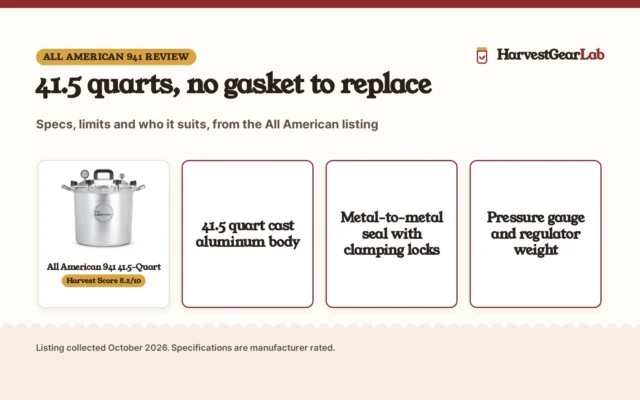
The All American 941 review walks through the large model in detail, and the Presto vs All American pressure canner comparison sets the brand against a common alternative. Reading those alongside this guide shows where each size sits in the range.
Jars, lids and tools that go with either size
Whichever model you pick, the jars and tools around it stay the same. Use jars made for home canning, in the sizes your recipes call for, and buy more flat lids than you think you need, since a nicked rim or a lid that does not seal sends you back to the box. Jars and bands can be reused for years if they are free of chips and rust, but the flat lids with sealing compound are made for a single use.
A few hand tools make canning day calmer. A jar lifter grips the neck of a hot jar so you can lift it straight out of the pot, a wide-mouth funnel keeps food off the jar rim where it can stop the lid from sealing, and a bubble remover helps you match the headspace your recipe gives. These usually come together in a kit; our best canning tool kit comparison lines up the sets by pieces and materials.
What to skip or double-check
- Oven heat for jars: skip it. Dry oven heat is not a safe way to handle canning jars.
- Electric pressure cookers: do not use one for canning unless the maker states it is made for pressure canning.
- Small stovetop cookers sold as cooker and canner: check that the listing states a quart jar capacity before you treat it as a pressure canner.
- Old or secondhand canners: check the gauge, seal and safety plug before use, and ask your local extension office whether they can check a dial gauge.
- Reused single-use lids: buy new flat lids each season.
- A canner bought on volume alone: compare the stated jar count for the jar sizes you use before deciding.
What this guide does not cover
This is a buying guide for choosing between two sizes. It does not give recipes, times, pressures, headspace figures or altitude changes. Take those from current USDA and National Center for Home Food Preservation guidance, and follow them exactly for each food. Every canner and tool guide on the site is collected in our canning section, and the pressure canner guides sit under pressure canners.
FAQ: preserving at home
Which model suits a household that cans a little at a time?
The mid-size 925 suits a modest pace, since its loads match the batches a small household fills most often.
When does the large 941 make sense?
The 941 makes sense when big harvests arrive all at once and you want to clear them in fewer loads across the busiest weeks.
Do both models handle low-acid foods?
Both are pressure canners, so both suit low-acid foods such as plain vegetables, meat and stock when you follow a current recipe from USDA or National Center for Home Food Preservation guidance.
What should I check on the listing before buying?
Check the stated jar count for the jar sizes you use, the gauge, the regulator weight, the safety plug, whether a rack is included, and whether the base suits your stove.
Can I use the same jars and tools with either size?
Yes. Jars, lids, bands and hand tools are independent of canner size, so the kit you already own carries over whichever model you pick.
More preserving guides
See every pressure canners guide and all canning guides.
More picks: All American 941 review, Presto vs All American pressure canner, best pressure canner and water bath canner vs pressure canner.